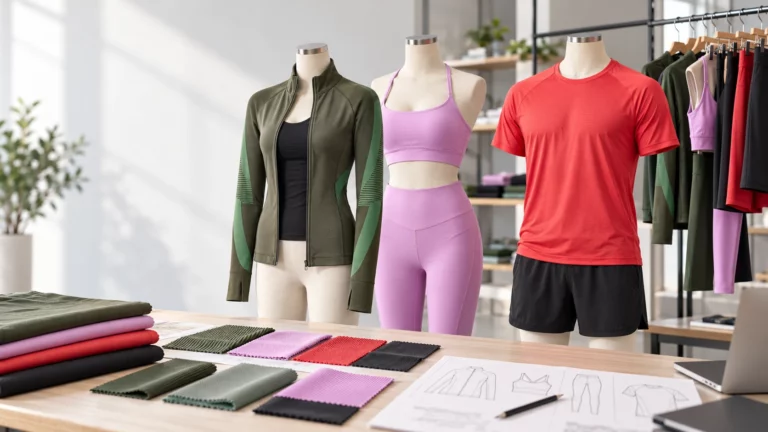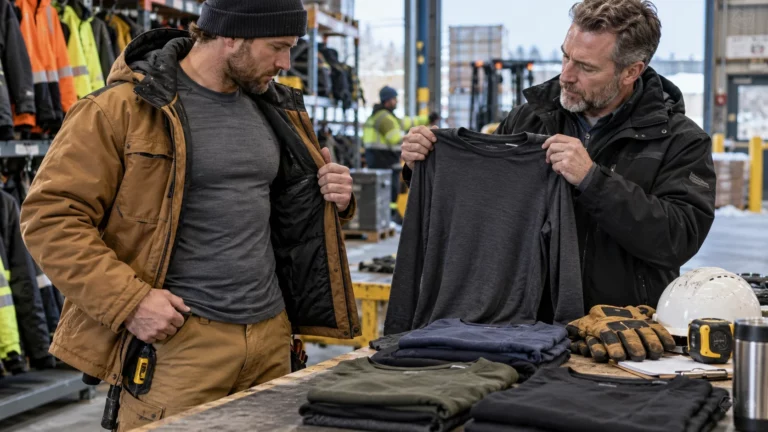


A supplier that offers leggings, training tops, yoga apparel, cycling garments, and thermal layers may look like a convenient one-stop partner. But a broad catalog does not prove that one manufacturer can develop and produce every category to the same standard. First-time buyers should verify the work behind the range: product-specific construction knowledge, material selection, sampling, quality checks, and clear order terms.
The practical test is to ask for evidence at each stage, from the initial tech pack review to pre-production approval. Treat every product family as a separate capability until the supplier demonstrates relevant experience, appropriate equipment, material knowledge, and consistent quality controls. This approach helps buyers distinguish genuine multi-category manufacturing capacity from a broad but unverified product catalog.
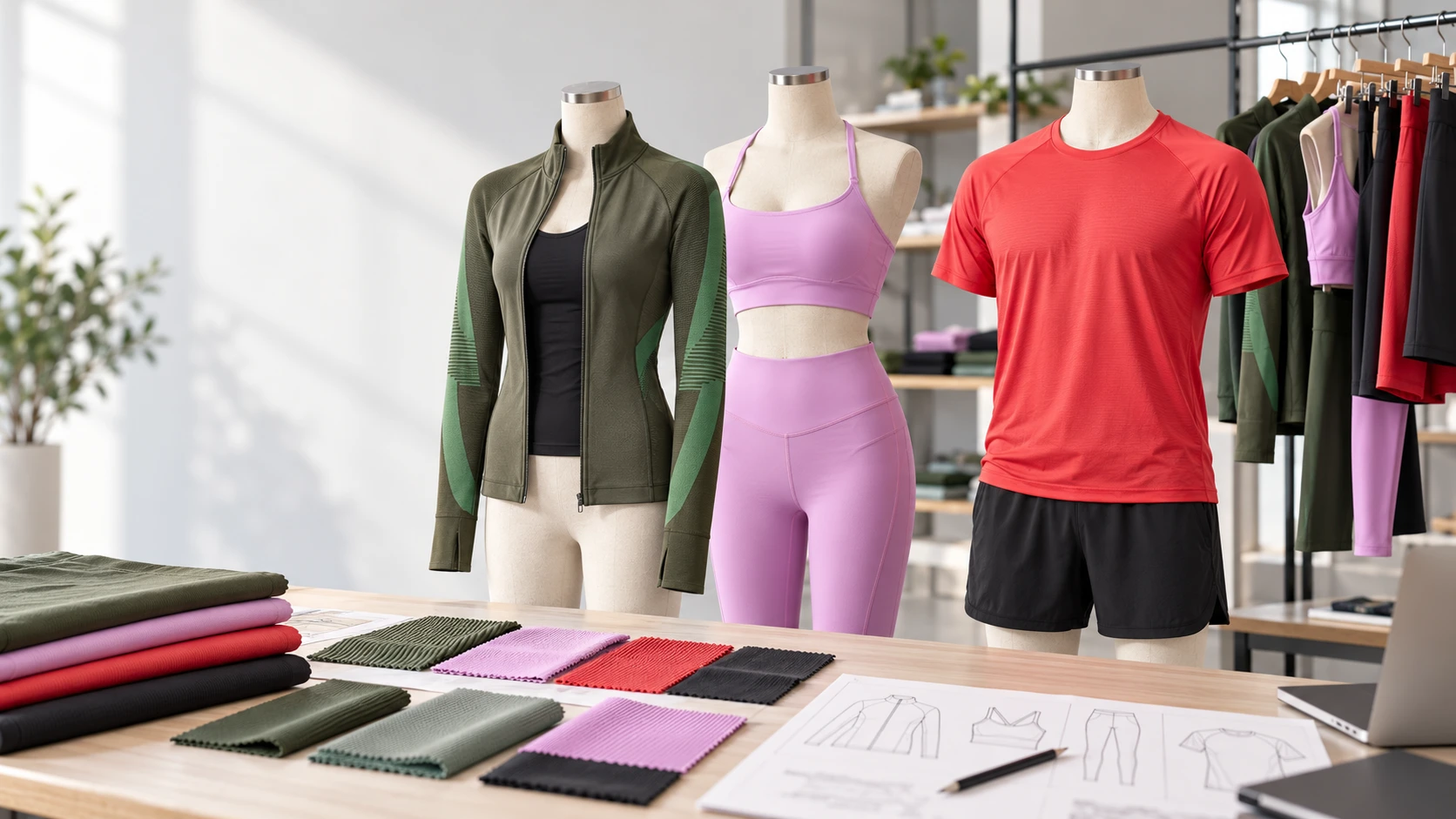
Multi-Category Capability Is a Supply Chain System, Not Just a Factory Catalog
A multi-category activewear supplier may operate its own production facilities, coordinate specialized manufacturing partners, or combine both models. Buyers should verify who controls product development, manufacturing execution, quality assurance, and delivery across each category. Ownership of every machine is not required; accountable technical and production control is.
Supplier models | Integrated manufacturer: verify actual facilities and processes; specialized manufacturer: verify category expertise; OEM/ODM supply-chain partner: verify technical ownership, traceability and QC; sourcing intermediary: verify technical involvement and production oversight.
Multi-Category Supplier Verification Framework
Product Requirements → Category Capability → Production Responsibility → Sampling Evidence → Quality Control → Commercial Feasibility → Pilot Order (when appropriate) → Supplier Approval.
Start With Your Product Mix, Not the Supplier’s Catalog
Product Category Capability Matrix
- Leggings — stretch pattern, gusset and stretch-compatible seams; verify opacity, waistband stability and seam integrity.
- Sports bras — band, strap, support and grading engineering; verify coverage, pressure and support.
- Running tops — lightweight knits and seam comfort; verify fit, chafing and moisture behavior.
- Cycling apparel — riding-position pattern and panel construction; verify ergonomic fit and friction.
- Thermal base layers — merino/synthetic fabrics and layering fit; verify dimensional stability and thermal balance.
- Seamless activewear — specialized circular knitting and engineered zones; verify sizing and pressure consistency.
Shared vs. Specialized Production Processes
Shared activities may include material sourcing, cutting, conventional sewing, labeling, packing and inspection. Specialized operations may include seamless knitting, bonded construction, engineered compression or complex bra assembly. Verify which processes and equipment each product actually requires.
Before contacting manufacturers, list the categories you plan to launch and what makes each one different. A range might include yoga leggings, sports bras, running tops, and a lightweight thermal base layer. For each style, note the intended activity, target customer, fit, fabric behavior, construction details, branding, and planned order quantity.
This simple breakdown prevents a common sourcing mistake: assuming that a supplier’s general “activewear” experience covers every garment in the range. A fitted legging, a supportive bra, and a thermal layer may require different pattern work, fabrics, seams, and fit tests. Some products may also involve specialized processes, such as seamless knitting, which should be confirmed separately.
Group products by shared requirements. If several styles use similar fabrics and construction, they may be easier to develop together. If one item relies on different materials or machinery, treat it as its own development track. Harvest SPF lists distinct activewear categories alongside outdoor and thermal apparel; buyers should still verify capability at the specific style level.
Ask for Evidence by Category
Capability Evidence Hierarchy
- Level 1: Catalog/product photos — claimed range.
- Level 2: Construction notes, fabric specifications — technical understanding.
- Level 3: Sample revisions and test records — development execution.
- Level 4: Lot traceability, inspection records and pilot production — manufacturing control.
When customer confidentiality limits evidence sharing, request anonymized records, authorized samples or controlled demonstrations instead of third-party confidential information.
Manufacturing Responsibility Matrix
- Fabric development → supplier or partner mill → approved fabric specification.
- Pattern development → technical team or partner → revision-controlled pattern.
- Sampling → sample room or factory → approval record.
- Bulk sewing/knitting → approved production facility → production and traceability records.
- Testing → internal or external laboratory → relevant test report.
- Final QC → supplier or independent inspector → inspection report.
- Shipment → responsible logistics party → shipment documents.
A supplier need not own every process, but should identify responsibility, oversight and contractual accountability. Actual production sites and subcontracting must be disclosed as required by the buyer agreement, audit rules and applicable law.
Ask the manufacturer to show relevant examples for each product family you plan to order. Useful evidence can include product photos, sample details, fabric options, construction notes, or a description of how the product moved from concept to production. A general catalog is a starting point, not proof that the supplier has handled your exact combination of fabric, fit, and finish.
For every example, ask what the supplier actually did. Did it develop the pattern, source the fabric, add branding, or produce only a finished item from buyer-supplied specifications? This distinction helps clarify whether the supplier can support your development needs or expects you to provide a complete, production-ready package.
Also ask what changes when the product category changes. A supplier may be comfortable producing basic tops but need additional development time or external support for compression garments, bras, or seamless styles. Specific answers help you identify capability gaps before they become sample delays or quality disputes.
Compare the Development Process Across Styles
Multi-Category Development Control System
For EACH style (e.g., leggings / sports bra / thermal top), record: Tech Pack [Approved/Open]; Fabric [Approved/Open]; Fit Sample [Approved/Open]; Size Set [Approved/Open]; PP Sample [Approved/Open]; Bulk Release [Approved/Hold].
Maintain one coordinated project schedule while preserving separate technical approvals and release decisions for every style. Record document revision, issue owner, approval date and unresolved blockers.
Approval Responsibility
- Buyer technical representative: fit and specifications.
- Supplier technical team: construction and manufacturability.
- QA: testing and inspection criteria.
- Merchandising/project owner: milestone tracking and consolidated change log.
Define the authorized final approver in writing.
A repeatable development process matters when several categories must be managed at once. Ask how the supplier records measurements, fabric choices, colors, trims, labels, and revision notes. Confirm who approves each sample and how changes are documented before bulk production.
Request a written development sequence that covers design or tech-pack review, fabric selection, first sample, fit comments, revised sample if needed, and pre-production approval. A supplier may describe its process differently, but each milestone should have an owner and an approval record. If a supplier cannot explain how your feedback becomes a controlled specification, multi-style coordination can become difficult.
Harvest SPF describes an OEM/ODM workflow that includes tech-pack or design input, material selection, quotation, prototype sampling, buyer review, and bulk production. Use that as a discussion point, then confirm how the same controls apply to each style in your own order. Its OEM/ODM service information also identifies different order minimums by customization type, so ask for current terms that match your specific category and order structure.
Evaluate Materials and Performance Separately
Fabric Capability Verification Matrix
- Composition → approved specification and verification when required.
- GSM → test result and agreed tolerance.
- Stretch/recovery → direction, extension force and recovery method.
- Opacity → garment-specific movement/extension condition.
- Moisture management → defined test and acceptance criterion.
- Colorfastness → relevant use and care conditions.
- Dimensional stability → agreed wash method and limit.
- Functional finish → evidence specific to the performance claim.
The same nominal composition and GSM do not guarantee equivalent performance: yarn, knit density, construction and finishing can change stretch force, recovery, opacity and comfort.
Material Substitution Control
Do not treat substitute fabrics as equivalent solely because composition and GSM appear similar. Assess the effect on fit, function, color, care and cost; obtain documented buyer approval and targeted testing or resampling before bulk use where necessary.
“Performance fabric” is too broad to guide a purchase. For each style, define the fabric composition, weight, stretch and recovery expectations, opacity or coverage needs, hand feel, and care requirements. The appropriate choices depend on the intended use and garment construction, so ask the supplier to recommend options against your brief rather than selecting from a generic swatch list.
Ask whether a proposed fabric is in stock or needs to be developed, and whether the quoted sample and bulk order will use the same material. If a custom color is important, confirm how color approval is recorded and whether the approved lab dip or fabric reference will be retained for production.
Request test evidence only for properties that matter to your product and market. For example, if stretch recovery, colorfastness, or abrasion resistance affects your design, agree on how that property will be assessed and what acceptance criteria apply. Do not assume a fabric name or a supplier’s general claim guarantees a particular result.
Use Samples to Test the Supplier’s Range
Representative Sample Strategy and Approval Limits
Screen at least one representative style from each materially different product family where practical. For leggings test squat opacity, waistband and seam stretch; for bras, band, straps and support; for thermal tops, layering fit and wash stability; for cycling apparel, riding-position fit and friction. Representative screening does not automatically approve untested styles.
Factory Sample Evaluation Scorecard (Illustrative)
Technical understanding 20% | Material 20% | Fit and construction 25% | Functional performance 15% | Revision accuracy 10% | Documentation 10%. Score each area 1–5; weighted score = sum of (score × weight). Adjust weights to product risk.
Critical safety, compliance, material-identity or functional failures must remain separate pass/fail blockers; a high average score cannot override them.
A sample is not just a preview of appearance. It tests whether the supplier can translate specifications into a garment, communicate trade-offs, and correct issues. For a multi-category order, review at least one representative style from each materially different product family before committing to a broad assortment.
Evaluate fit, measurements, stitching, seam placement, fabric hand, trims, labeling, and branding against your approved spec. For leggings, include the intended movement and coverage checks; for a base layer, assess fit under the intended layering system. These are buyer-defined checks, not universal pass criteria. Write down what is acceptable before reviewing the sample so feedback stays specific.
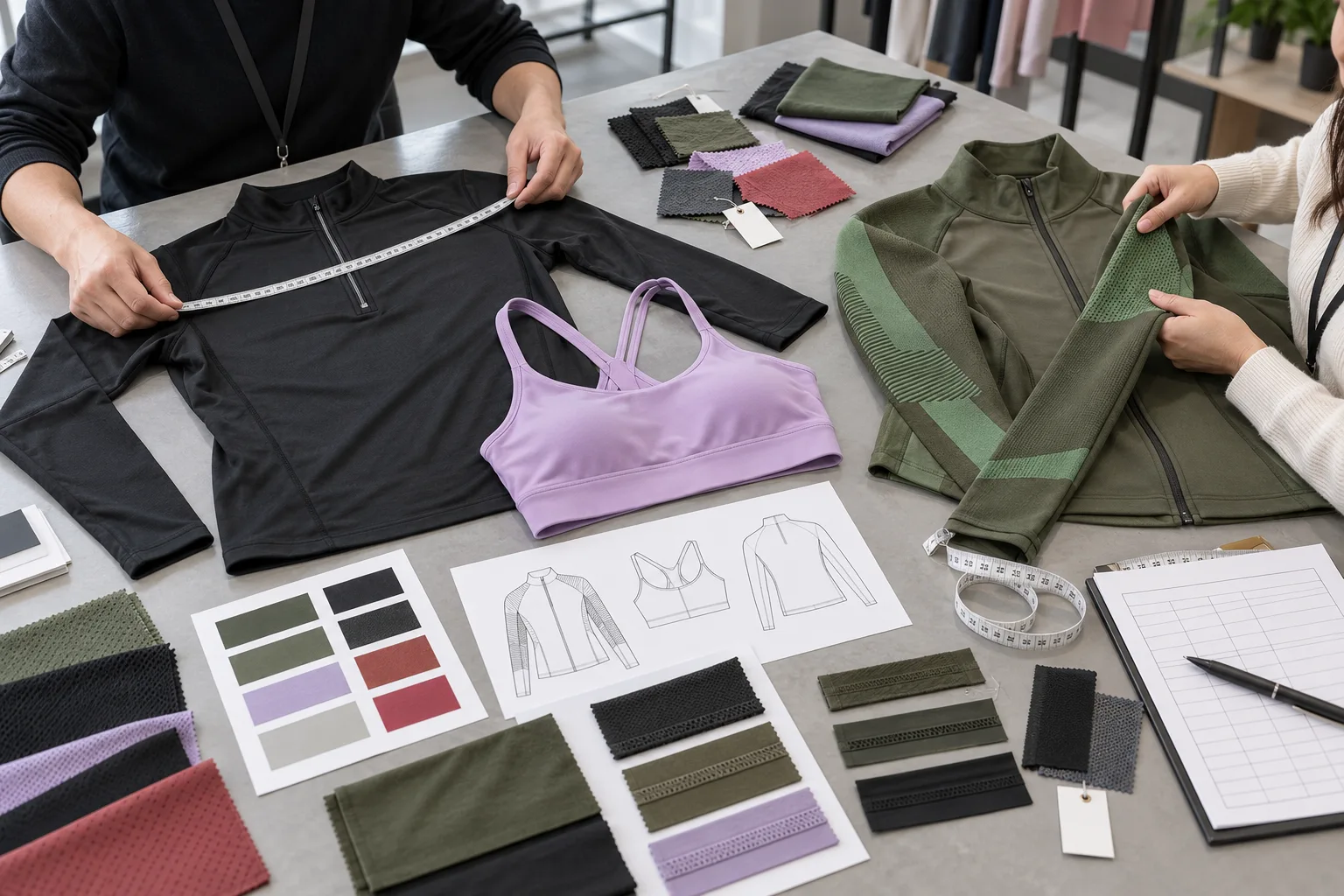
Keep a dated reference sample or an agreed record of approved measurements and changes. When a supplier revises a sample, ask it to identify what changed and why. Harvest SPF describes a prototype and buyer-review process, including sample revisions and pre-production approval. Confirm in writing whether these steps, sample charges, and revision limits apply to each style in your project.
Check Quality Control at Style and Order Level
Multi-Factory Quality Control Framework
Approved specification → incoming material verification → pre-production alignment → inline quality checks → final inspection → corrective action and shipment release. Each facility may use category-specific checklists, but all must follow the buyer-approved requirements and traceability system.
Critical-to-quality examples: Leggings — opacity, seam strength, waistband; Sports bras — support, elastic and straps; Running tops — seam comfort and moisture behavior; Cycling wear — ergonomic fit and friction; Thermal layers — shrinkage and layering fit.
Supplier Audit and Subcontracting Transparency
Verify actual production locations, relevant equipment/capacity, outsourcing controls, lot traceability, audit requirements and notification of material production changes. Social-responsibility assessments such as SMETA do not by themselves certify technical product quality.
Quality control should connect to measurable requirements, not an undefined promise of “high quality.” Ask the supplier when inspections occur, what is checked, how defects are recorded, and how the team separates a production issue from a specification disagreement.
For a multi-category order, agree on checks that reflect each garment’s risks. These may include measurement tolerances, seam or stitch appearance, color matching, label placement, garment count, and packaging. Where relevant, specify fabric tests or third-party inspection requirements. Establish who approves any replacement, rework, or concession before production begins.
Ask whether the supplier can provide inspection records by style or lot. If it uses an internal checklist, review the items and acceptance limits rather than relying on the checklist’s existence alone. Harvest SPF’s service information describes in-process and final inspection options, including third-party inspection when requested. Buyers should confirm the applicable inspection plan and reporting format for their order.
Confirm Minimums, Costs, and Timing by Product
MOQ Structure Comparison
Ask separately about fabric MOQ per construction/color; dyeing MOQ per shade; garment MOQ per style; colorway MOQ; size-ratio restrictions; and whether mixed-category quantities can be combined.
Total Program Cost, Not Only Unit Price
Compare garment price + sampling/development + material commitments + required tests + inspection + packaging + logistics + other agreed charges. Align Incoterms, currency, payment terms and quote inclusions before comparing suppliers.
Multi-Category Critical Path
Track fabric development, sample approvals, material purchase, production, inspection and shipping by style. Shared mills, trims or production resources can create cross-style delays even when styles are sampled in parallel.
A single MOQ or lead-time figure may not apply to every product in a multi-category program. The minimum can depend on the production method, fabric availability, color, size breakdown, customization, or whether the supplier must source or develop material. Ask for a style-by-style quotation and identify whether minimums apply per style, color, size, or total order.
Compare quotes using the same assumptions. Include sample costs, fabric or trim costs, labels, packaging, inspection, freight, and payment terms where applicable. Ask which elements may change after sample approval and how the supplier handles cost changes. A lower unit price may not represent a lower total commitment if it requires larger fabric minimums or additional development charges.
Build a timeline with separate milestones for material confirmation, sampling, approvals, bulk production, inspection, and shipping. Ask what could delay each step and how changes to one style affect the others. Do not rely on one headline delivery estimate for several different product categories.
Look for Coordination Risks Before Placing the Order
One Project Owner, Multiple Production Workstreams
Confirm who owns the overall timeline, controlled technical revisions, material allocation, subcontractor changes, quality escalations and delivery commitments. Maintain style codes, BOM revisions, size/color masters and packaging instructions centrally.
Staged Pilot Order and Supplier Approval Gates
Stage 1: technical screening → Stage 2: representative samples → Stage 3: pilot order where justified → Stage 4: close critical issues and approve supplier → Stage 5: selective category expansion. A pilot is a risk-based option, not a universal mandatory stage.
Final Supplier Evaluation Matrix (Illustrative)
Category technical capability 25%; development and sampling 20%; material/supply-chain control 15%; quality management 20%; commercial terms 10%; project coordination 10%. Evaluate technical capability, critical quality/compliance and commercial feasibility as independent pass/fail gates as well.
Multiple categories create more handoffs: separate fabrics, fit approvals, artwork, labels, size ranges, and packing instructions. Assign one buyer-side owner to consolidate feedback, maintain the approved spec for each style, and track open questions. This reduces the risk of conflicting instructions reaching the supplier.
Ask how the manufacturer will keep styles distinguishable during sampling and production. Use consistent style codes and document color names, size breakdowns, approved samples, and packaging requirements. If multiple products share branding or trims, verify that those common elements are specified once and applied consistently.
A first-time buyer does not need to launch a full assortment immediately. A staged order can reduce exposure: begin with representative styles, learn how the supplier handles approval and corrections, then expand after reviewing the results. Whether a supplier supports staged quantities or mixed-category orders must be confirmed in its quotation and production plan.
How Harvest SPF Supports Multi-Category Activewear OEM/ODM Programs
Harvest SPF can support multi-category apparel programs through technical specification review, functional fabric sourcing and development, sampling coordination, specialized manufacturing partnerships and quality oversight, subject to the capabilities and services confirmed for each project. Each category should be assessed against its specific fabric, construction, fit, performance and production requirements.
Key workstreams to confirm with Harvest SPF include: functional fabric development; fit and construction engineering; category-specific manufacturing coordination; prototype/fit/PP sample revision control; approved specifications and QC; and cross-category timeline and materials management.
Conclusion
To assess whether an activewear manufacturer can handle multiple categories, look beyond the breadth of its product menu. Verify relevant work by category, compare the development process, test representative samples, define measurable quality checks, and confirm MOQ, cost, and timing for each style. A supplier is a stronger fit when it can explain its process clearly and document decisions from sample approval through production.
Harvest SPF’s published catalog and OEM/ODM information provide starting points for evaluating activewear and thermal product fit, but buyers should confirm current capability and terms for their exact designs. Before requesting a quote, prepare a style list, tech packs or reference sketches, fabric requirements, size breakdowns, target quantities, branding needs, and required delivery window.
FAQs
Does a multi-category activewear supplier need to own every factory?
No. Verify production responsibility, technical control, quality oversight and contractual accountability.
How can buyers verify real category experience?
Request relevant technical examples, approved samples, development records and production or inspection evidence.
How does a manufacturer differ from an OEM/ODM supply-chain partner?
They may differ in facility ownership and coordination structure; either model must demonstrate accountability and technical control.
Should first-time buyers place a pilot order?
It can reduce risk for complex or multi-facility programs, but should be evaluated against project needs and costs.
How should buyers assess subcontractors?
Verify approved facilities, process ownership, change control, inspection requirements and traceability.
Can one manufacturer produce different types of activewear?
Some manufacturers serve multiple product categories, but capability should be verified separately for each style, fabric, and construction method. Ask for relevant examples and samples rather than relying on a broad catalog.
What should a first-time buyer send with an RFQ?
Include product sketches or tech packs, materials or performance requirements, sizes, colors, branding, packaging, quantities by style and color, and the target delivery window. Flag any details that are still undecided.
Should every style be sampled before a bulk order?
For styles with different construction, fit, or fabric requirements, sampling is a useful way to verify execution before bulk production. Agree on sample scope, approval criteria, costs, and revision steps with the supplier.
How can buyers compare quotes across categories?
Request itemized, style-level quotations based on the same assumptions. Compare MOQs, fabric and trim costs, sampling, customization, inspection, packaging, freight, payment terms, and timing.
What is a useful first step if the assortment is too large?
Prioritize a representative style from each distinct product family, then confirm whether the supplier can support the required materials, sampling, and order terms. Expand after the first styles have passed your review.
Ready to Evaluate Your Multi-Category Activewear Project?
Structured Multi-Category Production Assessment
For an actionable review, share: product category list; style sketches/tech packs; fabric and construction requirements; size ranges; quantity by style and color; target FOB; testing/quality requirements; destination market; and delivery date.
The review can identify category capability, fabric-development needs, sampling route, manufacturing responsibilities, MOQ feasibility, quality-control scope and a realistic production timeline.
Request a Multi-Category Production Assessment.