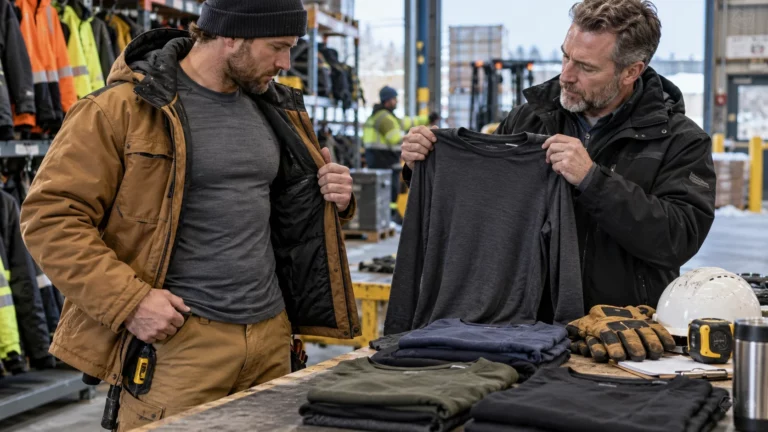


The right merino base layer for work is not simply the warmest or the one with the highest wool percentage. Compare each top as part of a clothing system: activity, exposure, outer workwear, shift length, laundering, and safety requirements all affect the result. Assess composition, fabric weight and knit, fit, moisture behavior, construction, and wash stability before price.
For sourcing teams, the goal is repeatable performance across approved sizes and production lots. Compare candidate tops against the same job requirements and uniform system before requesting samples or quotations.
Merino Workwear Evaluation Framework
The best merino base-layer top is not necessarily the warmest, softest, or highest in wool content. Choose the construction that meets comfort, mobility, moisture, durability and safety-compatibility requirements in the intended workwear system.
| Evaluation area | Buyer question | Evidence |
| Work environment | Where and how will it be worn? | Job profile |
| Material | Which fiber and yarn construction is required? | Fabric specification |
| Weight and knit | Is it suitable for the intended use? | GSM and knit reference |
| Fit | Does it work under the uniform? | Movement trial |
| Moisture | Does it perform through the shift? | Wear or laboratory evidence |
| Durability | Does it survive the required care process? | Wash and abrasion results |
| Safety | Is it compatible with PPE requirements? | Applicable verification |
| Production | Can the specification be reproduced? | Approved sample and QC plan |
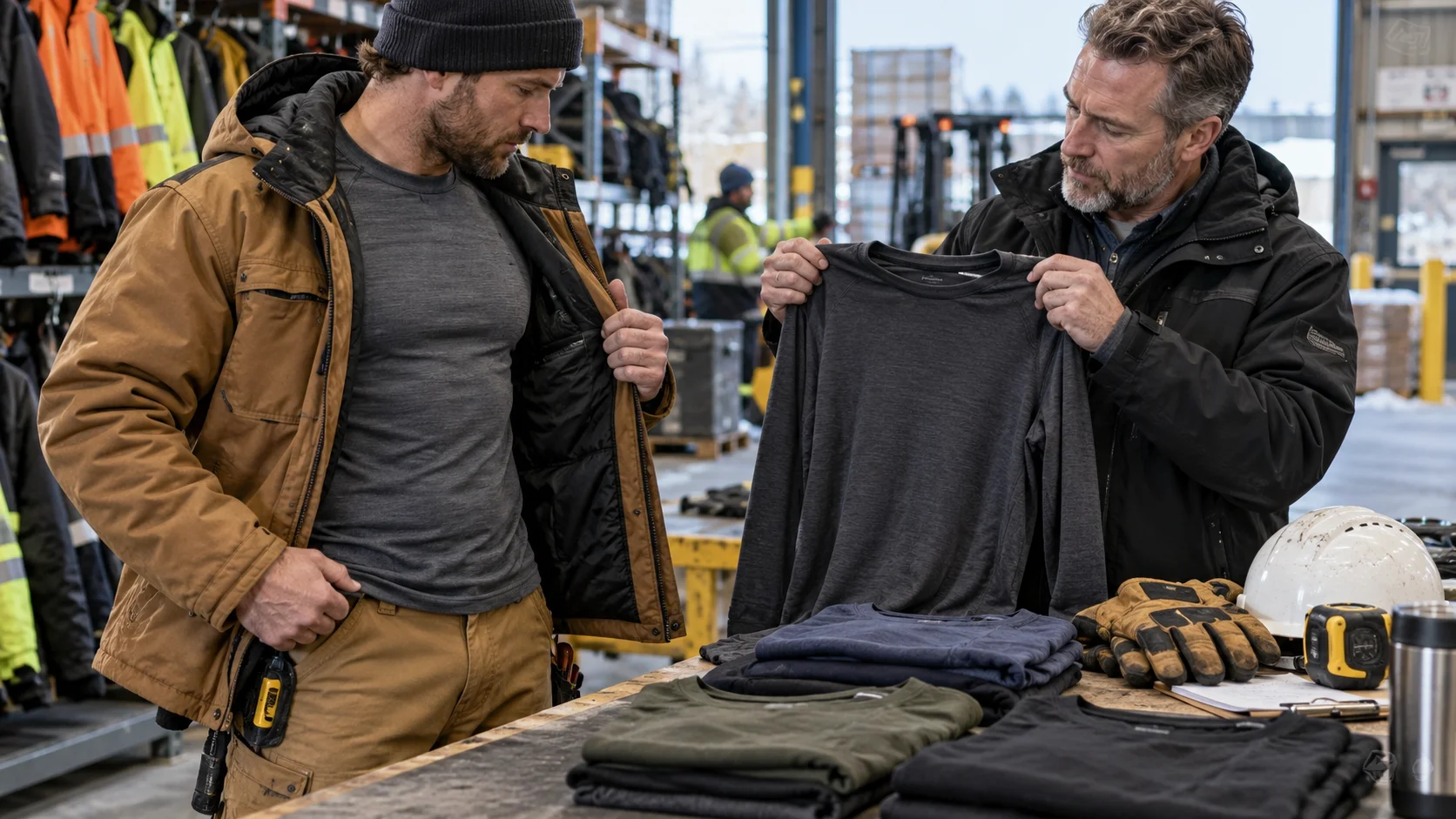
Define the Workwear Layering System First
Workwear Application & Layer Configuration Matrix
| Work scenario | Development priority | Validation focus |
| Indoor warehouse / high activity | Moisture management and low bulk | Sweat, cling and mobility |
| Outdoor maintenance / variable activity | Thermal transition management | Movement between indoor and outdoor conditions |
| Delivery driver / intermittent exposure | Comfort recovery | Comfort after repeated exposure changes |
| Cold storage / sustained cold | Insulation within the full ensemble | Full-layer thermal trial |
| Outdoor construction / equipment contact | Abrasion resistance and mobility | Contact-point wear and movement trial |
These are development priorities, not prescribed GSM or temperature ratings.
Record the actual clothing ensemble, including the base layer, uniform shirt, mid layer, outer shell, protective vest, belt or harness, activity level, shift duration, and exposure.
Test identical configurations across suppliers. Select by actual activity and clothing system, not job title alone.
Start with the conditions the garment must handle. A warehouse picker moving continuously indoors has a different heat and moisture profile from a technician alternating between a heated cab and outdoor cold. A worker in a wind-blocking jacket also needs a different balance from someone wearing a breathable overshirt.
Record temperature, weather exposure, activity pattern, shift duration, break conditions, every outer layer, and pressure from equipment. These details determine whether a lightweight, midweight, or heavier construction is worth sampling.
Safety compatibility is a separate gate. Buyers should not assume that a merino top is flame resistant, arc rated, antistatic, or approved beneath protective workwear. Where a regulated or hazard-controlled clothing system is required, verify the complete ensemble against the employer’s risk assessment, applicable rules, and documented product specifications.
Compare the Material System, Not the Word Merino
Merino Composition, Micron & Yarn Engineering Comparison
| Material system | What to assess |
| 100% merino | Wool-rich feel, durability and care |
| Merino/polyester | Drying and durability potential |
| Merino/nylon | Abrasion and strength potential |
| Merino/elastane | Fit and recovery |
| Merino/cellulosic | Hand feel, moisture and stability |
All outcomes depend on actual blend ratio, yarn, knit and finish—not fiber names alone.
Wool micron describes fiber diameter, not a guaranteed comfort grade. Record micron, yarn count/twist, fiber distribution, surface finish and next-to-skin feel. Two 18.5 μm merino fabrics can feel different.
Compare conventional spun, blended, core-spun and plated/layered yarn structures where relevant. Core-spun construction alone does not guarantee comfort or durability; verify the actual material and finished garment.
A merino label does not describe the entire fabric. Ask for the exact fiber percentages, yarn structure, wool specification, knit construction, finishing route, and permitted substitutions. Compare 100% merino with merino blends according to the intended outcome rather than treating one as automatically superior.
Pure merino may suit a wool-rich brief. Blends may adjust stretch, recovery, drying, abrasion resistance, cost, or care. The result depends on the companion fiber, yarn, knit, and finish, so “merino blend” is not a sufficient RFQ entry.
Micron information describes wool fiber diameter but cannot guarantee comfort. Yarn twist, fiber distribution, fabric surface, seams, finishing, and individual sensitivity also matter. Require a sample and wearer feedback.
Select Fabric Weight and Knit for the Job
GSM, Knit & Thermal Evidence
- Lightweight tops for high-output work, indoor use, or mild conditions where moisture and bulk control matter.
- Midweight tops for mixed activity and changing environments where buyers need a broader operating range.
- Heavier tops for lower-output tasks or colder exposure, provided the full system does not trap excessive heat or restrict movement
These are comparative development roles, not universal GSM bands or guaranteed temperature ranges.
GSM is not thermal resistance. If thermal performance is a purchasing requirement, agree on an appropriate method (for example ISO 11092 where applicable), sample condition and acceptance limit. Laboratory thermal resistance does not promise comfort at a specified outdoor temperature.
Compare single jersey (low bulk), rib (stretch potential), engineered mesh zones (local airflow) and double-layer knits (designed inside/outside interaction). None is automatically warmer, drier or better without construction-specific verification.
Fabric weight in GSM is a useful control point, not a universal temperature rating. Two tops at a similar GSM may feel different because of knit density, loft, surface texture, fit, airflow, and moisture content. Compare warmth only under defined conditions and with the intended outer layers.
A practical development plan can use three roles:
- Lightweight tops for high-output work, indoor use, or mild conditions where moisture and bulk control matter.
- Midweight tops for mixed activity and changing environments where buyers need a broader operating range.
- Heavier tops for lower-output tasks or colder exposure, provided the full system does not trap excessive heat or restrict movement.
Specify the knit alongside GSM. Jersey, rib, mesh zones, and double-layer constructions affect stretch, air movement, surface feel, and drying. Buyers who need measurable requirements can use Harvest SPF’s thermal base-layer specification guide to structure warmth, wicking, drying, and wash-stability checks.
Check Fit and Construction Under the Actual Workwear
Layered Fit & Size-Set Approval Matrix
| Garment area | Movement/task | Risk to record |
| Body length | Bend/reach | Hem rise |
| Shoulder | Overhead reach | Restriction |
| Sleeve/cuff | Reach/rotate | Migration or bulk |
| Neckline | Head/neck motion | Collar interference |
| Underarm | Arm motion | Pressure/bunching |
| Hem | Bend/climb | Pull-out or rolling |
Check base-layer sleeve against jacket sleeve, hem against work trousers, shoulder seams under harnesses, neckline under outer collars and cuffs with gloves. Record displacement, pressure and required manual adjustments with the actual uniform.
One passing base size does not validate the whole range. Define chest, body length, sleeve, shoulder, hem and neck-opening POMs with buyer-approved tolerances; check representative graded sizes and wearers based on program risk.
A useful top should stay close without creating compression, binding, or restricted reach. Evaluate it beneath the real shirt, jacket, bib, or coverall. A standalone fit may bunch, pull out, or create pressure once outer garments and equipment are added.
Compare these construction points:
- Body length and hem retention during bending, climbing, and overhead reach.
- Sleeve length, cuff bulk, and compatibility with gloves or jacket cuffs.
- Neckline height and whether a crew, mock neck, or zip opening improves ventilation without interfering with the outer collar.
- Seam placement under shoulder straps, harnesses, elbows, and waistbands.
- Size grading and ease across the full wearer population, not only the fit sample.
Set garment measurements and tolerances for each approved size. Do not use stretch as a substitute for correct grading. If the program includes men’s and women’s fits, evaluate both patterns with representative wearers and the same task sequence.
Test Moisture, Drying, and Comfort Through a Shift
Moisture Definitions & Full-Shift Wear Trial
Absorption = fiber uptake of moisture; liquid wicking = movement of liquid through fabric; drying = moisture loss under defined conditions. Strong absorption does not automatically mean fastest drying.
| Checkpoint | Primary observation | Required records |
| Start | Fit and comfort | Activity, ambient conditions and outer layers |
| High activity | Sweat and cling | Comfort score and moisture observation |
| Break | Dampness and cooling | Garment adjustments and comfort condition |
| Exposure change | Thermal transition | Activity, ambient conditions and outer layers |
| End of shift | Odor perception and fit stability | Final comfort score, moisture observation and adjustments |
At each point record activity, ambient conditions, outer layers, comfort score, moisture observation and garment adjustments.
Evidence mapping: Wicking → defined liquid-transport method; Drying → agreed drying method; Thermal comfort → structured wear trial; Thermal resistance → relevant laboratory method; Odor perception → controlled wearer observation. Wear feedback does not constitute laboratory certification.
Moisture absorption, liquid transport, and drying are different. Record where sweat appears, how the top feels during high activity and rest, and how quickly comfort returns. A comfortable absorbent fabric may not be the fastest to dry.
Use fixed checkpoints during a representative shift: start, first high-output task, scheduled break, exposure change, and end of day. Record thermal comfort, dampness, cling, chafing, odor perception, layer adjustments, and restricted movement. Keep subjective observations separate from laboratory results.
The same sample should be tested beneath the intended workwear because airflow and vapor movement change under windproof or water-resistant layers. Harvest SPF’s full-day base-layer trial framework offers a useful recording structure that buyers can adapt to workplace tasks.
Build Wash Stability and Durability Into Approval
Home and Industrial Care Durability Considerations
Home laundering and industrial laundering involve potentially different mechanical, thermal and chemical conditions. Approval for home washing must not be treated as approval for industrial care; define the actual wash/dry protocol and agreed number of cycles.
Compare before vs after agreed care cycles: dimensions/shrinkage, spirality, pilling/fuzzing, color, seams, stretch recovery, hand feel and layered fit. Record baseline, result, tolerance and decision.
Assess job-specific abrasion points: shoulder straps, belts, elbows, backpack contact, side seams and cuffs. Revalidate changed fiber ratios, knit constructions or finishes where they may affect fit, moisture, durability or care.
Frequent home or industrial laundering makes first-wear comfort insufficient. State the care method, test cycles, and acceptance limits. Check dimensional change, twisting, pilling, seams, color, stretch recovery, and hand feel.
Evaluate abrasion at job-specific contact points. If a blend or construction changes after approval, repeat the relevant checks; substitutions can alter fit, drying, durability, and shrinkage even at a similar GSM.
Compare Supplier Evidence With a Structured Scorecard
Weighted Supplier Comparison Scorecard
| Category | Weight | Supplier A | Supplier B |
| Material | 15% | 4/5 | 5/5 |
| Fabric | 15% | 4/5 | 4/5 |
| Fit | 20% | 5/5 | 4/5 |
| Performance | 20% | 4/5 | 3/5 |
| Durability | 20% | 3/5 | 4/5 |
| Production | 10% | 4/5 | 5/5 |
| Weighted total | 100% | 4.00/5 | 4.05/5 |
Adjust the weights by job. Rate each category from 1 to 5 using agreed evidence. The weighted total is calculated by multiplying each category score by its weight. This is an example, not an industry-mandated scoring scheme.
Critical Approval Gates
Approval requires three separate checks: the technical score, successful completion of all critical requirements, and production readiness. A high average score must not override an unresolved PPE, composition, safety, critical-fit, or other buyer-defined blocker. Align the fiber ratio, GSM, yarn, knit, finish, grading, and test requirements before comparing prices.
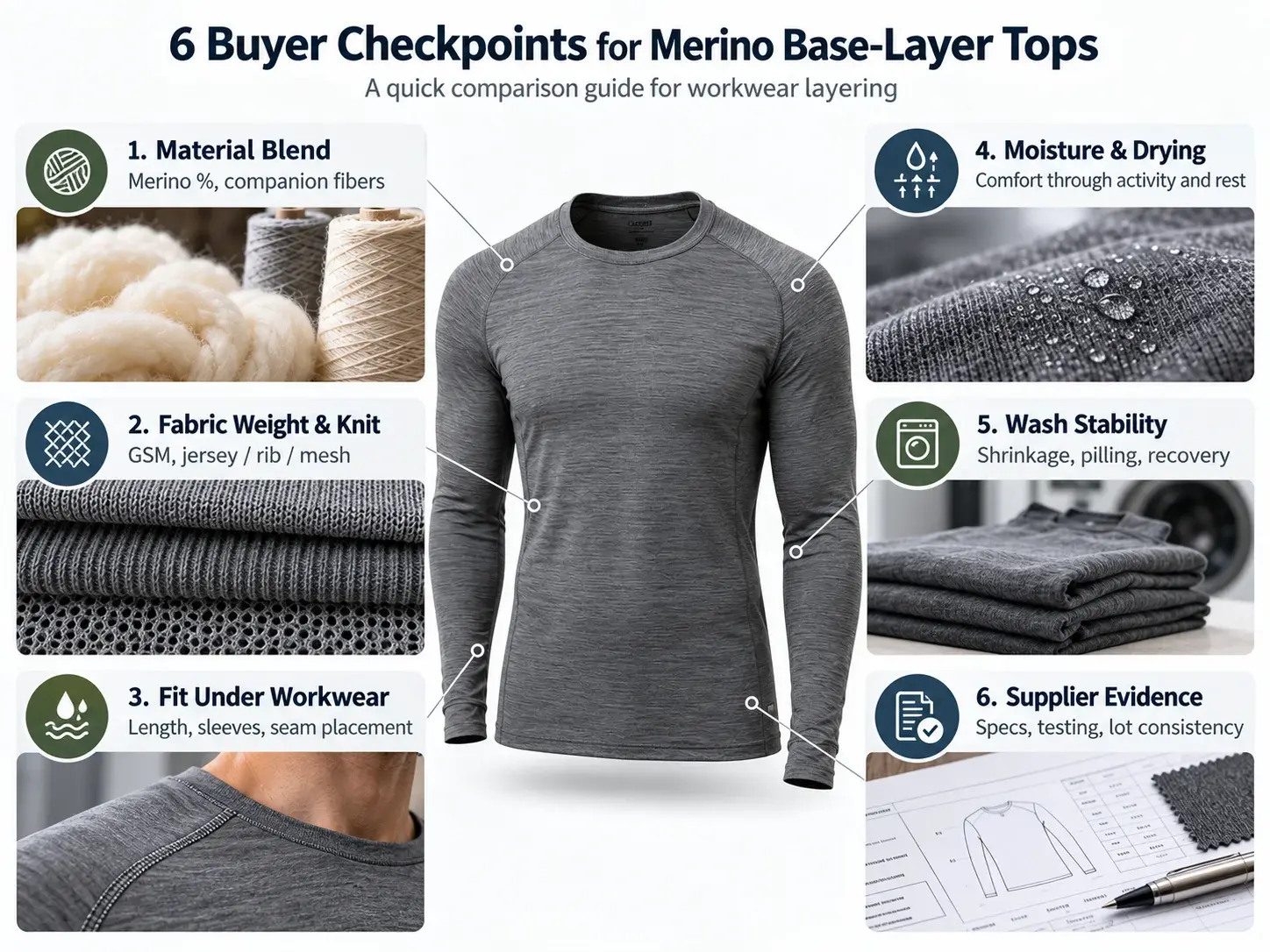
Use the same evidence request for every supplier:
| Decision area | Evidence to request | Approval question |
| Material | Fiber percentages, yarn and wool details, substitution rules | Is the delivered material traceable to the approved specification? |
| Fabric | GSM tolerance, knit, finish, color | Does the bulk fabric match the approved sample? |
| Fit | Measurement chart, grading, garment tolerances | Does the top layer smoothly under the complete uniform? |
| Performance | Agreed methods and conditions for warmth, moisture, and drying | Are claims tied to reproducible results? |
| Durability | Wash protocol, dimensional change, pilling, recovery | Does performance remain acceptable after planned care? |
| Production | Sample ID, revision control, inspection plan | Can changes be identified before bulk shipment? |
Price comparisons become more meaningful after these variables are aligned. A lower quote based on a different fiber ratio, wider tolerance, or unverified finish is not a like-for-like offer.
Use Product Options as a Starting Point, Not the Final Specification
PPE Compatibility Is a Separate Approval Gate
Merino fiber content does not establish certified flame resistance, arc rating or other protective performance. Wool-rich fabric is not automatically an arc-rated garment; comfort beneath PPE is not proof of PPE compatibility. Verify the complete ensemble against applicable workplace hazards, employer requirements, standards and documented product evidence.
How Harvest SPF Can Support Merino Workwear Development
Subject to confirmed project capabilities, discuss wool micron/fiber/yarn selection; GSM/knit and surface engineering; layered fit, grading and mobility; thermal/moisture/wash test planning; sample revisions; and controlled bulk BOM, measurements and QC.
Harvest SPF lists a men’s merino wool zip-up top with pure-merino and multiple merino-blend options, a published 130–450 GSM range, and sizes from XS to XXL. Those options can help a buyer define samples, but each program still needs a specific composition, weight, knit, color, measurement chart, care method, and acceptance plan.
Before requesting quotations, prepare the job scenario, target wearer profile, outer garments, expected order quantity, size range, color requirements, and test priorities. That information helps Harvest SPF or another qualified supplier propose comparable constructions rather than unrelated samples.
Conclusion
Merino Workwear Base-Layer Specification Review
Invite buyers to provide: work environment and activity level; full outer-layer/PPE configuration; target merino composition, GSM and knit; size range; home or industrial care method; performance and safety requirements; order quantity; target price; and delivery schedule.
Harvest SPF can review potential fabric constructions, fit and sampling requirements, testing scope and production feasibility, subject to project confirmation.
Buyers should compare merino base-layer tops as engineered components of a workwear system. Define the job first, then control composition, GSM, knit, fit, construction, moisture behavior, laundering, and production tolerances. Sample under the actual outer garments, record performance through a realistic shift, and approve measurable requirements before bulk production.
Review My Merino Workwear Program
FAQs
Is 100% merino always more durable than blends?
No. Durability depends on fiber ratio, yarn, knit, finish and exposure.
Does higher GSM always mean greater warmth?
No. Knit loft, fit, moisture, activity and outer layers also matter.
Can merino tops be industrially laundered?
Only when the specific garment has been validated for the intended care process.
What should buyers validate before approval?
Material identity, layered fit, movement, moisture behavior, care durability, relevant safety requirements and production consistency.
How should buyers compare quotes?
Align composition, yarn, GSM, knit, finishing, grading, tests and quality limits before comparing price.
Is 100% merino always better than a merino blend for work?
No. The better option depends on the required comfort, stretch, recovery, drying, abrasion resistance, care method, and price target. Compare finished samples under the same work conditions.
What GSM should a merino work base layer use?
There is no universal GSM for a temperature or job. Activity, knit, fit, wind protection, moisture, and outer layers all affect warmth. Treat GSM as one controlled specification and validate the full system.
Should a base-layer top fit tightly under workwear?
It should generally stay close to the body without restricting movement, creating pressure, or distorting the outer garment. Approve fit through task-based trials in the intended uniform.
Can any merino top be worn under protective workwear?
Do not assume compatibility. For flame, arc, static, chemical, or other controlled hazards, verify the entire clothing system against the applicable workplace requirements and documented product specifications.