

1. Industry Background and Trend Analysis
1.1 Global Yoga Wear Market Development Trends
Industry Data on the Global Popularization of Yoga Culture and Growing Apparel Demand:
The international yoga market has been experiencing steady growth. The CAGR is estimated to be around 5% to 9% by market research firms.
The yoga clothing industry, as a sector of the international sportswear market, is usually termed a multi-billion-dollar market. The growth rate of this market in North America, Europe, and the Asia-Pacific region is usually higher than in other regions.

Opportunities and Challenges for Fashion Brands Entering the Yoga Wear Market:
(functionality, comfort, sustainability requirements, etc.)
I. Opportunities
1. Functionality
- The application of high-performance fabrics: The performance of high-performance fabrics, which includes moisture-wicking, quick-drying, antibacterial, anti-odor, breathable, and four-way stretch, can be improved to enhance performance in sports and comfort in wearing the clothing.
- Innovative structural design: Seamless stitching, body-contoured design, high-waist design, muscle support, V-back, and back ventilation can be used to enhance flexibility, especially in different yoga postures.
- Multi-scenario adaptability: The application of yoga wear can be extended to other sports, not only yoga, but also other sports, like indoor sports, Pilate, and leisure wear after sports.
2. Comfort
- Fit and silent performance: Reducing restrictions improves fit. It also minimizes friction and pulling during complex yoga poses. This greatly enhances the wearing experience.
- Lightweight and soft hand feel: Optimized material selection and manufacturing processes prevent excessive stiffness. They improve comfort and freedom of movement.
- Size and body inclusivity: Covering a wider range of sizes and body shapes ensures better fit for different consumers. It reduces return rates.
3. Environmental Requirements
- Sustainable materials and certificates: Recycled polyester/nylon, organic cotton, recycled materials, and materials with certificates such as OEKO-TEX, Global Recycled Standard, Bluesign, and GOTS can assist in creating brand reputation.
- Transparent supply chain: Making the supply chain transparent for raw materials, production, carbon footprint, and water consumption can assist in reducing the risk of ‘greenwashing’ for the company.
- Low environmental impact during production phase: This could include minimizing water usage during the dyeing process, promoting recycling, etc.
II. Challenges
- Cost pressure and pricing balance: There is a balance to be made in terms of the cost of materials and technology, which is reflected in the final product and its pricing.
- Homogeneous competitors and brand positioning: There are established sportswear companies that have established supply chains and brand equity. For new entrants in the fashion industry, brand positioning has to be established in a competitive market. This could be in terms of product design or marketing campaigns.
- Supply chain and compliance risks: There are issues in terms of country of manufacture and quality assurance and certification. This, again, points to the importance of supply chain management.
- Professional certification and trust building: There is a greater emphasis on functional product benefits and consumers validating product benefits against independent test data and certification.
- Incremental innovation costs: There are continuous innovation costs in terms of materials and structures, which may have a short-term effect on cash flow and profitability.
1.2 Differences Between Yoga Wear and Sportswear: Positioning and Technical Requirements
Unique Usage Scenarios for Yoga Wear
Yoga apparel requires specific performance characteristics. These include high elasticity, movement expansion capability, skin-friendly comfort, and a non-restrictive feel.
Compared with general sportswear (such as running or fitness clothing), yoga wear has differentiated technical requirements. These appear in fabric composition, structural design, and detail processing.
Yoga wear generally requires higher performance levels. It must accommodate a wide range of yoga movements. These include stretching, twisting, forward bends, and backbends. It allows full joint mobility without restriction.
It fits closely to muscle contours. It does this without creating pressure or discomfort during intense postures.
It quickly recovers shape after complex poses. It avoids sagging or deformation.
It maintains breathability in yoga studios or hot yoga environments. It does this without excessive ventilation that may cause exposure.
It provides moderate support for key areas such as the waist, abdomen, and chest. It maintains coverage and privacy.
It stays durable in high-friction areas such as hips, knees, and inner arms. It prevents pilling and abrasion.
Because of these requirements, yoga wear differs from ordinary sportswear in several key aspects:
A. Fabric and Material Composition
Yoga Wear High elasticity, softness, fit, low skin irritation, no wrinkling, and recovery. The common materials used are high elastic fibers, which include spandex or LYCRA. This constitutes 15-30% or more. Polyester or nylon base fabrics are used in combination with the above. Breathability and quick drying are also needed. Mesh panels or perforated patterns are used to meet this requirement, especially in regions of high movement. This gives a smooth feel to the fabric to avoid over-exposure.
Running/Fitness Wear This primarily consists of moisture management, lightness, abrasion, antibacterial, and durability, especially when wearing the garment during intense exercise. The common materials used are high percentage polyester or nylon with moderate spandex.
Therefore:
- Yoga wear emphasizes elasticity, skin comfort, and unrestricted movement.
- Running and fitness wear emphasizes moisture management, lightweight performance, and durability under high intensity.
B. Structural Design
Yoga apparel often adopts seamless or low-seam construction. It uses flat stitching and gentle support structures. These follow muscle contours without compression. Waist and hip support zones stay flexible and comfortable.
Running and fitness apparel typically uses full-coverage compression structures. It includes reinforcement in key areas such as shoulders, waist, and hips. It has durable stitching for high-intensity movement and wind resistance.
Therefore:
- Yoga wear focuses on softness, body-hugging comfort, and seamless construction.
- Running and fitness apparel focuses on sweat management, lightweight performance, and functional details.
C. Detail Processing and Functional Features
Yoga wear minimizes rigid seams near skin contact areas. It typically uses flat seams, seamless waist and thigh structures to reduce friction and pressure.
Running and fitness apparel prioritizes durability. It uses techniques such as three-needle six-thread stitching or overlocking to withstand high-intensity training.
Additional yoga wear design features include:
- Moderate waist and hip support
- Balanced stretch distribution in the legs
- Breathable mesh panels in key areas while maintaining coverage and confidence during practice
Running and fitness wear, on the other hand, often includes:
- Pockets
- Reflective strips
- Chest/back support straps
- Skirt overlays
These features emphasize practicality and safety (for example, during night running).
D. Fabric Performance Testing and Certification Focus
Common Testing for Yoga Wear
- Stretch recovery (elastic rebound speed and degree)
- Four-way stretch capability
- Low friction coefficient for skin comfort
- Anti-pilling and durability
- Breathability and moisture permeability
- Antibacterial and odor resistance
Common Testing for Running/Fitness Apparel
- Water vapor permeability and moisture wicking
- Strength and abrasion resistance
- Wind resistance and thermal performance
- Adhesion and friction performance
- UV protection
Certification Focus
Yoga wear commonly prioritizes certifications such as:
- OEKO-TEX
- Bluesign
- GOTS (for organic materials)
- Global Recycled Standard
Running and fitness apparel typically emphasizes material performance certifications and testing reports along with OEKO-TEX and Bluesign compliance.
2. Core Evaluation Criteria When Choosing a Yoga Wear Manufacturer
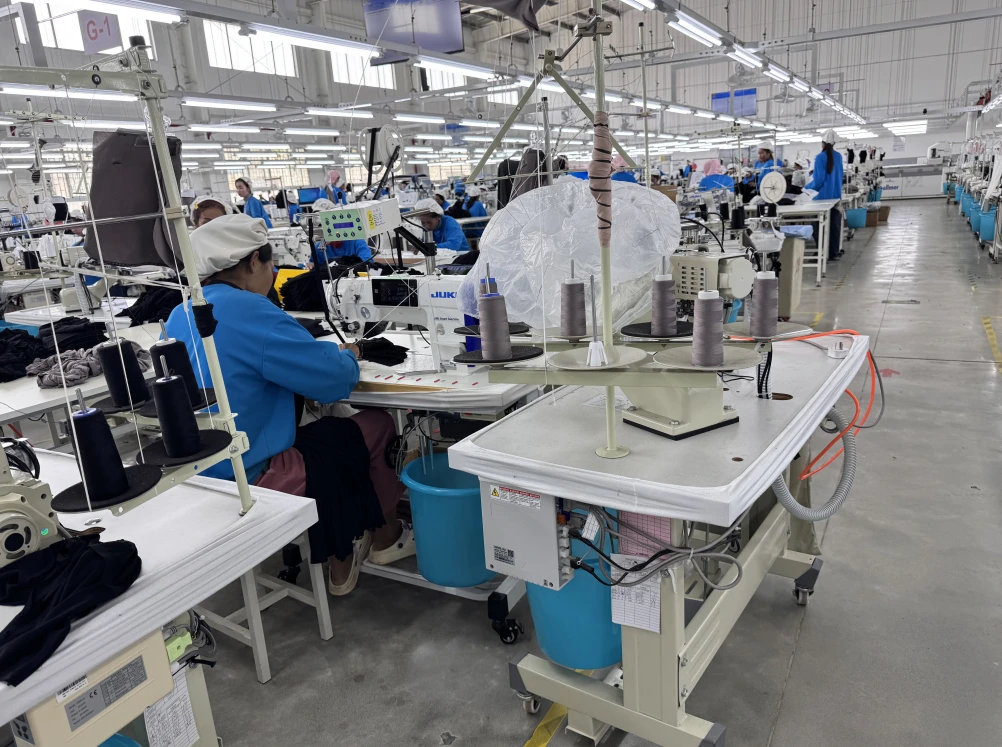
When selecting a manufacturing partner, brands should evaluate the following core capabilities and metrics.
1. Production Capacity and Delivery Capability
- Monthly capacity and ability to handle seasonal demand peaks
- On-time delivery (OTD) rate and delay ratio
- Production line scalability and rapid expansion capability
- Sample development cycle and mass production lead time
2. Quality Management and Stability
- Finished product qualification rate and return rate
- Incoming material inspection systems and defect rates
- Process quality control capability (SPC monitoring, inspection points, first-article evaluation)
- Rework and repair rates and root-cause analysis
3. Material and Process Capabilities
- Compliance and supply stability of fabrics and trims
- R&D and sampling capabilities including rapid prototyping and ergonomic fitting tests
- Key manufacturing technologies such as seamless knitting, zoned stitching, laser cutting, heat bonding, and edge finishing
- Ability to co-develop custom fabrics or functional materials with brands
4. Quality Systems and Compliance
- Quality system certifications such as ISO 9001 or ISO 13485
- Environmental and social responsibility certifications such as OEKO-TEX, BLUESIGN, GOTS, BSCI, and SEDEX
- Supply chain traceability and ethical audit mechanisms
- Workplace safety and labor compliance records
5. Cost Structure and Financial Stability
- Transparency of raw material and processing costs
- Price fluctuation management for materials, exchange rates, and tariffs
- Financial stability indicators such as cash flow and debt levels
- Minimum order quantities and pricing strategies
6. Supply Chain Resilience and Risk Management
- Multi-source supply capability
- Availability of alternative materials and backup factories
- Geographic concentration risk and logistics stability
- Emergency plans for disruptions such as pandemics or natural disasters
- Information system interoperability such as ERP, EDI integration, and order visibility
7. Innovation and Partnership Capabilities
- Joint development of new materials and functional fabrics
- Rapid prototyping and iterative development support
- Technical collaboration and training for manufacturing optimization
8. Reliability and Communication
- Daily communication efficiency and response speed
- Factory management culture and understanding of brand requirements
- Closed-loop problem-solving capability including documentation and corrective actions
2.1 Fabric and Functional Performance Support
Yoga apparel requires fabrics with properties such as breathability, elasticity, softness, and moisture management.
A. Breathability
Performance requirements:
- Air permeability testing
- Micro-pore structure and gas transmission evaluation
Technical standards:
- ISO 9237 – Air permeability testing
- ASTM D737 – Standard air permeability test for textiles
B. Moisture Permeability and Sweat Management
Performance requirements:
- Water vapor transmission rate (MVTR)
- Moisture absorption rate
- Drying time
Technical standards:
- EN ISO 11092 – Thermal and water vapor resistance
- ASTM E96/E96M – Water vapor transmission rate testing
C. Elasticity and Recovery
Performance requirements:
- Warp and weft elongation rate
- Elastic recovery after stretching
Technical standards:
- ISO 13934-1 – Tensile strength testing
- ASTM D5034 – Tensile strength and elongation testing
D. Softness and Hand Feel
Performance requirements:
- Instrument-based tactile evaluation
- Skin friction coefficient testing
Technical standards:
- AATCC 88 / AATCC 127
E. Antibacterial and Odor Control
Performance requirements:
- Bacterial inhibition rate
- Long-term odor control testing
Technical standards:
- AATCC 100
- ISO 20743
2.2 Structural and Pattern Design Capabilities
Ergonomic Design and Motion Adaptation
Manufacturers must be capable of designing high-waist leggings, sports bras, and yoga sets. These are optimized for different yoga movements.
Harvest SPF can provide design support and collaborative development resources for ergonomic analysis and dynamic wear testing.
Key design methods include:
A. Zoned pattern cutting
High-elastic zones such as hips, glutes, and inner thighs are designed as independent panels. They have gradual elasticity transitions.
B. Seamless or low-seam stitching
Flatlock seams or seamless waist and thigh structures reduce friction points.
C. Waist and abdominal fit
Elastic waistbands combined with lining structures provide support. They do not restrict breathing.
D. Testing and iteration
Wear tests evaluate slippage, wrinkles, pressure points, and misalignment. These help optimize pattern shapes and seam placement.
E. Fabric matching strategy
High-elastic fabrics go in movement zones. Moderate elasticity applies elsewhere for comfort and breathability.
F. Certification and compliance
Breathability and safety certifications should be considered early for bra-style products. This ensures market compliance.
2.3 OEM / ODM Customization Services
Evaluation of Customization Processes and Service Systems
Brands should confirm whether the manufacturer provides one-stop services. These cover design concepts and sampling to fabric sourcing and mass production.
Key evaluation factors include:
- Sample development cycle
- Revision cycle
- Mass production lead time
Harvest SPF capabilities
- Complete development system covering design, sampling, and production
- Sample development cycle typically 7–10 days
- Bulk production lead time 30–50 days
- Flexible MOQ and customization including logos, hang tags, packaging, and labels
2.4 Production and Quality Control Systems
Production Transparency and Quality Management
Brands should verify whether the factory has:
- Standardized production lines
- Strict QC procedures
- Full traceability systems
Harvest SPF has international-level quality certification and inspection processes. It supports third-party inspections.
The company operates standardized production lines. It uses strict QC procedures and a complete traceability system to ensure product accountability.
3. Industry Application Examples: Typical Yoga Wear Product Categories
Based on the product categories found on the Harvest SPF website, including Yoga Wear Manufacturer and Seamless products, the following categories can be used as structural examples.
3.1 Yoga Pants Products
Typical products include:
- Women’s high-elastic soft yoga leggings
- Women’s seamless compression yoga shorts
- Women’s loose training pants
Harvest SPF provides a wide product range. It includes multiple pants styles as reference examples.
3.2 Tops: Yoga Shirts and Sports Bras
Structural Design and Support Requirements for Women’s Yoga Sports Bras
Different support levels are required for different training intensities.
Yoga sports bras must:
- Provide stable support during forward bends, backbends, twists, standing poses, and seated poses
- Reduce chest movement
- Minimize friction and pressure points
- Maintain breathable comfort without restricting breathing
- Prevent strap slippage and pressure on the back
- Provide smooth edges and coverage for various cup sizes (A–E or larger)
Support levels are typically divided into:
Light Support Suitable for:
- Relaxation yoga
- Breathing exercises
- Post-yoga stretching
- Low-intensity core work
Features:
- Thin or no cups
- Narrow shoulder straps
- Focus on softness and breathability
Medium Support Suitable for:
- General yoga practice
- Flow sequences
- Standing or seated twisting poses
Features:
- Moderate cup structure
- Medium-width straps
- Balanced support without excessive compression
High / Maximum Support Suitable for:
- High-intensity yoga flows
- Inversions
- Fast-transition sequences
- Situations requiring additional stability
Features:
- Deeper cup coverage
- Wide straps
- Multiple back support points
- Double-layer construction for compression and stability
3.3 Yoga Sets and Multifunctional Design
Yoga sets combine tops and bottoms. They require comprehensive consideration of fit, structure, and function.
A. Structural Considerations
Upper body (tops or bras)
- Cup coverage and freedom of movement balance
- Neckline and strap width coordination with waistline design
- Back structures such as cross straps or V-back designs
- Adequate underarm coverage to prevent friction
Lower body (leggings)
- High-waist structure and abdominal support
- Comfortable crotch construction for bending and cross-leg poses
- Balanced elasticity distribution for hips and legs
- Waist finishing and mesh ventilation areas
B. Material and Functional Requirements
- Breathability and quick drying through mesh zones
- Zoned elasticity and compression distribution
- Seamless or flatlock construction for comfort
- Durability including anti-pilling and wash resistance
- Sustainable material options such as recycled fibers
3.4 Seamless Technology and Its Value
Seamless yoga apparel offers significant advantages compared with traditional stitched garments.
A. Friction and irritation
Seamless: fewer seams and edges reduce friction. It improves comfort during long workouts.
Traditional sewing: seams may create pressure points and irritation.
B. Elasticity distribution
Seamless: uniform elasticity distribution and natural movement adaptation.
Traditional sewing: elasticity relies on panel stitching and elastic bands.
C. Touch and hand feel
Seamless: smooth surface and improved skin contact comfort.
Traditional sewing: seams may produce noticeable tactile differences.
D. Appearance
Seamless: smoother silhouette and streamlined design.
Traditional sewing: multiple seams may visually segment the garment.
4. Key Steps When Evaluating a Manufacturer
4.1 Manufacturer Capability Verification Checklist
Brands can use the following checklist to quickly determine whether a manufacturer is suitable.
- Can fabric function test samples be provided?
- Can the supplier provide fabric source documentation and inspection reports?
- Can the manufacturer support repeat orders and seasonal product updates?
Harvest SPF accepts fabric function testing. It provides samples, offers fabric sourcing documentation and inspection reports, and supports repeat orders and seasonal product iterations.
4.2 Custom Contracts and Intellectual Property Protection
Brands must ensure that design drafts, patterns, and brand assets are protected during custom manufacturing.
Harvest SPF signs an NDA agreement before receiving customer design drafts. This ensures confidentiality.
Customer samples are properly stored. They will not be shown to or used by other clients for reference.
img.yoga wear OEM ODM wholesale supplier in China.webp
5. Sustainability and Eco-Friendly Manufacturing
5.1 Eco-Friendly Materials and Green Production
Global demand for environmentally friendly sportswear continues to grow.
The global sustainable fashion and eco-apparel market (including sportswear) generally has a CAGR of around 8%–10%. The sustainable sportswear segment can reach 7%–12% growth.
Consumers increasingly prioritize:
- Health and safety
- Transparent supply chains
- Material sourcing information
- Certification labels
Many countries are also introducing regulations. These require chemical disclosure, restricted substances, and higher production transparency.
Eco-friendly fabrics used by Harvest SPF
A. Recycled Polyester (rPET) / Recycled Nylon
- Reduces virgin resource consumption
- Lowers carbon emissions
- Decreases reliance on fossil materials
- Maintains durability suitable for high-performance sportswear
B. Recycled fibers
Examples include recycled polyester, recycled nylon, and recycled cellulose fibers.
Benefits:
- Reduce landfill waste
- Improve circular economy ratios
- Lower lifecycle carbon footprint
C. Organic cotton (GOTS certified)
- Controlled chemical usage during cultivation
- Skin-friendly and biodegradable
D. Bamboo fiber, lignin-derived fiber, and wood-pulp fiber (such as TENCEL/Lyocell)
- High moisture absorption
- Soft and smooth texture
- Lower environmental impact when produced with closed-loop solvent systems
5.2 Raw Material Sourcing and Supply Chain Transparency
Brands should evaluate:
- Reliability of raw material suppliers
- Presence of international eco certifications
Harvest SPF supports supply chain transparency and environmentally responsible sourcing. It does this through certifications such as:
- GOTS
- GRS (Global Recycled Standard)
- OEKO-TEX Standard 100
6. Frequently Asked Questions (FAQ)
How do you evaluate whether a yoga fabric matches your brand positioning?
A practical evaluation process can be divided into several steps:
- Initial screening
Define required and optional performance characteristics according to brand positioning. Select 2–3 representative fabrics for comparison.
- Laboratory testing
Basic physical tests:
- Stretch and recovery
- Tensile strength
- Washing durability
- Shrinkage rate
Comfort and skin compatibility:
- Friction tests
- Allergy sensitivity evaluation
Breathability and moisture management:
- Air permeability tests
- Moisture transfer testing
- Quick-dry time
Color and dyeing quality:
- Lightfastness
- Wash resistance
- Colorfastness ratings
- Real wearing evaluation
Prototype wear tests including:
- Stretching
- Forward/back bending
- Twisting
- Arm raising
User testing groups can include participants with different body shapes, genders, and training levels.
- Cost and supply chain evaluation
- Fabric cost
- Supply stability
- Fabric utilization rate in mass production
- Decision and implementation
Summarize test data into a scoring system. Record improvement points for future product versions.
What fabric functionality does Harvest SPF provide?
Harvest SPF is a factory with 20 years of manufacturing experience. It continuously develops new fabrics.
Both standard and eco-friendly materials are used, including:
- Recycled polyester (rPET)
- Recycled nylon
- Recycled fibers such as recycled polyester, recycled nylon, and recycled cellulose
- Organic cotton
- Bamboo fiber
- Lignin-derived fibers
- Wood pulp fibers such as TENCEL/Lyocell
What is the minimum order quantity (MOQ) and sample development cycle?
- Standard styles: 500 pieces per color
- Seamless styles: 1000 pieces per color
How can consistency be maintained across seasons and production batches?
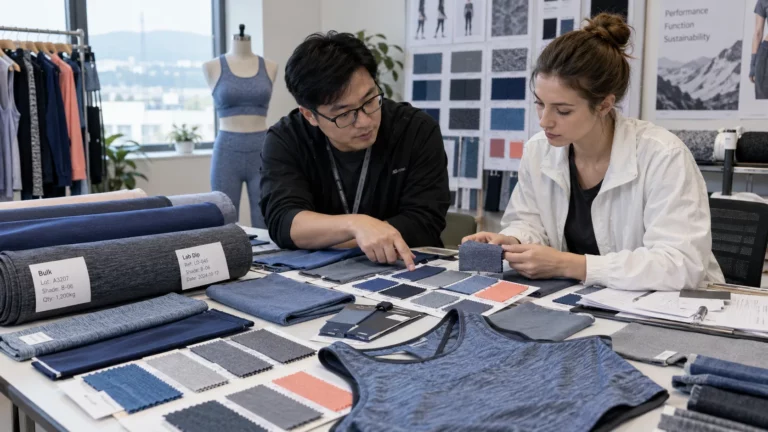
- Color consistency
Use standardized color systems such as Pantone or NCS. Combine them with a comprehensive Color Management System (CMS).
Processes include:
- Locking main and secondary color cards during design
- Recording dyeing parameters
- Approving factory color samples (Lab Dip or Color Card)
- Comparing pre-production samples with approved references
- Pattern consistency
Critical pattern parameters should be fixed in a Tech Pack. These include:
- Stitch positions
- Seam widths
- Fabric usage
- Elastic zones
- Fit points
Standard size charts and pattern templates ensure consistent cutting and assembly across production batches.
New fabric batches require small-scale trial production before full manufacturing. This ensures alignment with baseline samples.
Can compliance documentation for major international markets be provided?
European Union
- EU 1007/2011
- Oeko-Tex Standard 100
- CE
United States
- GOTS
- OEKO-TEX
7. Contact Harvest SPF for Custom Solutions
If you are looking for a reliable yoga wear manufacturer, the team at Harvest SPF can provide professional development and production support.
Contact the Harvest SPF Team Email: joy@spftex.com WhatsApp: +86 18310458626
Feel free to reach out to request samples, customization consultations, or product development solutions for your brand.