

For children’s thermal base layers, the lowest FOB quote is rarely the lowest total cost. A fabric that pills quickly, a waistband that loses recovery, or sizing that varies between batches can create markdowns, returns, and replenishment problems. For a 2027 back-to-school program, buyers should define the performance target first, then select the fabric, construction, decoration, and order structure that can meet the target FOB cost consistently.
The practical objective is not to maximize every feature. It is to choose the simplest specification that gives children enough warmth, stretch, comfort, and wash durability for the intended retail position.
Kids’ Thermal Base Layer Development Framework
Kids’ thermal underwear should not simply be a smaller version of an adult base layer. Development should connect use case, age and size architecture, thermal target, fabric, skin comfort, fit and movement, wash durability, safety/compliance planning, target FOB, MOQ/SKU structure, and bulk control.
Use Case → Age/Size Architecture → Thermal Target → Fabric → Skin Comfort → Fit & Movement → Wash Durability → Safety/Compliance → Target FOB → MOQ/SKU → Bulk Control
Start With the Use Case, Not the Fabric Name
“Thermal” can describe several different product roles. A lightweight base layer for classroom wear has different requirements from a heavier first layer for outdoor sports or cold-weather travel.
Before requesting an OEM quote, define:
- Expected temperature range and layering position
- Indoor, outdoor, school, or sports use
- Target retail price and target FOB ceiling
- Size range and expected size ratio
- Top-only, bottom-only, or coordinated set
- Number of colors and seasonal graphics
- Required wash life and appearance standard
Back-to-school products also need a broader comfort range than specialist ski apparel. Children may wear the garment under uniforms, jeans, snow pants, or sportswear. Excessive bulk can reduce sell-through even when thermal performance is good.
A clear use case helps the factory compare fabrics on relevant criteria rather than quoting a generic “warm” material.
Define the Age Group and Fit Architecture
Before fabric selection, define the target age group, body-size system, intended fit, dressing independence, activity level, and layering use. A young child and an older child may require different body proportions, neck openings, waistband comfort, and ease of movement even when both products are sold as kids’ thermal base layers.
Do not create kids’ sizing by simply scaling down an adult pattern. Establish a children’s base size, grading rules, size-set review, and approved measurement chart for the intended market.
Growth allowance should be engineered rather than added randomly. Balance movement, layering and growth with the intended thermal fit. Define whether the product is a close base-layer fit, regular base-layer fit, or more relaxed layering fit.
Balance Warmth and Comfort Through GSM and Fiber Selection
Fabric weight is one of the clearest cost and performance levers, but higher GSM does not automatically mean a better children’s base layer. A heavier fabric can improve coverage and warmth while increasing material consumption, drying time, and FOB cost.
A useful development approach is to compare two or three weight levels using the same pattern:
- Lightweight for active use and mild winter conditions
- Midweight for everyday school layering
- Heavier weight for colder climates or low-activity wear
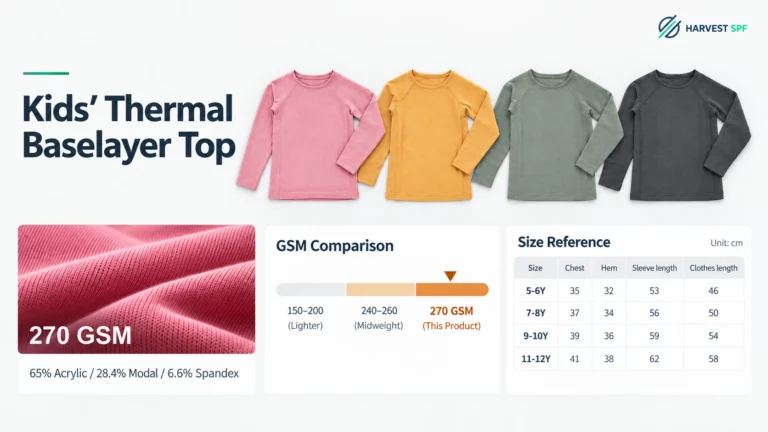
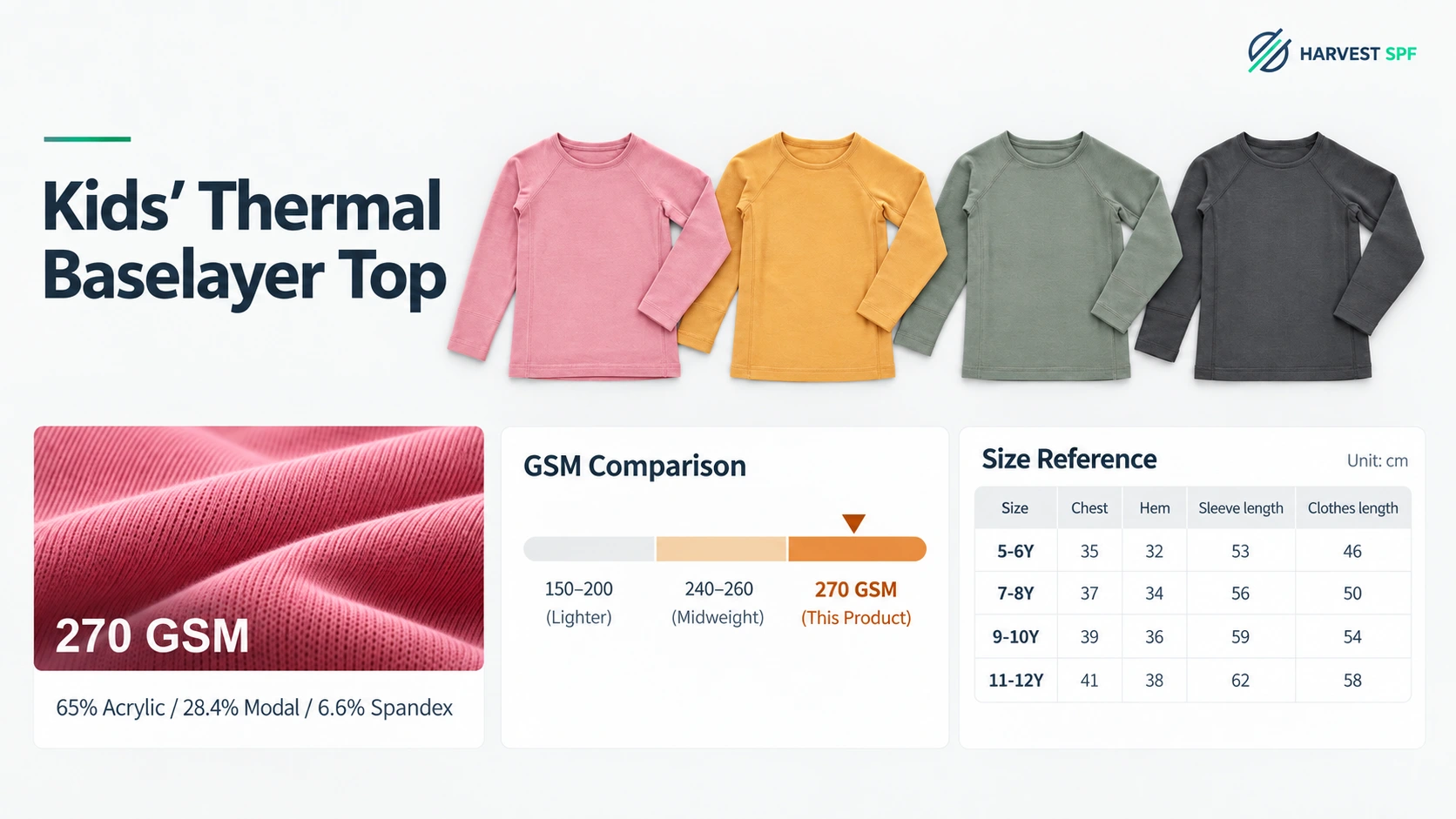
Harvest SPF publishes a children’s acrylic-modal-spandex long-sleeve baselayer at 270 gsm. The listed composition is 65% acrylic, 28.4% modal, and 6.6% spandex. The product is positioned around softness, stretch, and everyday warmth rather than a single extreme-weather claim. Buyers can use this type of specification as a starting point, then confirm hand feel, recovery, pilling, and shrinkage through sample testing. See the children’s acrylic-modal-spandex baselayer for the published reference specification.
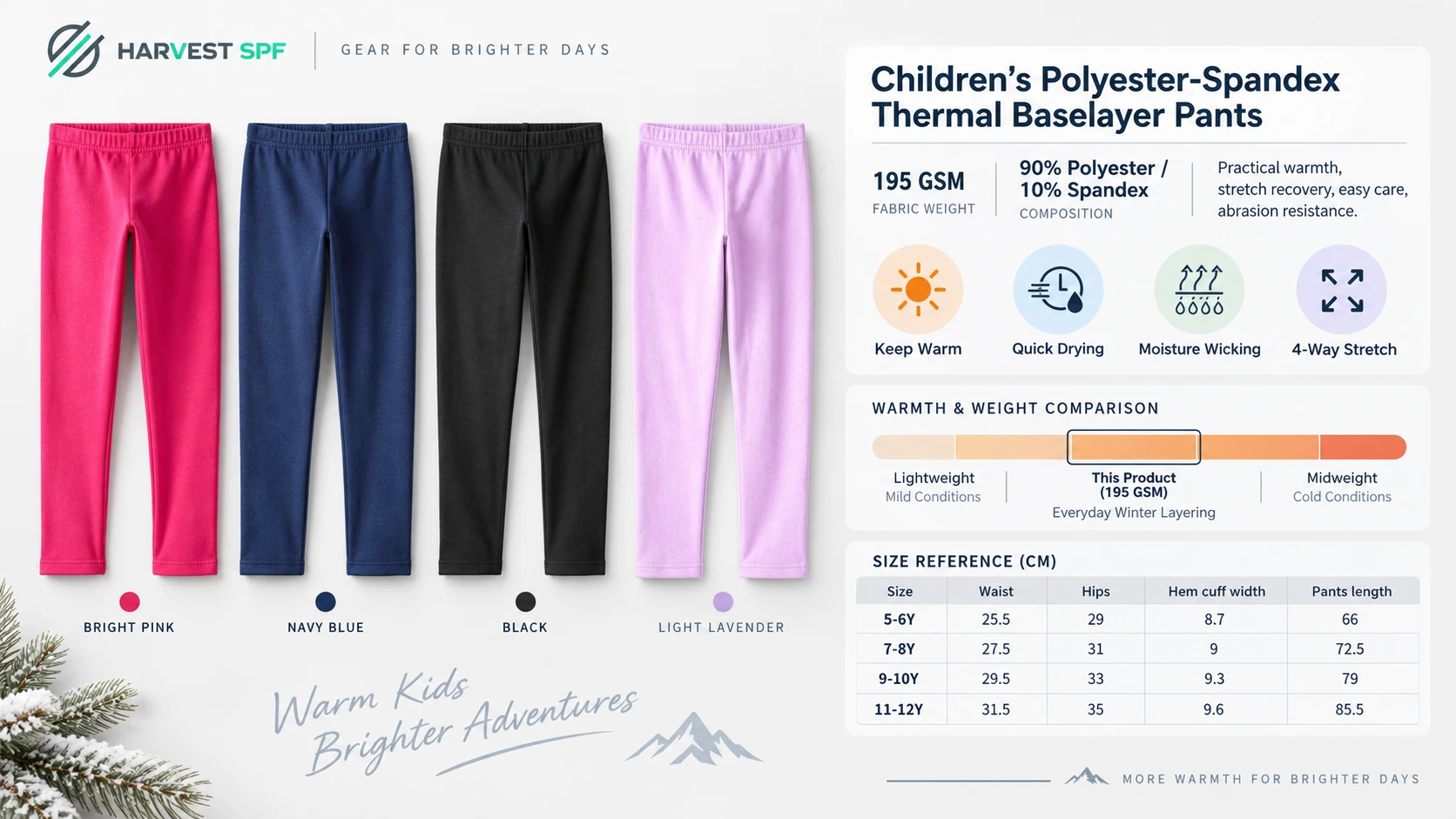
For a more cost-sensitive or active program, a lighter polyester-spandex blend may be more practical. Harvest SPF also lists a children’s polyester-spandex baselayer pant at 195 gsm, using 90% polyester and 10% spandex. Polyester can support abrasion resistance and easier care, while spandex contributes stretch and fit recovery. These benefits still need to be checked against the buyer’s required softness, breathability, and wash standards. The children’s polyester-spandex baselayer pant provides a relevant comparison point.
GSM Is Not a Thermal-Performance Claim
GSM is a fabric-weight specification, not a universal warmth rating. Two fabrics at the same GSM may perform differently because of fiber type, yarn architecture, knit construction, thickness or loft, brushing, and finishing. Use lightweight, midweight, and heavyweight descriptions as development references rather than universal temperature ratings.
Evaluate the complete fabric system: skin-side hand feel, moisture handling, drying behavior, stretch and recovery, pilling, shrinkage, wash appearance, and thermal performance where required. A fabric can meet composition and GSM requirements and still miss the intended comfort target.
| Variable | 270 GSM Acrylic/Modal/Spandex Reference | 195 GSM Polyester/Spandex Reference | Buyer Should Evaluate |
| Fabric strategy | Higher-weight soft/stretch blend | Lower-weight synthetic/stretch blend | Intended layering and use |
| Positioning | Everyday warmth/comfort | Active/easy-care direction | Target market and climate |
| Approval | Sample and test | Sample and test | Final comfort, durability and performance |
Treat Durability as a Construction Package
Durability is not controlled by fiber content alone. Seams, elastic recovery, neckline construction, hems, and label application all influence how a children’s base layer performs after repeated wear and washing.
Ask the OEM supplier to specify:
- Seam type and stitch density at high-stress areas
- Stretch recovery at cuffs, waistband, and neckline
- Seam strength after repeated extension
- Pilling and abrasion expectations
- Dimensional change after the agreed wash process
- Colorfastness and print durability
- Needle detection and finishing controls where required by the program
Flatlock or other low-profile seams may improve comfort when the garment is worn directly against the skin. However, the construction should be selected according to fabric weight and stretch rather than added as a decorative feature. Extra seam operations, special thread, printed care labels, and complex trims can all raise FOB cost.
For children’s products, pattern tolerance is equally important. A garment that measures correctly in one size but shifts significantly across a size run can create fit complaints. Require a graded measurement chart, pre-production sample approval, and a clear tolerance table before bulk cutting.
Kids’ Thermal Durability and Comfort Package
Evaluate durability in four layers: fabric durability (pilling, abrasion, dimensional stability), construction durability (seams, stitches, elastic recovery), appearance durability (color, print and surface appearance), and fit durability (waistband, cuff and neckline recovery after washing).
Test the garment after the buyer-agreed wash process, not only in new condition. Compare dimensions, waistband and neckline recovery, cuff recovery, pilling, surface appearance, color, print condition and hand feel. The buyer should define the wash protocol and acceptance criteria.
For bottoms, review waistband width, elastic construction, extension, recovery, pressure/comfort, twisting after wash and seam bulk. For tops, check head opening and neckline recovery for dressing comfort. High-movement areas such as underarm, shoulder, side seam, waistband, crotch and inseam should be evaluated for seam profile, stretch and placement.
Build Safety and Compliance Into the OEM Brief
Children’s product requirements vary by market, age range, and product classification. Confirm whether the garment is sold as a base layer, daywear, sportswear, or sleepwear, then define the applicable labeling, chemical, flammability, safety, testing, and documentation requirements in the RFQ.
Reduce unnecessary trims and hard components where practical. Drawcords, decorative attachments, zippers, buttons/snaps, heat transfers, labels and other components should be reviewed for comfort, durability and applicable buyer/market requirements.
Build the Target FOB From Cost Drivers
A target FOB should be a specification-based ceiling, not an isolated number sent to several factories. When a quote is lower than expected, ask what has changed. The difference may come from fabric weight, fiber quality, construction, testing, packaging, or order quantity.
The main cost drivers usually include:
- Fiber blend and yarn price
- Fabric GSM and width utilization
- Knitting, brushing, dyeing, or finishing
- Pattern complexity and sewing minutes
- Number of colors and size breakdown
- Custom labels, transfers, prints, and packaging
- Testing requirements and inspection scope
- MOQ, fabric availability, and production efficiency
Harvest SPF’s published thermal underwear guidance explains why GSM, fiber blend, construction, and MOQ should be reviewed together in an OEM quotation. The thermal underwear cost breakdown is useful when building a cost comparison sheet.
A practical quote request should ask the supplier to return at least two options:
- A target-cost version using the most efficient compliant fabric and construction
- A premium version showing the incremental cost of softer fibers, higher GSM, upgraded seams, or additional testing
This makes trade-offs visible. It also prevents the team from accepting a low quote that excludes necessary trims, packaging, or quality controls.
Compare Program Cost, Not Only FOB
The lowest FOB is not always the lowest program cost. A small unit-price saving can be offset by pilling, shrinkage, poor recovery, returns or markdowns. Compare FOB savings against quality, return and markdown risk.
Where useful, request Good / Better / Best specification options. Good should be cost-controlled while still meeting the buyer’s minimum safety and quality requirements; Better should balance comfort, durability and cost; Best may add premium material, construction or testing.
Use MOQ and SKU Planning to Protect Margin
Children’s collections often become expensive through SKU multiplication rather than through one fabric decision. A top in four colors and six sizes already creates 24 size-color combinations. Adding matching pants, graphics, or separate boys’ and girls’ fits can increase inventory risk quickly.
Harvest SPF lists MOQ starting points of 300 pieces when fabric is in stock, 600 pieces for new colors, and 1,000 pieces for new fabric development on the published children’s long-sleeve baselayer. These are product-page conditions, not a universal guarantee; the final requirement should be confirmed for the selected fabric, color, and construction.
Use the first order to test the commercial assumptions:
- Keep the initial color palette focused
- Prioritize proven core colors before fashion shades
- Concentrate volume in the most likely sizes
- Avoid developing a new fabric unless the volume supports it
- Separate must-have customization from optional decoration
The multi-SKU thermal underwear MOQ guide can help buyers model style, color, and size allocations before issuing a purchase order.
Control SKU Proliferation and Size Allocation
Model SKU count before confirming MOQ: Styles × Colors × Sizes × Fits × Graphics = SKU Count. A program with 2 styles × 4 colors × 6 sizes already creates 48 size-color SKUs before separate fits or graphics are added.
Evaluate MOQ against the intended size curve rather than only the total program quantity. Use sales history, target age, channel and regional customer profile where available instead of automatically allocating equal quantity to every size.
Published MOQ references should be treated as starting points only. Actual MOQ depends on fabric, color, size breakdown, construction and current supply conditions.
Create a 2027 Development and Approval Checklist
A back-to-school launch requires enough time to approve both the garment and the commercial assumptions. The development calendar should include:
- Technical pack and measurement chart
- Fabric and color confirmation
- First prototype review
- Fit sample and graded-size review
- Wash, pilling, colorfastness, and seam checks
- Pre-production sample approval
- Packaging and labeling confirmation
- Final FOB review based on the approved specification
Do not approve a quote before the supplier confirms what is included. Clarify whether the FOB covers labels, polybags, cartons, testing, standard packing, and the agreed inspection process. Also confirm whether the quote changes at different quantities or when fabrics move from stock to custom development.
For children’s thermal wear, sample approval should involve both an adult technical reviewer and a real-world wear assessment. Check ease of movement, waistband pressure, neck opening, sleeve length, and whether seams remain comfortable under another garment.
2027 Kids’ Thermal OEM Approval Gates
- Gate 1 — Product Brief: use case, age group, fit and target FOB.
- Gate 2 — Fabric: composition, GSM, hand feel and stretch.
- Gate 3 — Fit: base size and size set.
- Gate 4 — Durability: wash, pilling, recovery and color.
- Gate 5 — Compliance: buyer-required market documentation/testing.
- Gate 6 — Pre-production sample.
- Gate 7 — Packaging and labels.
- Gate 8 — Bulk release.
Combine technical measurement review with wear evaluation where appropriate. Technical review covers measurements, tolerances and construction; wear evaluation can review movement, neck opening, waistband comfort, sleeve length and layering. Wear evaluation does not replace formal safety or compliance testing.
Pre-Bulk Kids’ Thermal Checklist
| Control | Buyer Requirement | Approval Evidence |
| Use case | Defined | Product brief |
| Age / size | Defined | Size chart |
| Fabric | Approved | Fabric swatch/spec |
| GSM | Approved | Fabric report/spec |
| Fit | Approved | Fit/size-set sample |
| Recovery | Approved | Test/sample |
| Pilling | Approved | Test |
| Shrinkage | Approved | Wash test |
| Color | Approved | Standard/lab dip |
| Label | Approved | Artwork/sample |
| Compliance | Confirmed | Buyer-required documents |
| Packaging | Approved | Packing sample |
| FOB | Confirmed | Final quotation |
| MOQ | Confirmed | PO allocation |
| PP sample | Approved | Sealed PP sample |
How Harvest SPF Supports Kids’ Thermal Base Layer Programs
Harvest SPF presents children’s thermal baselayers within its broader outdoor and thermal product range, including acrylic-modal-spandex tops and polyester-spandex pants. Its product pages list customizable colors, labels, and supplier size labels from XS to 3XL. Buyers should confirm the corresponding body measurements and grading rules. The company also describes OEM/ODM development and production services for branded apparel programs.
These published details make Harvest SPF a relevant supplier to evaluate for a 2027 children’s thermal capsule. They do not replace project-specific confirmation. The final fit depends on the buyer’s target market, approved fabric, size chart, color plan, decoration, testing requirements, and order quantity.
Protect the Approved Specification in Bulk Production
Lock the approved fabric source/specification, GSM, color standard, pattern and grading, construction, elastic/trim, artwork and packing before bulk. Any substitution affecting the approved specification should be reviewed before use in bulk production.
Harvest SPF can support fabric and construction options, kids’ pattern/grading development, sampling and fit review, MOQ/SKU planning, labels and packaging, testing coordination and bulk QC. The objective is to optimize against the buyer’s target FOB, age/size architecture, thermal target and order structure rather than simply offer a fixed product.
Conclusion
A successful kids’ thermal base layer OEM program begins with a controlled trade-off between warmth, comfort, durability, and cost. Start by defining the use case, then compare fabric weights and fiber blends through samples. Protect durability through seam and fit specifications, and protect the target FOB through transparent cost breakdowns and disciplined SKU planning.
For a 2027 back-to-school launch, the strongest supplier brief will include the target FOB range, required performance tests, size and color plan, packaging requirements, and acceptable alternatives. This gives the factory room to optimize the product without quietly removing the features that protect customer satisfaction.
Core Sourcing Principle
The best kids’ thermal base layer is not simply the warmest or cheapest option. It is the simplest approved specification that consistently meets the intended fit, comfort, durability, safety and thermal target at the required cost.
FAQs
What fabric weight is suitable for kids’ thermal base layers?
It depends on climate, activity level, and layering position. Lightweight fabrics suit active or mild-weather use, while midweight fabrics are more suitable for everyday cold-weather layering.
Is polyester or acrylic better for children’s thermal underwear?
Neither is universally better. Polyester may support durability and easy care, while acrylic blends can provide warmth and softness. Compare the complete blend, fabric weight, finishing, and test results.
How can buyers reduce FOB without reducing quality?
Control the number of colors and SKUs, use in-stock fabrics where appropriate, simplify decoration, standardize packaging, and request alternative specifications from the same supplier.
What should be included in an OEM thermal underwear RFQ?
Include fabric composition, GSM, measurements, size range, colors, labels, packaging, testing, quantity by SKU, delivery terms, and the target FOB definition.
Can an adult thermal base layer pattern simply be scaled down for kids?
No. Children’s body proportions and fit requirements should be addressed through a dedicated measurement chart, grading rules and fit validation.
Is higher GSM always warmer for kids’ thermal underwear?
No. GSM is only one variable; fiber, yarn, knit structure, thickness/loft and finishing also affect the final product.
What should buyers check after washing kids’ thermal base layers?
Review dimensions, pilling, surface appearance, color, seam condition, hand feel, and waistband/cuff/neckline recovery according to the agreed protocol.
How should buyers plan MOQ across children’s sizes?
Evaluate MOQ against the intended size curve and SKU structure rather than dividing quantity equally across every size.
Get a Kids’ Thermal Base Layer Specification Review
Share the target age group, destination market, intended use/climate, top/bottom/set structure, size range, target fit, preferred fiber blend, target GSM or warmth level, colors, quantity by size/color, required testing/compliance, target FOB, packaging and required delivery date.
Harvest SPF can review fabric options, GSM/construction direction, fit and grading requirements, MOQ/SKU feasibility, testing requirements and cost-optimization options before the program moves into bulk development.
Review My Kids’ Thermal Program