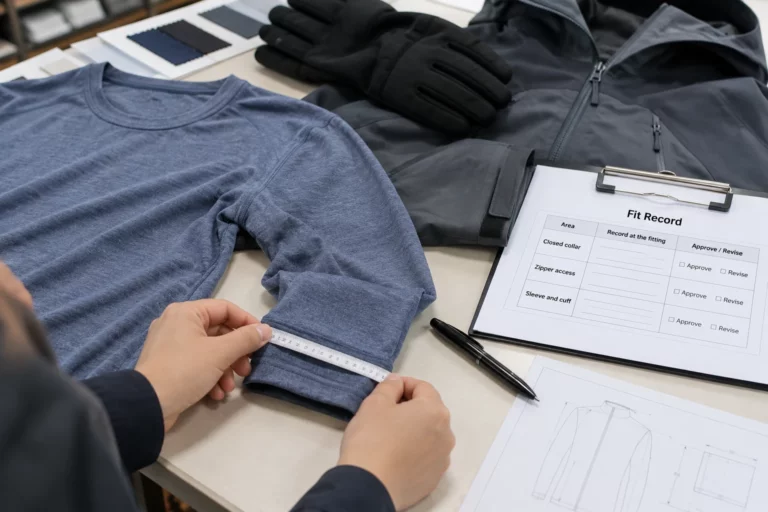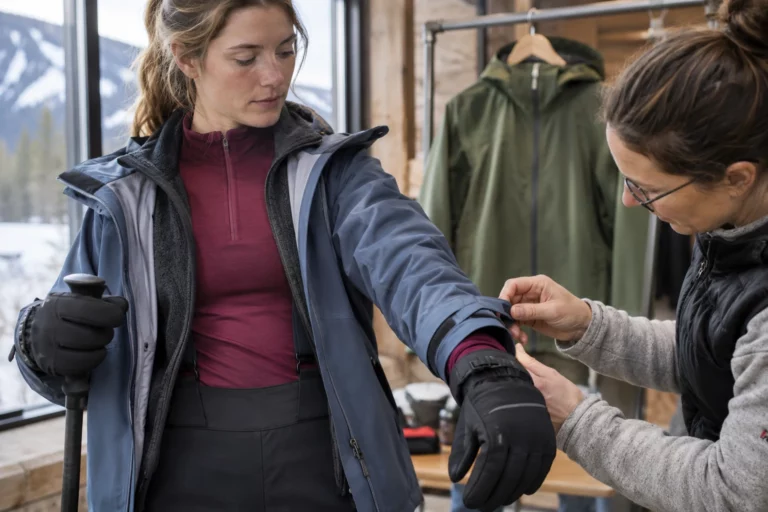


When specifying merino base layer collars and cuffs for hardshell jackets, approve the sample with the shell zipped and the intended gloves in place. The shell should close without pressing the inner zipper pull into the chin. If the base layer has a zip for venting, the wearer should be able to reach it with gloves once the shell is partly open. At the wrist, the base-layer sleeve should slide through the shell cuff and stay smooth when the tab is fastened. Each check gives the pattern team a specific place to look when a sample fails.
Collar & Cuff Layering-System Engineering Framework
A merino base layer should be specified against the complete clothing system. Collar height, zipper hardware, cuff depth, sleeve length, fabric thickness and elastic recovery interact with the hardshell, midlayer and gloves. Define the configuration → measure the garment → test closure and movement → diagnose interference → revise and retest → approve the size set and bulk specification.
Set the Shell and Glove Combination Before Fitting
Use the shell model and size intended for the collection. If the base layer will be paired with several shells, check which has the least room at the neck and which has the smallest usable cuff opening. They may be different jackets. Include the intended midlayer if its collar or sleeve ends overlap the same area. Record whether the glove goes inside the shell cuff or over it, since the two arrangements put different layers under the cuff closure.
Mark the normal tab position and note whether the hood is up or down. If both hood positions are part of the intended use, check both. A shell collar that clears the base-layer zipper with the hood down can sit differently once the hood is up and adjusted. Use the same closure settings when comparing two samples or checking a revision.
Layering Configuration & Traceability Matrix
| Test variable | Configuration A | Configuration B |
| Base layer | Style / size / revision | Same or documented alternative |
| Midlayer | Model / size / thickness | Model / size / thickness |
| Hardshell | Model / size | Model / size |
| Hood / shell zipper | Up/down; closed/partly open | Up/down; closed/partly open |
| Gloves / cuff tab | Inside/over; marked tab setting | Inside/over; marked tab setting |
| Tester / date | ID / body measurements / date | ID / body measurements / date |
A comparison is meaningful only when the clothing configuration, closure settings and sample revision are documented. The tightest collar, smallest cuff opening and hardest gloved zipper access may occur in different shell combinations; identify each worst-case configuration through actual fitting.
Fit the Collar Behind the Shell Zipper
With both zippers closed, ask the wearer to look down and turn their head. Check where the inner pull and top stop sit relative to the shell’s zipper guard. If the inner zipper feels fine with the shell open and presses into the chin when the shell closes, mark the exact point of contact. A collar edge that folds inward calls for a different change from two zipper pulls stacked at center front.
Harvest SPF’s women’s merino quarter-zip top offers a collared reference for this fitting. If the program also permits a crew neck, use it as a reference to see how the shell closes without inner zipper hardware. For a zip style, capture finished collar height at center front and the position of the top stop from an agreed seam or other fixed point. If the zipper guard folds, document its finished shape and thickness at the point of contact before asking the supplier to change it.
Collar Technical Specification & Pressure Diagnosis
| Specification / symptom | Measurement or isolation check |
| Finished collar height / circumference | Defined center-front height and neck measurement location |
| Zipper top stop / guard | Position from fixed reference; guard width, shape and thickness |
| Seam / hardware contact | Mark precise contact point with shell fully closed |
| Chin pressure | Compare shell open vs. closed; inspect pull and top stop |
| Hood-dependent pressure | Compare hood up/down and adjustment |
| Midlayer-dependent pressure | Repeat with/without specified midlayer |
Collar height alone does not establish hardware clearance. Before changing the neckline, identify whether pressure comes from the base layer, midlayer, shell or their interaction. Record look-down, left/right head-turn and hood-position results. Suggested internal severity scale: 1=no pressure; 2=minor contact; 3=noticeable; 4=repeated discomfort; 5=unacceptable. This is a subjective fit score, not an instrumented pressure test.
Gloved Zipper Accessibility & Pull Design
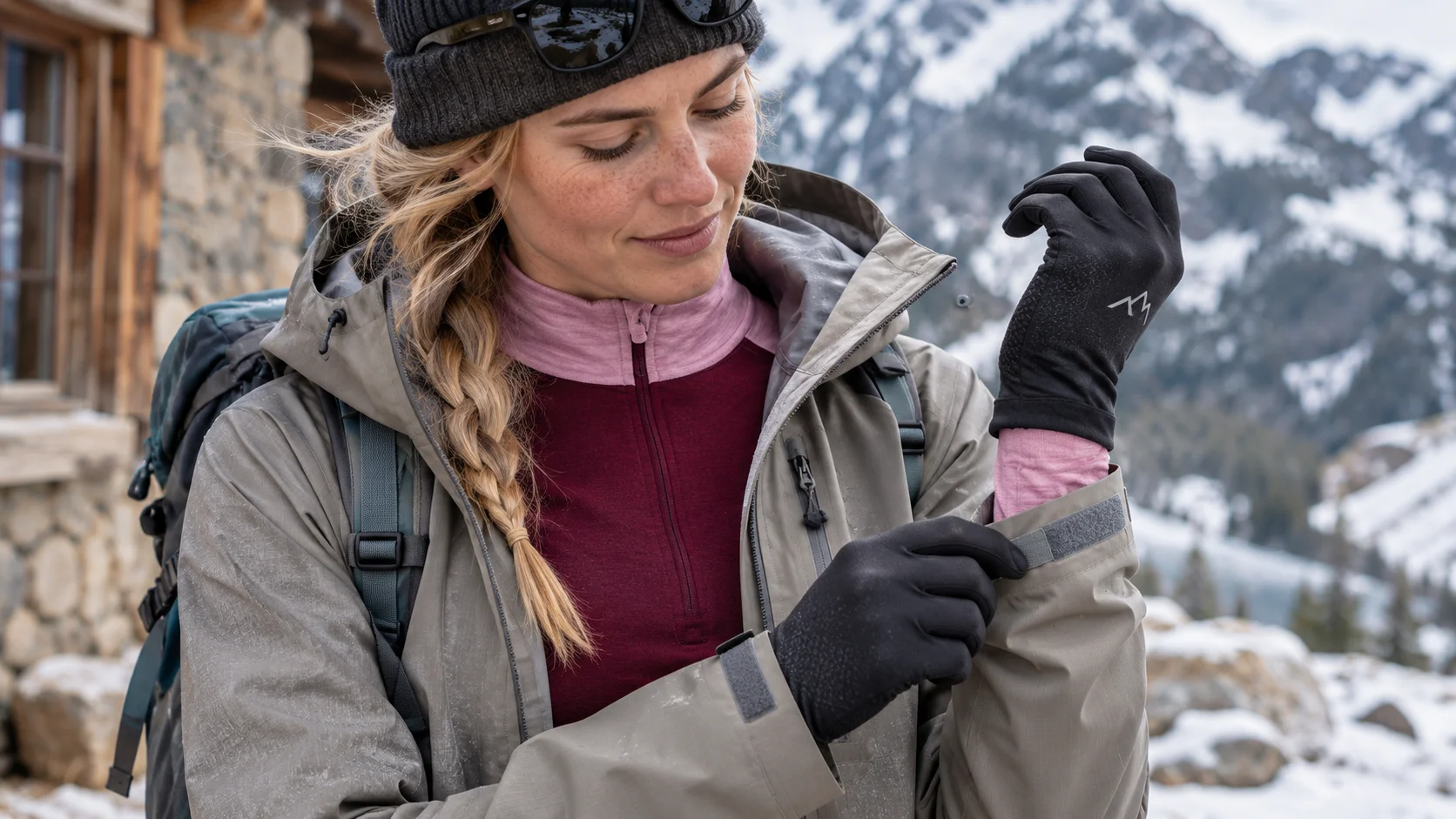
Put on the specified gloves, open the shell to the position the wearer would use for venting, and try to locate and move the inner pull. Check whether the wearer can open it to the intended position and close it again. If the pull hides behind the shell placket, photograph its position with the shell partly open. If it is visible but difficult to grasp, review pull shape and size. Recheck the new pull with both layers closed so the change also clears the chin.
| Check | Record |
| Pull visibility / reach | Visible or hidden; reachable or obstructed |
| Grip and operation | Successful openings and closings / total attempts |
| Snagging | Yes / no; exact location |
| Pull design | Length, shape, grip surface, cord/tab, weight and bulk |
| Closed-shell clearance | Chin contact after the proposed change |
Operation success rate (%) = successful attempts ÷ total attempts × 100. For example, 8 of 10 attempts = 80%; this is illustrative, not a universal acceptance threshold. Use the intended gloves and shell opening. A larger pull may improve grip yet increase chin pressure, so recheck both functions after revision.
Match the Base-Layer Cuff to the Shell Opening
Start with the shell cuff open. Have the wearer put on the shell without holding the base-layer sleeve at the wrist. Mark where the inner cuff sits before and after donning. If the sleeve comes up the forearm before the tab closes, check where it catches inside the shell sleeve. If it moves freely until the tab is fastened, inspect the overlap between the inner cuff edge, the outer tab, and any glove material sitting underneath.
Harvest SPF’s men’s merino long-sleeve top gives buyers a crew-neck reference for observing how a sleeve sits at the wrist. With the shell cuff fastened, have the wearer bend the elbow and flex the wrist. Check whether the inner cuff doubles over or needs to be pulled flat by hand. A fold directly under the tab is a reason to review cuff depth or where the seam lands. If the inner cuff retracts when the arm bends, review sleeve length and check for drag farther up the shell sleeve before changing the cuff opening.
Cuff Construction & Interface Comparison
| Cuff construction | Potential benefit | Main fit risk |
| Self-fabric | Consistent appearance | Bulk / recovery |
| Rib knit | Stretch and retention | Thickness / compression |
| Folded | Clean edge | Double-layer bulk |
| Bound | Controlled edge | Local stiffness |
| Thumbhole | Hand coverage | Glove interference |
Inspect cuff thickness and seam bulk at the actual shell-tab closure, with the intended glove overlap. Record tab setting, folding and perceived pressure. Subjective comfort is not an objective pressure measurement. Cuff construction should be chosen for the complete shell-and-glove interface, not wrist tightness alone.
Cuff Measurement & Dynamic Sleeve Migration
Record the relaxed cuff opening and finished cuff depth. Agree on whether the opening is recorded as a flat width or a circumference, and where the factory places the tape. For a folded cuff, mark which edge contacts the shell closure. If a revised sample changes the knit, binding, or seam, repeat the closed-cuff fitting. A cuff can match the width on the measurement sheet and still feel bulkier where the layers overlap.
| Control point | Required definition / observation |
| Cuff opening | Relaxed flat width or circumference; fixed tape location |
| Cuff depth / thickness | Finished dimensions and specified measurement location |
| Seam position | Position relative to shell tab and glove overlap |
| Sleeve length | Approved point of measurement (POM) |
| Extension / recovery | Agreed test conditions and residual change |
| Sleeve migration | Position after movement minus initial position, with signed direction defined |
Measure initial wrist coverage, after donning, after cuff-tab closure, after elbow/wrist flexion and after overhead reach. Record displacement (cm), fold occurrences and manual adjustments. Use the same tester, shell size, glove model, tab setting, repetitions and hold duration. Flat cuff width × 2 is only a geometric approximation of relaxed circumference under consistent measurement definitions; it is not the worn circumference.
Give the Supplier a Fit Record They Can Reproduce
Write one row for each issue and size pairing. Use the actual shell and base-layer sizes, even when their labels differ. When a size boundary changes the pairing used by the customer, include that combination in the approval plan. A fit record for an early sample might look like this.
| Area | Record at the fitting | What to approve or revise |
| Closed collar | Shell model and size, base-layer size and revision, hood position, and location of any chin contact | Shell closes fully and the wearer can look down and turn their head without pressure from the inner hardware |
| Zipper access | Glove model, shell opening position, and where the inner pull sits relative to the placket | Wearer can operate the inner zipper with the specified gloves at the intended shell opening |
| Sleeve and cuff | Tab position, glove overlap, inner cuff position before and after donning, and location of any fold | Inner cuff lies flat and stays within the agreed wrist-coverage range after donning and wrist flexion |
If a cuff pulls back during an overhead reach, check whether the whole top rides up or the shell binds at the shoulder. Keep that observation with the cuff issue so the supplier can trace the cause. If care could change a dimension the team relies on, repeat the affected collar or cuff check after the specified wash and dry cycle.
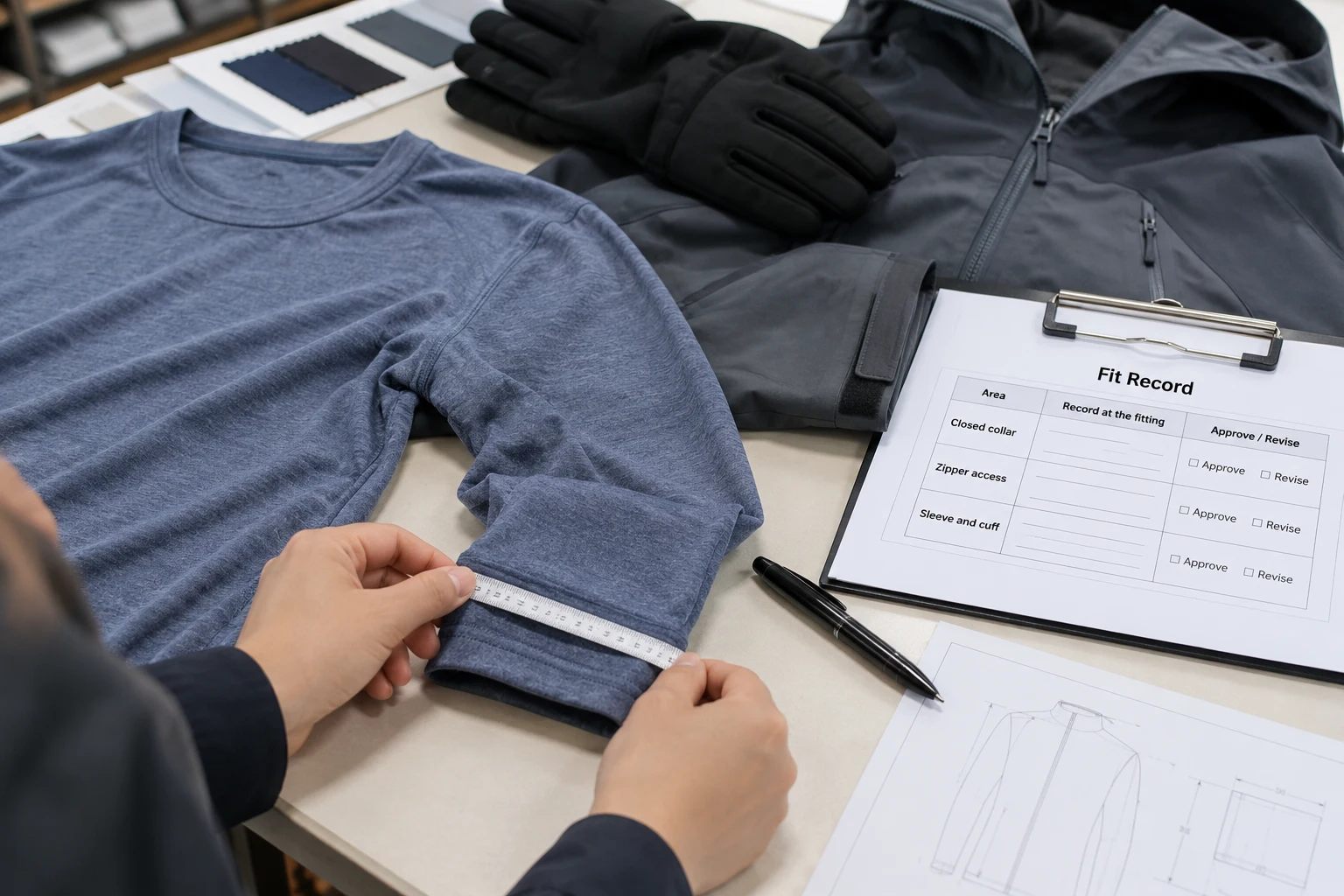
Use the Harvest SPF merino wool base layer range to identify reference styles for the request. Attach a marked photo and ask the supplier to confirm the measurement point, proposed dimension and tolerance, and the shell-size pairing for the next fitting.
Quantitative Fit-Test Record (Illustrative)
| Metric | Sample R01 | Sample R02 |
| Collar discomfort severity (1–5) | 4 | 2 |
| Gloved zipper operation success | 70% | 100% |
| Cuff migration | 3.0 cm | 1.0 cm |
| Cuff folding events | 4 | 0 |
| Manual adjustments | 3 | 0 |
| Status | Revise | Pending final approval |
Illustrative values only; buyers must set project-specific pass/fail criteria. Root-cause checks: chin contact → pull/top stop; inaccessible pull → placket overlap/pull geometry; cuff catching during donning → sleeve-shell friction; fold under tab → cuff depth/seam bulk; sleeve retraction → sleeve length/shoulder mobility; after-wash failure → dimensional stability.
Revision, Size-Set, Wash & Pre-Bulk Approval Controls
Revision workflow: document the failure → identify a plausible cause → define a controlled change → issue revised sample → retest the original failure → check for new interference → approve or revise again. Every zipper change requires both closed-shell chin-clearance and gloved-access retests; every cuff change requires both donning and movement retests. Recheck other previously approved shells if a shared construction feature changes.
| Approval control | Required evidence |
| Size-set / boundary pairings | Representative base-layer and shell sizes; different arm/neck proportions as relevant |
| After-wash fit | Collar height/shape, sleeve length, cuff opening/recovery, affected access tests |
| Critical-to-quality POMs | Collar height, top-stop location, guard, pull type, cuff opening/depth, sleeve length, seam position |
| Materials and construction | Approved merino fabric/rib, thickness and seam construction |
| Release decision | Approve / Revise / Retest / Hold |
Fit-sample approval is not automatic bulk-production authorization. Confirm approved tolerances, material specifications, construction, wash criteria and inspection plan. Any change to zipper hardware, cuff knit, seam placement, fabric thickness, sleeve pattern or approved shell pairing requires documented impact review and appropriate retesting.
How Harvest SPF Supports Merino Collar & Cuff Development
Harvest SPF can support or coordinate merino fabric selection (micron, GSM, knit and blends), collar and zipper construction review, cuff engineering, hardshell-and-glove compatibility fitting, controlled sample revisions, representative size-set validation and bulk specification control, according to the agreed project scope.
Conclusion
Approve the collar and cuffs against the shell and gloves the wearer will use. The most useful fit record shows where contact or displacement occurs, which closure setting produces it, and what finished measurement the supplier should review. Check the revised sample in that same configuration before signing off.
FAQs
How should buyers measure quarter-zip collar height?
Use a defined center-front finished-garment reference and record the zipper top stop separately.
How can buyers test a zipper with ski gloves?
Check visibility, reach, grip, opening/closing and snagging using the intended gloves and shell opening.
Should cuffs be tight under a hardshell?
They should provide intended wrist fit without unacceptable bulk, pressure, folding or migration.
Does a thicker cuff always create more pressure?
Not necessarily; compressibility, seam placement, tab setting and glove overlap also matter.
Should collars and cuffs be retested after washing?
Yes, where dimensional or structural change could affect clearance, coverage or zipper access.
Does a crew neck need the same collar check as a quarter-zip?
Check it with the shell fully closed. A crew neck removes the inner pull from the fitting, but the neckline binding can still fold or rub if it sits against the shell collar. The glove-access check applies to styles with an inner zipper.
Should a cuff that bunches be made wider?
First check when the fold appears. If it forms directly under the shell tab, review cuff depth and seam position. If the cuff catches as the wearer puts on the shell, locate the catch point before asking for a width change.
Which size combinations should be checked after a revision?
Retest the pairing that exposed the problem and any planned pairing that uses the revised collar or cuff dimensions near a size boundary. Keep the shell closure and glove setup consistent with the original check.
Request a Collar and Cuff Fit Review for Your Hardshell Program
Before approving your merino base layer sample, request a collar and cuff fit review from Harvest SPF.
Use the review to confirm which dimensions the supplier should revise for the next sample, such as finished collar height, zipper stop position, cuff opening, or cuff depth.
Buyer Submission Checklist
Submit:
- Base-layer tech pack
- Merino composition/GSM
- Collar height and zipper details
- Cuff opening/depth and sleeve length
- Hardshell model/size
- Midlayer and glove configuration
- Hood and tab settings
- Fit-issue photos
- Target size range
- Quantity
- Target FOB
- Delivery schedule
Harvest SPF can review technical dimensions, hardware suitability, sample revision scope, size-set testing and bulk QC requirements.
Review My Merino Collar & Cuff Project.