

Seasonal color approval for activewear OEM works best when color is treated as a controlled production specification, not a screenshot or one-time sample decision. A lab dip can look right yet produce a different bulk shade when fiber, construction, dyeing, finishing, or lighting changes. The safeguard is a documented standard, repeatable approval method, and production release that links every dye lot to the approved reference.
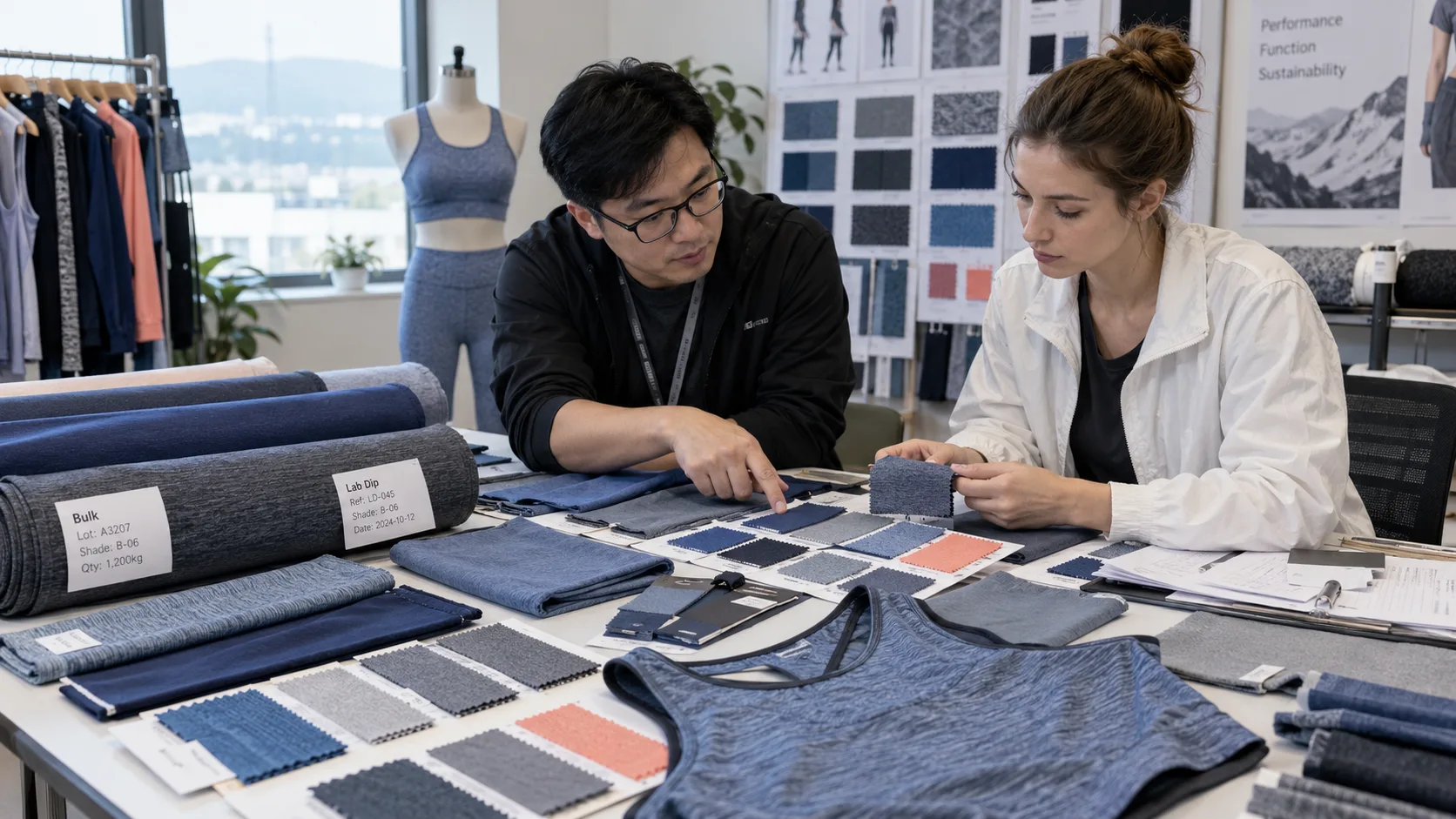
Color Approval Is a Chain, Not a Single Sign-Off
Color Brief → Master Standard → Production-Equivalent Lab Dip → Visual & Instrumental Approval → Bulk Dye Lot → Bulk Yardage Approval → Cutting Lot Control → Finished Garment Review → Shipment Release
A lab dip approval authorizes a target shade. It does not automatically approve every future bulk dye lot.
Why a seasonal color can change between lab dip and bulk
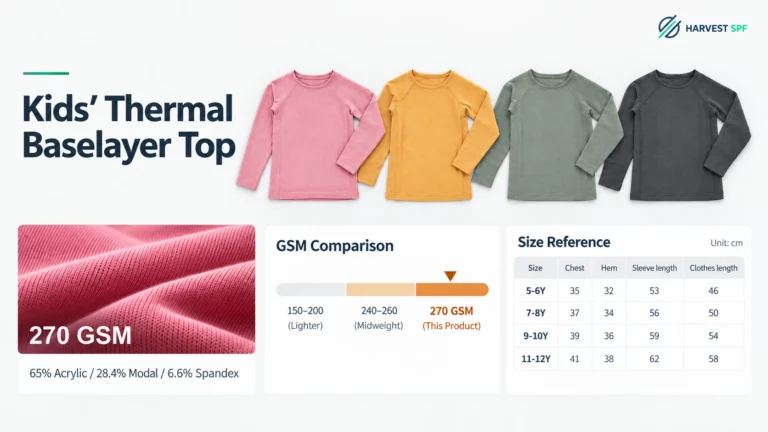
Lab dips are small fabric trials made to approximate a target shade before production. Bulk dyeing uses different fabric weight, machine geometry, liquor ratio, heat profile, and drying conditions. These variables affect dye penetration and surface reflection. Stretch activewear adds another layer: nylon, polyester, elastane, recycled fibers, brushed surfaces, and high-stretch constructions may not absorb or reflect color in the same way.
The approved appearance also depends on the reference. A Pantone or physical swatch, digital value, and garment photograph are not interchangeable. A monitor is emissive while fabric is reflective, and different lights can reveal metamerism: a match under one source but not another.
For buyers, the key question is not “Does this sample look close?” It is “Which reference, material, light, and tolerance define an acceptable match?”
Define the Color Reference Hierarchy
| Reference Level | Purpose |
| Level 1 — Master Physical Standard | Primary decision reference for the target seasonal color. |
| Level 2 — Approved Lab Dip | Production reference showing the target on the specified fabric and finish. |
| Level 3 — Approved Bulk Yardage | Verification that actual bulk dyeing is commercially acceptable. |
| Level 4 — Finished Garment Reference | Confirms appearance after garment construction and adjacent-material interaction. |
| Digital Image / Screenshot | Communication support only; not the final approval reference. |
Build one color standard before sampling
Start each seasonal palette with a controlled master standard. Record the color name and code, physical standard source and date, fabric composition, construction, weight, finish, and intended end use. If the color is shared across styles, identify whether one standard applies or each fabric needs a separate standard.
Create a Color Master Record
| Field | Required Information |
| Seasonal Color Name | Buyer-defined name/code |
| Master Reference | Physical standard / approved reference |
| Fabric | Composition and construction |
| GSM | Approved target |
| Finish | Brushed / peached / heat-set / other |
| Light Source | Buyer-defined viewing condition |
| Instrument Method | If required |
| Tolerance | Buyer-defined acceptance criteria |
| Approved Lab Dip | Revision/status |
| Approval | Date and authorized approver |
| Bulk Lot Rule | Same-lot / shade grouping / traceability rule |
The tech pack should state viewing conditions and approval authority. A practical protocol includes:
- Inspecting the standard and lab dip side by side, with fabric faces oriented the same way.
- Using a consistent light box or agreed daylight condition, plus a second light source for metamerism.
- Viewing dry, relaxed fabric after the expected production finishing route.
- Defining instrumental tolerance, such as a Delta E limit, only after agreeing on the instrument and measurement method.
- Keeping a signed or digitally locked master swatch under revision control.
Color science supports, but does not replace, visual judgment; surface texture and adjacent colors can make a numerical pass look wrong.
Why a Pantone Code Is Not a Complete Fabric Color Specification
A Pantone reference can define the target color direction, but the approved fabric standard should define the acceptable appearance on the actual textile construction. Fiber, yarn, knit structure, GSM, surface texture, finishing and lighting can all affect perceived color.
One Seasonal Color May Require Multiple Material Approvals
When a seasonal color is shared across leggings, sports bras, mesh, binding, elastic or lining, each materially different substrate may require its own approval against the master standard. The objective is a commercially coordinated appearance, not an unsupported assumption that different materials will produce identical readings or appearance.
Control Metamerism With Agreed Lighting
Define a primary approval light and a secondary light source for metamerism review. Samples should be compared under the same controlled conditions rather than mixing daylight, office lighting and screen images.
Delta E Is Not a Universal Pass/Fail Number
A Delta E value is meaningful only when the instrument, measurement geometry, illuminant/observer, calculation method, sample preparation and buyer acceptance criteria are defined consistently.
Use Visual and Instrumental Approval Together
Instrumental review asks whether measured color difference is within the agreed tolerance. Visual review asks whether the fabric is commercially acceptable under agreed lighting and in the actual construction. Where both are required, both should support the release decision.
Make the lab dip approval process representative
Send the dye house complete information: target standard, fiber blend, construction, GSM, finish, usable width, and shade range. Request the dip on the same or technically equivalent base fabric, with comparable brushing, peaching, sueding, or heat setting before review.
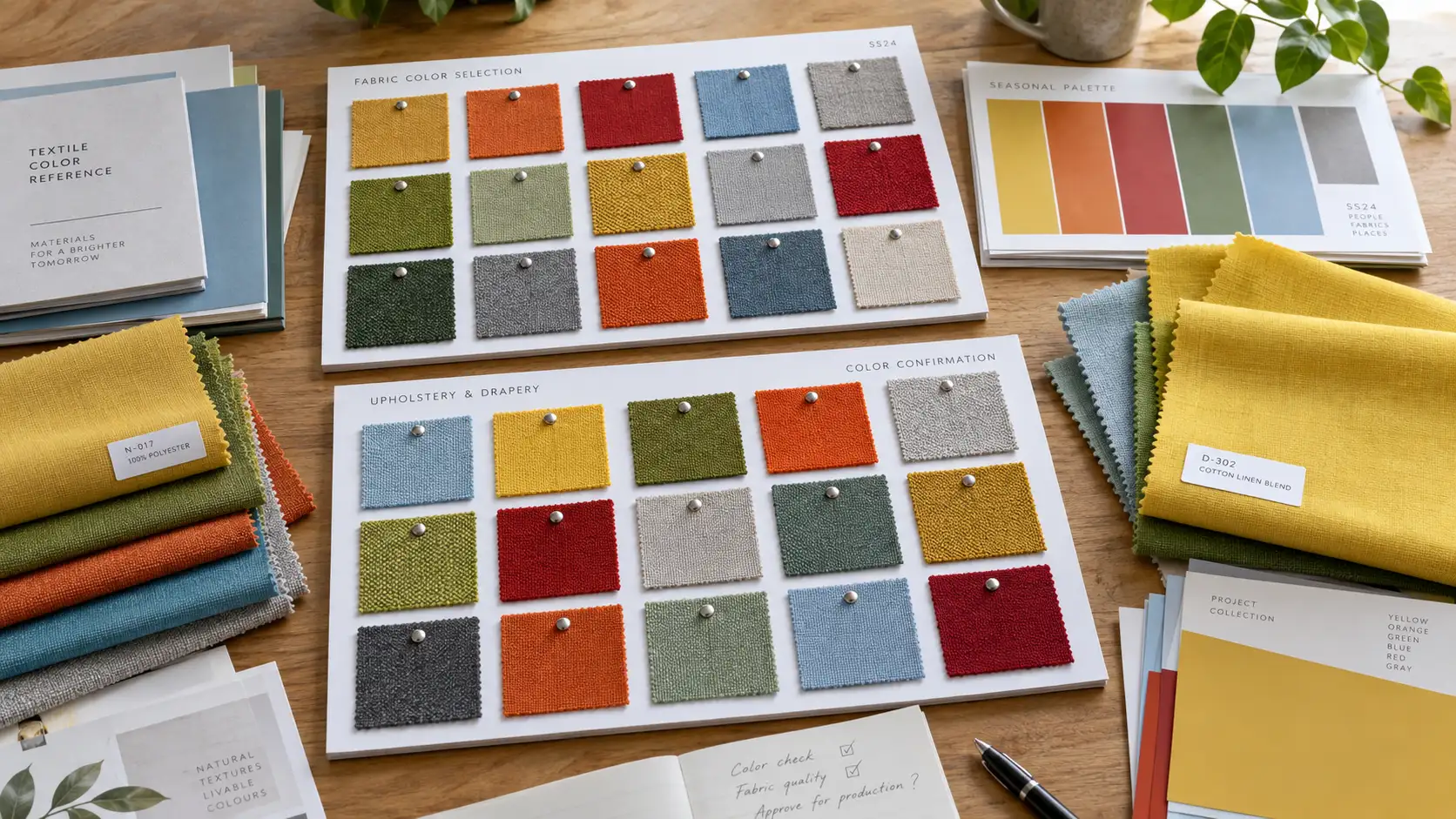
The first submission is a learning sample, not automatically a production sign-off. Compare it under agreed lights, note whether it is too red, green, yellow, blue, light, or dark, and return directional comments rather than “make it closer.” Photographs can support communication, but the physical standard remains the decision reference.
Keep revisions traceable. Label each dip with date, recipe or batch identifier when available, fabric details, and status. Record any commercial tolerance so an older approved piece cannot be used after the target changes.
The CottonWorks lab dip process guide describes lab dipping as the first step in developing and approving a product color; the same logic applies to performance fabrics when the substrate and finish are controlled.
Use Controlled Lab Dip Submissions
Where appropriate, request clearly identified options such as A, B and C on the same substrate and finish. The buyer can approve one option or give directional feedback against the closest option, reducing ambiguous resubmission cycles.
Use Directional Color Comments
Replace subjective comments such as “make it closer” with controlled direction: too red/green, too yellow/blue, too light/dark, or too saturated/muted, always against the approved reference.
Define Lab Dip Approval Status
Use clear status language such as Approved, Approved as Reference, Rejected—Resubmit, or Conditional/Commercially Accepted. Any commercial acceptance should record who approved it, what deviation was accepted, and whether it authorizes bulk production.
Production-Equivalent Substrate Matters
A lab dip on a different substrate may be useful for color direction, but it should not automatically be treated as final production approval.
Check Color Under Intended Stretch Where Relevant
For high-stretch leggings, sports bras and compression garments, evaluate relaxed appearance and, where relevant, appearance under intended stretch. Stretch can change apparent shade and opacity, but the stretch-state review should be defined separately from the lab-dip shade standard.
Separate Shade Approval From Colorfastness Performance
For high-sweat products, dark colors or contrast panels, wash, perspiration, wet appearance or color-transfer checks may be appropriate. These are performance/colorfastness controls and should not be confused with shade approval itself.
Connect approval to bulk production controls
Approval ends only when the bulk-control plan is agreed. Before dyeing, confirm the nominated fabric lot, greige source, recipe version, machine route, finishing sequence, and shade grouping method. If a color will run across several lots, define whether lots can be mixed, whether panels must come from the same lot, and how light, medium, and dark groups will be separated.
Request bulk approval yardage before cutting when the color is business-critical. Inspect it against the master and approved dip, then check complete garments because stretch, seam direction, lining, heat transfers, and adjacent colors can change appearance. Add wash or perspiration checks when required by the product claim, with conditions agreed in advance.
Bulk Shade Approval Gate Before Cutting
Bulk Dye Lot → Finished Bulk Yardage Sample → Compare With Master Standard + Approved Lab Dip → Visual Review + Instrumental Review When Required → PASS / CONDITIONAL / HOLD → Cutting Release
Obtain a representative sample from each bulk dye lot after the specified finishing process and before garment cutting. Compare the sample with the master physical standard and approved lab dip under the agreed lighting conditions. Use instrumental measurement when required by the buyer’s specification or agreed test plan.
Record each lot as PASS, CONDITIONAL or HOLD. PASS authorizes the identified dye lot for cutting. CONDITIONAL requires written buyer authorization that identifies the accepted deviation, affected lot and permitted use. HOLD prohibits cutting until the lot is corrected, replaced or otherwise dispositioned. Do not begin cutting before this decision is recorded, because the commercial cost of resolving a shade problem increases substantially after the fabric has been cut.
After release, retain a cutting from each approved dye lot and record the dye-lot and roll numbers on the cutting documents. Inspect cut panels under the agreed approval light before assembly. Keep any fabric, panels or finished garments outside the approved tolerance segregated until a documented disposition is issued.
Build Dye-Lot and Roll Traceability
Map Dye Lot → Roll → Cutting Batch → Garment Batch → Carton. Where shade groups are used, cutting controls should prevent visibly different groups from being combined within the same garment unless specifically approved.
Control Color Across Matching Activewear Sets
Sports bras and leggings may share one seasonal color but use different GSM, construction, elastane levels or dye lots. Define whether the requirement is an exact material match or a commercially coordinated match, and review top and bottom side by side at PP and bulk stages.
Review Adjacent and Contrast Colors
Color-blocked garments, contrast mesh, binding and heat transfers should be reviewed together. Individually acceptable components can still create perceived mismatch, migration, staining or contrast problems when assembled.
Common causes of lab dip-to-bulk shade problems
Most failures come from a broken link between the approved sample and production:
- Substrate mismatch.The dip uses a different fiber ratio, yarn, knit density, or finish.
- Process drift.Temperature, pH, dosing, time, water quality, or loading changes dye uptake.
- Scale-up behavior.Lab circulation and heat uniformity differ from production equipment.
- Finishing or reference differences.Surface treatment or an old or digital reference changes the perceived match.
- Lot mixing and lighting.Unsorted rolls or different light sources expose shade boundaries and metamerism.
Treat each cause as a checkpoint in the corrective-action report. Re-dyeing without identifying the broken control often repeats the problem.
Use a Root-Cause Matrix Before Corrective Action
| Observed Issue | Possible Cause | Check First |
| Bulk darker/lighter than dip | Recipe or process difference | Recipe, dyeing and finishing records |
| Panel mismatch | Lot/shade-group mixing | Roll and cutting records |
| Matches in one light only | Metamerism | Agreed light sources |
| Brushed fabric looks different | Surface/finish change | Finishing route |
| Legging looks lighter when worn | Stretch/opacity interaction | Construction and stretch-state review |
Diagnose before re-dyeing: verify the current standard, substrate, recipe/process, finishing, measurement/light conditions and lot handling before selecting corrective action.
Choose an OEM partner that can carry the color record
An activewear OEM should explain who owns color decisions, where standards are stored, and how revisions move from design to dyeing, cutting, and final inspection. Ask for evidence of a repeatable workflow rather than a promise of perfect matching.
Useful questions include:
- Can the team develop or recommend fabric while preserving the target shade?
- Will dips be reviewed on the final construction and finish with agreed light and tolerance?
- How are dye lots identified, grouped, and traced to finished cartons?
- What is the escalation path when bulk yardage is outside tolerance?
Harvest SPF’s activewear OEM/ODM service presents design, tech-pack, fabric selection, color development, sampling, and quality-control stages in one workflow. Its ODM/OEM production process also describes sending fabric lab dips for confirmation before mass production. These capabilities are useful starting points, but the exact test method, tolerance, and lot-control plan should still be written into each purchase specification.
For material decisions, pair color approval with the performance requirements in the activewear fabric sourcing guide. A color that matches on a sample is not enough if stretch recovery, opacity, pilling, moisture management, or care performance changes when the base fabric changes.
Evaluate OEM Color-Control Capability
| Capability | Evidence to Ask For |
| Color standard control | Current master record |
| Lab dip tracking | Submission/revision history |
| Instrumental measurement | Defined method/report where required |
| Bulk shade control | Bulk yardage approval record |
| Lot management | Dye-lot and roll record |
| Cutting control | Lot/shade-group mapping |
| Garment inspection | Approved reference and QC record |
| Escalation | Nonconformance / corrective-action process |
How Harvest SPF Supports Activewear Color Control
Harvest SPF can support color-standard review, fabric/construction alignment, lab-dip coordination, color revision control, bulk-yardage review, dye-lot traceability, matching-set review and final garment color inspection. Project-specific tolerances, test methods and approval authority should still be written into the purchase specification.
A practical release checklist for seasonal colors
Seasonal Color Bulk Release Checklist
| Control | Status | Evidence |
| Master standard current | Ready / Open | Approved reference |
| Fabric substrate locked | Ready / Open | Fabric specification |
| Lab dip approved | Ready / Open | Approved dip / revision |
| Viewing condition defined | Ready / Open | Color specification |
| Instrument method defined, if required | Ready / Open | Measurement record |
| Bulk yardage reviewed where risk warrants | Ready / Open | Bulk cutting / approval |
| Dye lots and shade groups controlled | Ready / Open | Lot/roll map |
| Matching set reviewed where applicable | Ready / Open | Garment approval |
| Cutting lot controlled | Ready / Open | Cutting record |
| Final garment shade checked | Ready / Open | QC record |
COLOR RELEASE = GO only when critical color controls are closed. Otherwise, HOLD or document an authorized conditional release.
Before authorizing cutting, the buyer and OEM should have the same answers:
- Is there one current master standard with revision and approval date?
- Does the approved dip use production-equivalent fabric and finish?
- Were visual and instrumental checks and tolerances recorded under agreed conditions?
- Is bulk yardage approved before cutting when risk warrants it?
- Are dye lots, shade groups, and carton records traceable, with a quarantine process?
If any answer is unclear, the color is not fully released.
Control Color Revisions and Approval Authority
Any change to the target color creates a new controlled revision. When the master target changes from Rev. A to Rev. B, earlier approvals should be marked obsolete and should not remain active for production. Multiple stakeholders may review color, but one final approval authority should be identified with approval date, revision and status.
Conclusion
Seasonal color approval for activewear OEM is a chain of evidence from target standard to lab dip, bulk yardage, dye-lot grouping, and finished-garment inspection. Control the substrate, light, measurement method, revision history, and production traceability, and shade problems become diagnosable before they become a costly shipment issue. Harvest SPF can use this information to assess the color-development and production controls required for a buyer’s collection.
FAQs
What is a lab dip in apparel production?
A lab dip is a small dyed fabric sample made to approximate and obtain approval for a target color before bulk dyeing. It should represent the production substrate and finish.
Why can bulk fabric look different from an approved lab dip?
Scale-up changes fabric lot, machine conditions, dye concentration, heat, circulation, finishing, and drying. Lighting and surface texture can also change the perceived shade.
Should brands approve color by photo?
Photos support communication but should not replace a physical master standard and controlled review.
How can a buyer reduce shade variation across dye lots?
Lock the standard and recipe, identify each lot, retain cuttings, group rolls by shade, inspect under consistent lighting, and define a documented disposition for nonconforming goods.
What should an OEM color specification include?
Include the color reference, fabric composition and construction, finish, viewing light, measurement method, tolerance, approval authority, lot-traceability fields, and escalation process.
Is a Pantone color enough for activewear bulk production?
No. It can define a target direction, but it does not replace approval on the actual fabric, construction and finish.
Does an approved lab dip guarantee the bulk shade will match?
No. The lab dip establishes an approved target reproduction; bulk production still requires controlled dyeing, lot management and risk-based bulk shade approval.
What is the difference between a lab dip and bulk shade approval?
A lab dip supports development and target approval on a representative substrate. Bulk shade approval verifies the actual production material before or during production release.
Why can matching activewear sets look different even with the same color code?
Different fibers, GSM, knit structures, finishes, elastane levels and stretch can change appearance, so matching sets may require cross-fabric and garment-level review.
Get an Activewear Color Risk & Bulk Approval Review
For a focused review, provide the seasonal color standard, fabric composition/construction/GSM, style or matching-set information, finish, quantity by color, any existing lab dip, defined tolerance if available, and required delivery date. Harvest SPF can review substrate risk, cross-fabric color risk, lab-dip requirements, bulk shade approval, dye-lot control, matching-set control and production traceability.
Review My Activewear Color Program.