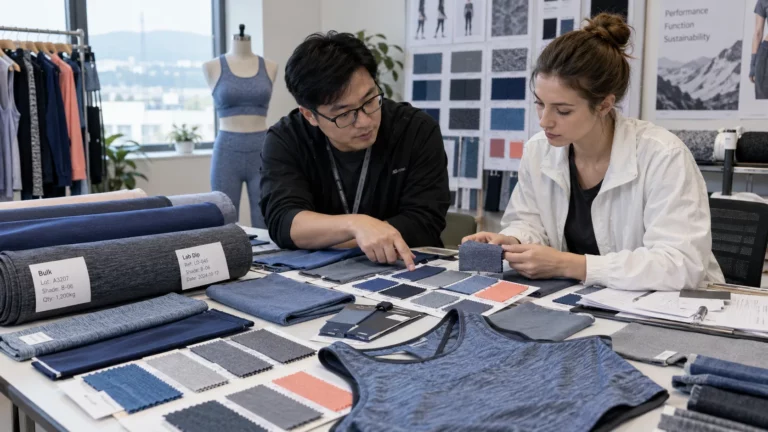

Thermal underwear MOQ planning becomes more complex when one order includes multiple styles, colors and sizes. A 1,000-piece program may contain dozens of SKUs, while fabric MOQ, color MOQ, yarn MOQ and production-method requirements can create minimum quantities far above the planned garment volume. Effective purchasing therefore depends on identifying which MOQ actually controls each SKU before finalizing the assortment.
Advertised MOQ vs. Effective MOQ
The advertised garment MOQ is not necessarily the quantity a brand must actually buy. Effective MOQ is the minimum commercially viable purchasing commitment created by the most restrictive material, color, construction, or SKU-level requirement.
A practical planning rule is: Effective MOQ = the highest binding production constraint. For example, if garment MOQ is 500 pieces, fabric MOQ is equivalent to 800 garments, color requirements imply 900 garments, and a custom yarn MOQ is equivalent to 1,200 garments, the material program may create an effective purchasing exposure closer to 1,200 garments.
Why Thermal Underwear MOQ Is Not One Number
Finished-Garment MOQ Is Only the First Layer
A quoted garment MOQ may apply per order, per style, per color or to another defined production unit. These structures create very different purchasing commitments. Industry sourcing references consistently distinguish style MOQ, colorway minimums and fabric-level minimums, meaning a headline quantity should never be treated as sufficient information for SKU planning.
A clothing manufacturer MOQ is therefore best represented as a hierarchy:
| MOQ Layer | Typical Production Driver | Procurement Impact |
| Style MOQ | Cutting, sewing and line setup | Limits style breadth |
| Color MOQ | Dye lots and color setup | Limits color breadth |
| Fabric MOQ | Knitting, dyeing and finishing | May exceed garment demand |
| Yarn MOQ | Custom spinning, fiber blends or yarn dyeing | Raises minimums for proprietary materials |
| Size MOQ | Cutting efficiency or knitting setup | Limits size flexibility |
| Seamless MOQ | Machine programming and size-specific production | Can multiply minimums across SKUs |
Do Not Ignore Trim and Packaging MOQ
| MOQ Layer | Typical Production Driver | Procurement Impact |
| Trim MOQ | Custom elastic, heat transfers, woven labels, zippers or logo components | Can create surplus components even when garment MOQ is met |
| Packaging MOQ | Printed polybags, retail boxes, hangtags or inserts | May exceed the first garment order and create separate inventory exposure |
Fabric and Color MOQ Can Become the Binding Constraint
Custom colors normally require lab dips, bulk dyeing and shade control. Because textile coloration is processed in batches, one color can require its own production lot even when several colors use the same fabric construction. Dye-lot separation also matters because independently dyed batches may show shade variation.
This means a factory may technically accept 500 finished garments while the selected fabric mill cannot economically produce the required quantity of a custom shade. In that case, the effective MOQ is controlled upstream by the fabric or dyeing requirement rather than sewing capacity.
MOQ Does Not Always Equal Garment Order Quantity
Where the manufacturing agreement allows it, material MOQ and finished-garment purchase quantity can be managed separately. If a fabric or yarn minimum exceeds the material consumed by the first garment order, possible arrangements may include holding approved excess material for a repeat order, assigning material liability to the buyer, reallocating material across compatible SKUs, or converting more of the material into garments. The agreed treatment of surplus material should be confirmed before the purchase order.
How Fabric MOQ, Yarn MOQ and Style MOQ Interact
Stock Fabric Can Reduce the Effective Entry Quantity
Existing fabric programs usually remove part of the development burden because knitting and initial material setup have already occurred. Custom-developed fabric changes the calculation. A new composition, GSM, knit structure or finish can require dedicated knitting, dyeing and finishing runs.
Public OEM manufacturing information also shows that full-package development may need to begin with yarn spinning or fabric knitting when the required material is unavailable.
For OEM thermal underwear, material availability should therefore be confirmed before finalizing the number of styles and colors. A low garment MOQ has limited commercial value when a proprietary yarn blend creates surplus raw material that cannot be consumed by the planned order.
Shared Materials Create MOQ Leverage
SKU consolidation does not necessarily require reducing the number of garments offered. A stronger approach is to standardize upstream components.
For example, a long-sleeve thermal top and matching long john can share the same fabric construction and color palette. Fabric demand can then be aggregated across both styles, subject to mill and factory policies. Conversely, specifying different GSMs, fibers or custom finishes for each style fragments purchasing volume and makes each style responsible for clearing its own material minimum.
The sourcing objective is therefore not simply fewer SKUs. It is fewer independent production inputs per SKU.
Build a Shared Material Platform Across SKUs
Multi-SKU programs can often reduce MOQ fragmentation by developing several garments around a limited number of common material platforms. For example, men’s and women’s thermal tops and bottoms may share the same fiber composition, GSM, fabric construction and core colors where product requirements allow. The objective is not simply to reduce the number of SKUs, but to reduce the number of independent yarn, fabric, color and finishing inputs that each SKU must support.
A Practical Multi-SKU Thermal Underwear Allocation Scenario
Start With Style and Color Depth Before Size Depth
Consider an illustrative purchasing program of 1,200 garments containing two thermal underwear styles. Each style receives 600 units. Assume the supplier requires 600 pieces per style and a minimum of 200 pieces for each custom color.
A three-color assortment of 300, 180 and 120 units would fail because two colors fall below the color minimum. Increasing those colors to the required level would create unnecessary inventory.
A lower-risk alternative is two colors per style:
| Allocation Level | Core Color | Secondary Color | Style Total |
| Thermal Top | 400 | 200 | 600 |
| Thermal Bottom | 400 | 200 | 600 |
| Program Total | 800 | 400 | 1,200 |
The assortment still provides color choice, but the purchasing depth is concentrated in the color expected to carry the highest volume.
Example: Same 1,200 Units, Different SKU Risk
| Planning Structure | Styles | Colors | Sizes | Total SKUs | Average Units per SKU |
| More fragmented | 2 | 3 | 5 | 30 | 40 |
| More consolidated | 2 | 2 | 5 | 20 | 60 |
The average units-per-SKU figure is only a planning indicator, but it makes fragmentation visible. The consolidated structure gives the core and secondary colors greater purchasing depth without increasing the total 1,200-unit commitment.
Allocate Sizes With a Demand Curve, Not Equal Quantities
Apparel size curves translate expected demand into size-level purchasing quantities, and historical sales data can be used to establish the percentage mix rather than allocating identical quantities to every size.
If a five-size buying curve is 10% / 20% / 30% / 25% / 15%, the 400-unit core color becomes 40 / 80 / 120 / 100 / 60 units. The 200-unit secondary color becomes 20 / 40 / 60 / 50 / 30 units.
This creates 20 style-color-size SKUs across the two styles, but inventory investment remains weighted toward stronger sizes and the core color. Equal splitting would ignore expected demand and increase the probability of residual stock in slower size-color combinations.
Core and seasonal colors do not necessarily require the same size curve. Historical sales may show different size demand by color, gender, channel, or market. Where data is available, size curves should therefore be built from SKU-level sell-through rather than applied uniformly across the assortment.
Calculate SKU Count Before Finalizing the Assortment
SKU Count = Styles × Colors × Sizes. A program with 3 styles, 4 colors and 6 sizes contains 72 SKUs. If the total order is 3,600 units, the average is only 50 units per SKU. A large total purchase order is therefore not necessarily a production-efficient purchase order.
Use SKU Density as a Simple Internal Planning Metric
SKU Density = Total Units ÷ Total SKUs. This is not an industry standard; it is a simple internal planning metric that can help merchandising and sourcing teams compare how fragmented different assortment options are.
Classify Core, Seasonal and Test SKUs
- Core SKUs: proven styles and core colors that justify deeper inventory.
- Seasonal SKUs: fashion or seasonal colors with more controlled depth.
- Test SKUs: new styles or colors where the brand wants limited initial exposure.
Where possible, Core, Seasonal and Test SKUs can still share upstream material platforms so that assortment variety does not automatically create separate yarn and fabric minimums.
Why Seamless Knitting Changes MOQ Planning
Size-Level MOQ Works Differently in Cut-and-Sew and Seamless Programs
In conventional cut-and-sew production, multiple sizes can generally share the same approved fabric and production program, so size allocation may be more flexible within the style-color quantity. In seamless production, machine diameter, programming, yarn feeding and size-specific knitting requirements can create stronger size-level constraints. The exact MOQ basis should therefore be confirmed with the manufacturer rather than assumed to be identical across both production methods.
A useful planning formula for seamless programs is: purchasing exposure = MOQ basis per style-color-size × number of colors × number of sizes, where the supplier’s MOQ is defined at that level.
Seamless MOQ Can Apply at SKU Level
A thermal underwear manufacturer using conventional cut-and-sew production may allow multiple sizes to share one fabric and cutting run. Seamless manufacturing follows another production logic because garments are knitted directly from yarn and require machine programming.
Published research on seamless circular knitting shows that different machine diameters can be used for different garment sizes and that changes in stitch construction and knitting density affect sizing and fit.
This explains why seamless knitting MOQ requires special attention. Some published OEM policies quote seamless production per style, color and size rather than only per style. One documented policy states a 500-piece minimum at each style-color-size combination. Under that particular structure, one style offered in two colors and five sizes could imply 5,000 units rather than 500. That figure is supplier-specific rather than an industry-wide benchmark, but it demonstrates why the MOQ basis must be confirmed before merchandising approval.
How Procurement Teams Can Reduce Overbuying
Build the MOQ Matrix Before Issuing the Final PO
MOQ analysis should happen before final assortment approval. A sourcing matrix can record the garment minimum, fabric construction minimum, minimum color quantity, custom-yarn requirement, size restrictions, trim minimums and seamless production rules.
The binding constraint is the requirement that produces the highest unavoidable commitment. If color MOQ forces 1,200 pieces while sewing requires only 600, purchasing calculations should be based on 1,200.
Find the Binding MOQ Before Issuing the PO
| Constraint | Illustrative Minimum | Planning Effect |
| Sewing MOQ | 600 garments | Sets the garment production floor |
| Fabric MOQ | Equivalent to 850 garments | Creates excess material if garment demand is lower |
| Color MOQ | Equivalent to 1,000 garments | May force greater depth or fewer colors |
| Custom yarn MOQ | Equivalent to 1,050 garments | May become the true material commitment |
| Packaging MOQ | 2,000 packaging units | Creates component inventory but does not necessarily require 2,000 garments |
The binding constraint is the requirement that creates the highest unavoidable inventory or financial exposure. Different MOQ layers should not automatically be converted into the same garment quantity; packaging, trims and excess material can be held separately depending on the commercial agreement.
Decide Who Owns Excess Material
Custom material liability should be agreed before the PO, especially when yarn or fabric MOQ exceeds garment consumption. The agreement should clarify whether approved excess material is held for a repeat order, paid for by the buyer, reallocated to compatible SKUs, or handled under another agreed disposition after a defined holding period.
Prioritize SKU Depth Over Unproven SKU Breadth
Assortment-planning research treats breadth and depth as competing inventory decisions. Excessive variety distributes open-to-buy budgets across more products, while insufficient depth can create stockouts in successful SKUs. Historical demand and profitability therefore provide a stronger basis for SKU selection than maximizing the number of launch options.
For initial thermal programs, commercially safer structures often concentrate volume in proven silhouettes, reusable fabrics, core colors and evidence-based size curves. Seasonal colors or specialized materials can be introduced after sell-through establishes sufficient demand to support their individual production minimums.
The appropriate balance between SKU breadth and depth depends on the brand’s sell-through history, launch strategy, channel mix and replenishment capability. The objective is not to minimize assortment variety at all costs, but to align SKU breadth with realistic demand and production constraints.
MOQ Planning Should Consider Replenishment
Where material availability and lead time support the selling season, brands may use a controlled initial buy followed by replenishment of stronger SKUs. This can reduce first-order inventory exposure, but it only works when repeat-order lead time, reserved material and seasonal delivery windows are compatible with the sales plan.
Multi-SKU MOQ Planning Workflow
- Forecast total demand.
- Define planned styles.
- Calculate styles × colors × sizes.
- Apply evidence-based size curves.
- Identify shared yarn, fabric, color and trim platforms.
- Check yarn, fabric, color, trim, packaging and seamless MOQ rules.
- Identify the binding constraint.
- Consolidate or redesign low-volume SKUs where appropriate.
- Agree treatment of leftover material and components.
- Confirm the PO and replenishment strategy.
Why Work With Harvest SPF on Multi-SKU Thermal Programs?
Harvest SPF can support material-platform planning across multiple styles, review garment, yarn, fabric, color, trim and seamless MOQ constraints before the PO, and help brands identify where assortment fragmentation creates unnecessary purchasing exposure. Merino and functional-fabric development capabilities allow compatible SKUs to be developed around shared material platforms where product requirements permit, while both seamless and cut-and-sew manufacturing routes can be evaluated according to MOQ, performance, target price and assortment strategy.
FAQ: Thermal Underwear MOQ and SKU Planning
What should be confirmed in a thermal underwear MOQ quotation?
The quotation should identify whether MOQ applies per order, style, color or size and whether separate fabric, dyeing, yarn, finishing, trim or packaging minimums apply. Construction method should also be confirmed because seamless and cut-and-sew programs can have different MOQ structures.
Can multiple styles share one fabric MOQ?
Potentially. Styles using exactly the same fabric specification and compatible production timing may allow material demand to be combined, but aggregation depends on the mill and manufacturing agreement. Separate constructions, weights, finishes or colors normally create separate production requirements.
Why do additional colors increase inventory risk so quickly?
Each color creates additional size-level SKUs and can trigger an independent dyeing minimum. Adding one color to a five-size, two-style program creates ten additional SKUs before any change in total demand.
Is a low garment MOQ always better for procurement?
No. A low finished-garment MOQ can still carry surplus fabric, custom-yarn requirements, small-batch surcharges or inefficient SKU allocation. Total purchasing exposure is more useful than the advertised garment minimum alone.
How should an OEM thermal underwear RFQ support MOQ planning?
A production-ready RFQ should define garment construction, fiber composition, GSM, fabric structure, colors, size range, quantity by style-color-size, testing requirements, labels and packaging. These inputs allow manufacturing constraints and price breaks to be evaluated against the planned assortment.
Get a Thermal Underwear MOQ & SKU Feasibility Review
For an assortment review, provide planned styles, colors per style, size range, quantity per SKU, fabric composition and GSM, custom or stock colors, Merino or synthetic composition, seamless or cut-and-sew construction, and target order quantity. Harvest SPF can review the assortment against material, color and production MOQs and identify where SKU consolidation or shared materials may reduce unnecessary inventory exposure.