

For an OEM thermal base layer, “warm,” “quick-drying,” or “moisture-wicking” is not a complete specification. Buyers need measurable requirements that connect fiber selection, fabric weight, construction, testing, and care instructions. A practical specification should also define what happens after repeated washing, because a garment that performs well only in the first sample creates returns, inconsistent reviews, and avoidable reorders.
This guide explains how apparel brands, retailers, and sourcing teams can convert thermal performance expectations into an RFQ and bulk-approval system.
A Thermal Base Layer Specification Should Define Performance, Not Adjectives
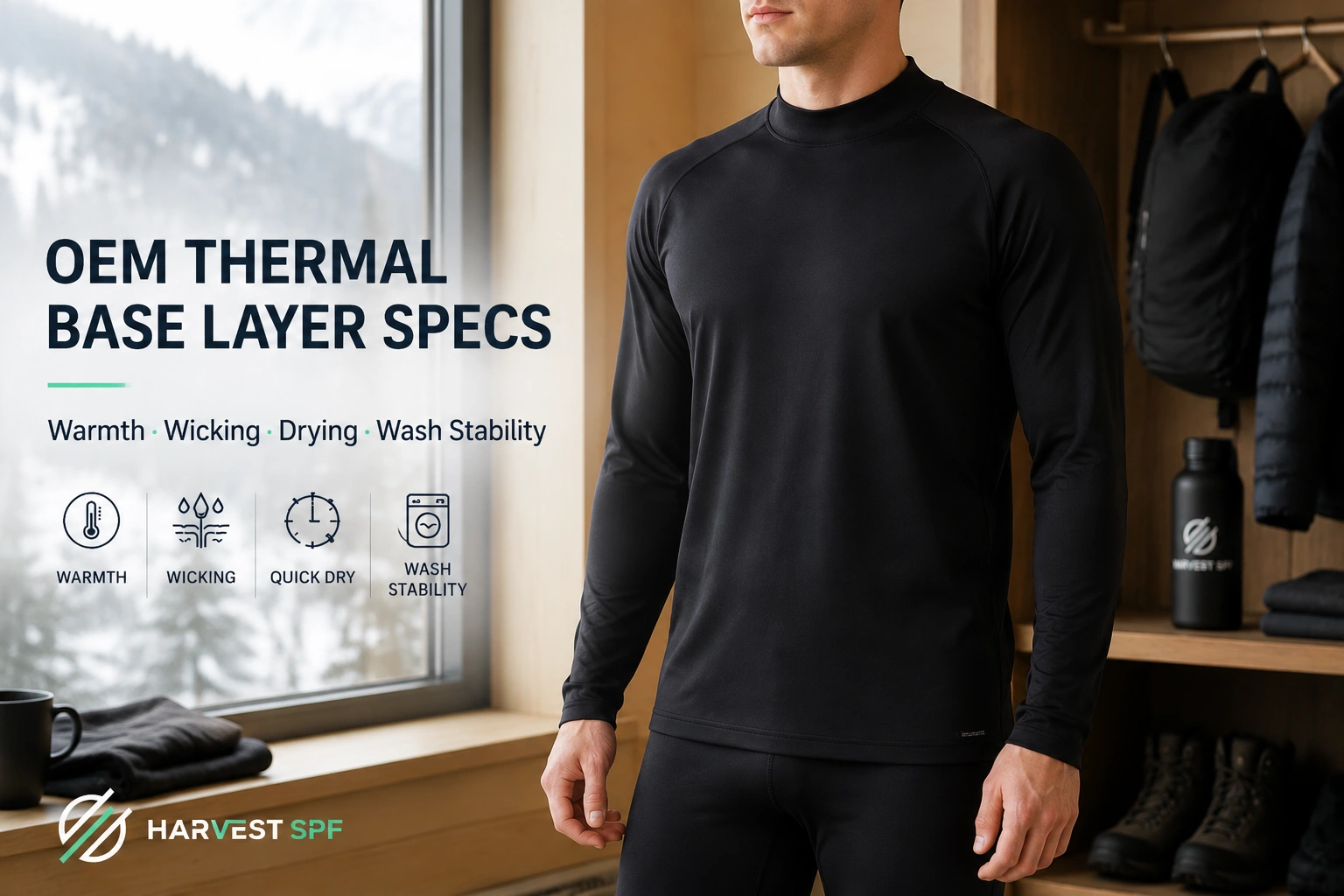
Translate each marketing requirement into a measurable procurement requirement: “warm” -> agreed thermal behavior; “moisture-wicking” -> defined liquid-transport method; “quick-drying” -> defined environmental conditions and endpoint; “wash-stable” -> agreed care cycles and acceptance criteria.
Recommended control chain: Marketing Claim -> Test Method -> Test Condition -> Acceptance Limit -> After-Wash Retention -> Bulk Verification.
Six Layers of a Thermal Base Layer Specification
- Use Case: climate, activity level and layering position.
- Material: fiber system, yarn, GSM and knit construction.
- Garment Construction: fit, seams, coverage and stretch.
- Performance: warmth, wicking, drying and breathability.
- Durability: wash stability, recovery, pilling and color.
- Bulk Control: tolerances, verification frequency and change control.
Why Performance Specifications Matter in OEM Orders
Base layers sit next to the skin and are expected to manage heat and moisture while remaining comfortable under another garment. The correct balance depends on use: skiing, hiking, commuting, workwear, children’s outdoor clothing, or moderate indoor activity may require different fabric weights and fits.
A procurement team should separate four performance outcomes:
- Warmth: how effectively the garment reduces heat loss in the intended layering system.
- Wicking: how quickly liquid sweat moves away from the skin.
- Drying: how efficiently moisture leaves the fabric during wear or between uses.
- Wash stability: how well dimensions, hand feel, color, stretch, and performance remain after care cycles.
These outcomes interact. A heavier fabric may improve insulation but dry more slowly. A very open structure may improve airflow but provide less warmth. A high-stretch fit can support next-to-skin contact but may lose recovery if fiber selection or finishing is unsuitable.
1. Define Warmth as a Use-Case Requirement
Warmth should be specified by operating scenario rather than by a marketing label such as “winter weight.” State the expected activity level, layering position, climate range, wind exposure, and whether the wearer will alternate between rest and exertion.
Fabric weight, yarn structure, surface texture, and garment coverage all influence insulation. A brushed inner surface can increase perceived warmth, while a smooth surface may layer more easily beneath shells. Rib or engineered knit zones can improve fit around the torso and limbs, but they also change stretch and air permeability.
For an OEM order, request:
- Fabric mass per unit area, with tolerance.
- Knit construction and finishing description.
- Air permeability or comparable breathability data where relevant.
- Dimensional measurements for the approved size set.
- A clear statement of intended temperature and activity assumptions.
Do not compare warmth claims from different suppliers unless the test method, specimen condition, and garment construction are equivalent. A supplier should identify whether results apply to fabric only or to a finished garment.
Harvest SPF lists an Outdoor & Thermal category with merino and synthetic baselayer styles. Its product range can help a buyer define a starting silhouette, while the final warmth target should remain tied to the brand’s tech pack and intended market.
Do Not Use GSM Alone as a Warmth Specification
GSM is a material construction parameter, not a direct measurement of thermal insulation. Two fabrics with different yarn structures, loft, knit density, brushing, moisture behavior or fit can deliver different thermal performance even at similar fabric weights.
Use Thermal Resistance When Objective Warmth Comparison Is Required
Where objective thermal comparison is required, buyers may specify a recognized thermal-resistance method such as ISO 11092, or another agreed method appropriate to the product. The specification should identify the method, specimen condition and whether the result applies to fabric or the finished garment; this does not mean every thermal base layer must be tested to ISO 11092.
GSM and CLO Are Not Interchangeable
GSM measures fabric mass per unit area, while thermal resistance describes resistance to heat transfer and CLO is a clothing-insulation unit. A buyer should not convert GSM directly into a CLO value without product-specific thermal testing.
Evaluate Warmth-to-Weight During Development
For lightweight performance products, compare whether different constructions can reach the required thermal target at lower mass. Treat warmth-to-weight as an internal development comparison rather than a universal industry rating.
2. Turn Wicking into a Testable Specification
Wicking describes liquid transport, not simply softness or fiber type. A fabric can feel comfortable but still leave sweat concentrated in high-contact areas. Buyers should ask how moisture moves vertically and horizontally across the fabric, and whether the result is measured before and after laundering.
Useful evaluation points include:
- Wetting time and absorption behavior.
- Vertical or one-way liquid transport.
- Spreading area and drying time.
- Performance after the planned number of wash cycles.
- Results on the actual color and finish intended for bulk production.
Fiber content alone does not guarantee wicking. Yarn geometry, knitting density, capillary channels, hydrophilic treatment, and seam placement can have significant effects. If a supplier proposes a fiber substitution, require a new performance comparison rather than accepting the original claim.
The product page for Harvest SPF’s Men’s Acrylic-Viscose-Lycra Long Sleeve Baselayer identifies acrylic, viscose, and Lycra in the composition field and lists a 270 gsm weight. Because the displayed composition should be reconciled with the signed specification, buyers should confirm the exact blend, tolerances, and test data before purchase.
Choose a Defined Moisture-Management Test Method
Where liquid moisture management is a key requirement, buyers may specify a recognized method such as AATCC TM195 or another buyer-selected method appropriate to the product. Vertical wicking, wetting, spreading and directional transport methods should not be treated as interchangeable. Supplier comparisons should use the same method, specimen preparation, conditioning and reporting format.
Wicking and Absorbency Are Not the Same
Define the target moisture path, transport speed, and post-wash performance. Absorbency and wicking should be evaluated separately because a fabric may absorb liquid without moving it efficiently.
3. Specify Drying for Real Operating Conditions
Drying performance matters when users sweat during activity, need to wear the garment again soon, or cannot access a heated drying room. A lab result is useful only when the test conditions reflect the product’s intended use.
Ask the supplier to document:
- Moisture regain or moisture content assumptions.
- Drying time under a defined temperature, humidity, airflow, and specimen size.
- Whether drying is measured flat, hanging, or on a body-form system.
- The effect of fabric softener, print, brushed finishing, or odor-control treatments.
- Drying behavior after repeated washing.
Design choices also influence drying. Extra thickness, dense elastane zones, double-layer panels, and heavy trims may retain moisture even when the main fabric dries quickly. For a commercial style, evaluate the complete garment, including waistband, cuffs, labels, and printed areas.
Care labeling should match the validated process. If the supplier recommends low-temperature washing or line drying, the brand must decide whether that instruction is realistic for the target customer and retail channel.
Define Whether You Are Measuring Drying Time or Drying Rate
Drying time measures how long a specimen takes to reach a defined endpoint, while drying rate describes moisture loss over time. “Quick-drying” without a defined test condition and endpoint is not a procurement specification, and results from different drying protocols should not be compared directly.
Moisture Management Is a System
For a next-to-skin base layer, evaluate the sequence: Wetting -> Transport -> Spreading -> Evaporation -> Drying. Fast spreading alone does not guarantee the same wearing experience if the fabric retains a large moisture load or dries slowly.
Test the Intended Skin Side
For directional, plated or two-layer constructions, the specification should identify which surface is worn against the skin and use that orientation consistently during testing. The inner and outer surfaces may be engineered for different transport, spreading or evaporation functions.
4. Make Wash Stability Part of the Acceptance Criteria
Wash stability is broader than shrinkage. A complete review should cover length, chest or waist circumference, skew, spirality, seam appearance, pilling, color change, color transfer, elastic recovery, and hand feel.
Before bulk production, agree on:
- Wash method, detergent, temperature, agitation, and drying method.
- Number of cycles for approval and the measurement points.
- Measurement tolerances for each size.
- Visual limits for pilling, shade variation, and seam distortion.
- Retesting rules if the fabric, dye lot, trim, or finishing process changes.
The approved sample should be retained with its measurement chart, fabric lot, labels, artwork, and care instructions. A pre-production sample is not sufficient evidence if the bulk fabric comes from a different lot or receives a different finish.
For long-term cost control, assess whether performance remains acceptable after realistic consumer care. A lower initial unit price can be offset by higher return rates, replacement claims, or shortened product life.
Evaluate Performance Retention After Laundering
Wash stability should include performance retention, not only dimensional change. Compare the approved initial baseline with results after the agreed care cycles for relevant properties such as wicking, drying, stretch/recovery, appearance and dimensional stability. Acceptance limits should be defined for the project rather than assumed to be universal.
Use Risk-Based Testing Across Approval Stages
- Fabric development: compare candidate constructions and finishes.
- Prototype: verify the selected performance direction.
- Pre-production: confirm final fabric, color, finish and garment construction.
- Bulk: verify material identity and selected high-risk characteristics according to the agreed control plan.
- Material/process change: re-test the performance characteristics affected by the change.
5. Connect Construction to Performance
Thermal comfort depends on how the garment is built, not only on the roll goods. Seam bulk can create pressure under outer layers. Poorly positioned seams can cause chafing. Inconsistent tension can produce cold spots or restrict movement.
Include construction requirements for:
- Flatlock or low-bulk seams in high-contact areas.
- Neck, cuff, and waistband recovery.
- Pattern balance between front and back.
- Stretch direction and elongation.
- Label placement and print durability.
- Needle detection, trimming, and final inspection.
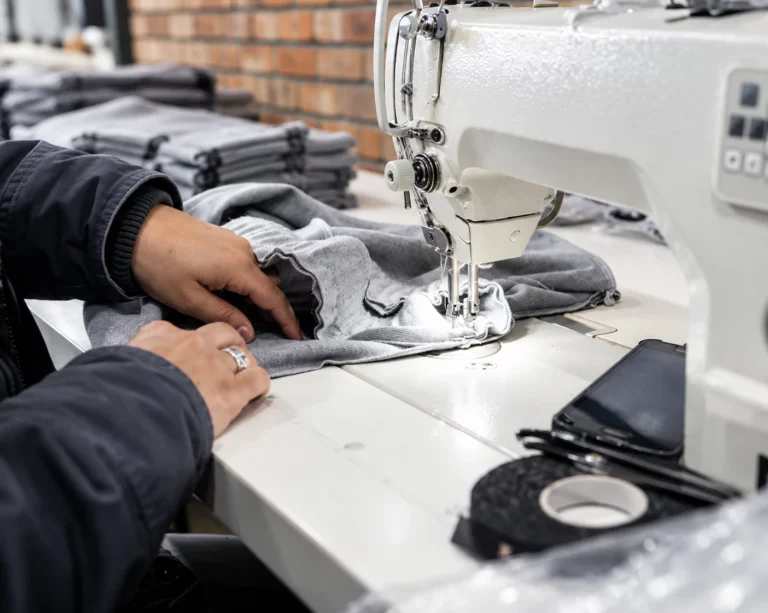
The supplier’s customization process should show how fabric knitting, dyeing, inspection, cutting, sewing, branding, and quality control are coordinated. Harvest SPF’s ODM/OEM process describes tech-pack review, fabric selection or development, prototype sampling, packaging, mass production, and quality inspection, which gives buyers a framework for asking who owns each approval step.
Fit Is Part of Thermal and Moisture Performance
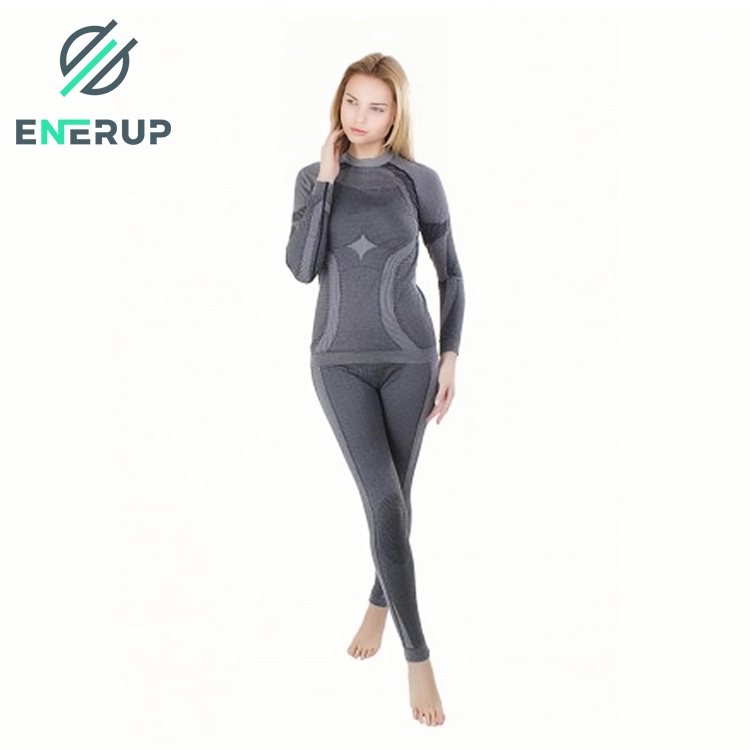
An excessively loose fit may reduce effective next-to-skin moisture transfer, while excessive stretch can affect comfort, mobility and the effective thickness or loft of some constructions. Interpret fabric-level performance together with the approved garment fit and stretch condition.
Different Fiber Systems Require Different Control Points
| Material System | Control Points to Emphasize |
| Merino | Micron, yarn structure, GSM, shrinkage, pilling and dimensional stability |
| Polyester / synthetic | Filament or yarn construction, moisture-management finish where used, drying and pilling |
| Blends | Blend ratio, fiber distribution and retention of intended performance after laundering |
The specification should reflect the chosen fiber system rather than applying one generic thermal base layer standard to every material.
6. Build a Performance Test Matrix
A useful OEM test matrix links every claim to a method, sample condition, and acceptance decision.
| Performance area | What to specify | When to test |
| Warmth | Fabric weight, construction, insulation or thermal method | Lab dip, proto, pre-production, bulk |
| Wicking | Wetting, spreading, one-way transport | Proto and after wash cycles |
| Drying | Time and environmental conditions | Proto and finished bulk |
| Wash stability | Dimensions, pilling, shade, stretch recovery | Before and after agreed cycles |
| Construction | Seams, labels, prints, needle control | Pre-production and final inspection |
Use the same protocol for supplier comparisons. If a test is outsourced, identify the laboratory, specimen preparation, conditioning, and reporting format. Keep raw reports with the purchase order so quality disputes can be traced to an agreed reference.
Expand the Performance Matrix to Include Acceptance Criteria
| Performance Area | Method / Condition | Acceptance Criteria | Typical Stage |
| Warmth | Buyer-selected thermal method; conditioned specimen | Buyer-defined target | Development / pre-production |
| Wicking | Selected moisture-transport method; initial + after wash where required | Buyer-defined target | Development / verification |
| Drying | Defined temperature, humidity, airflow and endpoint | Buyer-defined target | Development / verification |
| Dimensions | Agreed wash/care method after defined cycles | Tech-pack tolerance | Pre-production / bulk |
| Stretch / recovery | Selected stretch method; initial + after wash where required | Buyer-defined target | Development / pre-production |
Define What Changes Trigger Re-Testing
| Change | Performance to Review / Re-Test as Applicable |
| Fiber blend change | Moisture, thermal and care performance |
| GSM change | Warmth, drying and fit |
| Knit construction change | Stretch, air/moisture and thermal behavior |
| Brushing / surface finish change | Warmth, pilling and drying |
| Wicking finish change | Moisture-management performance |
| Color / dye-process change | Colorfastness and any finish-dependent performance |
Re-testing should follow the performance affected by the change rather than automatically repeating every test.
7. Evaluate the Supplier, Not Only the Fabric
A capable thermal base layer supplier should provide controlled documentation, sample traceability, and clear change management. During evaluation, ask for:
- A fabric specification with blend, weight, width, tolerance, and finish.
- A size chart and graded pattern for approval.
- Test reports tied to the submitted sample.
- A process for approving substitutions and color changes.
- Inspection records and defect classification.
- Packaging, labeling, and carton-marking details.
- Communication ownership for technical questions and corrective actions.
MOQ and development options also affect risk. The Harvest SPF product page states that the referenced style may be available from 300 pieces when fabric is in stock, 600 pieces for new colors, and 1,000 pieces for new fabrics. Treat these figures as style-specific and confirm them in the quotation, together with color, size, and fabric conditions.
A supplier’s certifications or sustainability claims should be checked against current, product-relevant documents. Do not assume that a factory-level certificate automatically covers every fabric, color, or finished garment.
Keep MOQ Language Project-Specific
MOQ depends on whether the project uses available fabric, custom colors, or newly developed fabric. Buyers should confirm style, color, size and material conditions in the quotation rather than treating one published MOQ as applicable to every thermal base layer project.
How Harvest SPF Supports Thermal Base Layer Development
- Material Engineering: merino, synthetic, blended and multi-layer material options.
- Thermal Performance Development: coordinate GSM, yarn, knit construction and finishing around the use case.
- Moisture Management: develop wicking and drying architecture appropriate to the garment.
- Performance Validation: coordinate buyer-agreed test methods and sample conditions.
- Wash-Durability Development: evaluate post-care appearance, dimensions and relevant performance retention.
- OEM Specification Control: connect approved fabric, sample, pre-production and bulk requirements through change control.
8. RFQ Checklist for Thermal Base Layers
Send the supplier enough information to quote and test responsibly:
- Target wearer, activity, climate, and layering position.
- Garment type, size range, measurements, and grading rules.
- Fiber blend, fabric weight range, finish, and color standards.
- Warmth, wicking, drying, and wash-stability requirements.
- Artwork, label, packaging, and compliance needs.
- Test methods, wash cycles, tolerances, and inspection level.
- Quantity by color and size, delivery location, and target schedule.
- Existing sample, pattern, tech pack, or reference garment.
Ask the supplier to return a compliance matrix showing which requirements are confirmed, conditional, or unavailable. This prevents a quotation from being mistaken for a performance guarantee.
Supplier Compliance Matrix
| Requirement | Buyer Target | Supplier Response / Evidence | Status |
| GSM | Buyer-defined | Fabric specification | Confirmed / Conditional / Pending / Not Available |
| Warmth | Buyer-defined | Test report / agreed method | Confirmed / Conditional / Pending / Not Available |
| Wicking | Buyer-defined | Test report | Confirmed / Conditional / Pending / Not Available |
| Drying | Buyer-defined | Test report | Confirmed / Conditional / Pending / Not Available |
| Wash stability | Buyer-defined | Wash / performance report | Confirmed / Conditional / Pending / Not Available |
| MOQ / commercial | Project-specific | Quotation | Confirmed / Conditional / Pending / Not Available |
Example: Convert a Marketing Brief Into an OEM Specification
Brand brief: “We need a warm, breathable, quick-drying winter base layer.”
- Use Case: define climate, activity and next-to-skin layering position.
- Material: select the buyer-approved fiber system.
- Fabric: define target GSM and tolerance plus knit construction.
- Orientation: identify the intended skin side where relevant.
- Warmth: specify the agreed thermal evaluation method and target.
- Wicking: specify the agreed liquid-transport method and target.
- Drying: define environmental conditions, endpoint and acceptance requirement.
- Wash Stability: define care method, agreed cycles and post-wash acceptance criteria.
- Fit: approve size specification and stretch condition.
- Bulk Control: freeze fabric, finish and color, and define change-control / re-test triggers.
Conclusion
Thermal base layer performance specifications should describe measurable behavior under realistic use and care conditions. Warmth, wicking, drying, and wash stability must be reviewed together with fabric weight, construction, fit, finishing, and change control. A disciplined sample-to-bulk process gives engineering, procurement, and merchandising teams a common basis for approval.
For brands developing merino, synthetic, or blended thermal garments, Harvest SPF’s Outdoor & Thermal collection offers relevant product directions for discussion. Final performance, composition, MOQ, testing, and delivery terms should be confirmed for the exact style and order.
FAQs
What fabric weight is suitable for an OEM thermal base layer?
There is no universal weight. The correct range depends on climate, activity level, layering position, fit, and fiber system. Specify the intended use first, then validate fabric weight through wear trials and laboratory testing.
Does merino automatically provide better warmth and wicking?
Merino can support moisture management and thermal comfort, but results depend on yarn, blend, knit structure, finishing, and garment construction. Require test data for the finished style rather than relying on fiber labels.
How many wash cycles should an OEM buyer test?
The buyer and supplier should agree on a cycle count that reflects the product’s care label and commercial risk. Test dimensions, appearance, stretch recovery, and moisture performance, not shrinkage alone.
Can a supplier substitute the approved fabric?
A substitution should require written approval and comparative testing. Even a similar fiber blend can change weight, hand feel, drying, color, stretch, and wash behavior.
What should be included in a thermal base layer quotation?
Request the exact blend, fabric weight, tolerances, sizes, colors, MOQ, testing scope, packaging, inspection terms, delivery assumptions, and change-control conditions for the quoted style.
Is a higher-GSM thermal base layer always warmer?
No. GSM measures mass per unit area, not thermal resistance. Yarn structure, loft, knit density, brushing, moisture and garment fit can all affect warmth, so objective comparisons should use an agreed thermal evaluation where required.
Is moisture-wicking the same as quick-drying?
No. Wicking describes liquid transport through or across the textile structure, while drying describes moisture removal over time under defined conditions. A base layer should be evaluated as a moisture-management system rather than assuming one property guarantees the other.
Should thermal base layer performance be tested after washing?
When post-care performance is commercially relevant, yes. The buyer should define the care method, agreed cycle count and acceptance requirements for the properties that need to be retained.
Get an OEM Thermal Base Layer Performance Specification Review
Provide the intended activity, climate/use case, layering position, fiber preference, target GSM, fabric construction, existing sample, size range, quantity, target market, required performance claims and existing test requirements.
Harvest SPF can review the material-construction-performance relationship and help define a development, testing and bulk-control plan for the project.
Review My Thermal Base Layer Specification