

Gym leggings pocket placement should be developed around the loaded garment during floor transitions. For brands seeking leggings that stay put, the key questions are where a carried item presses, how its weight pulls on the surrounding panel, and whether fabric contact with the mat adds drag. Addressing those forces may require a different pocket layout or surface choice, rather than simply a tighter waistband.
Establish the underlying fit first; the yoga pants waistband fit guide covers that foundation. The next development decision is how storage and floor contact interact with an otherwise suitable garment.
Development framework — Define carried item and load → specify pocket dimensions and construction → map movement/contact zones → measure loaded performance → compare fabric–mat interaction → revise and retest → approve size set and bulk specification. Pocket placement is a combined load, movement and fabric-contact decision.
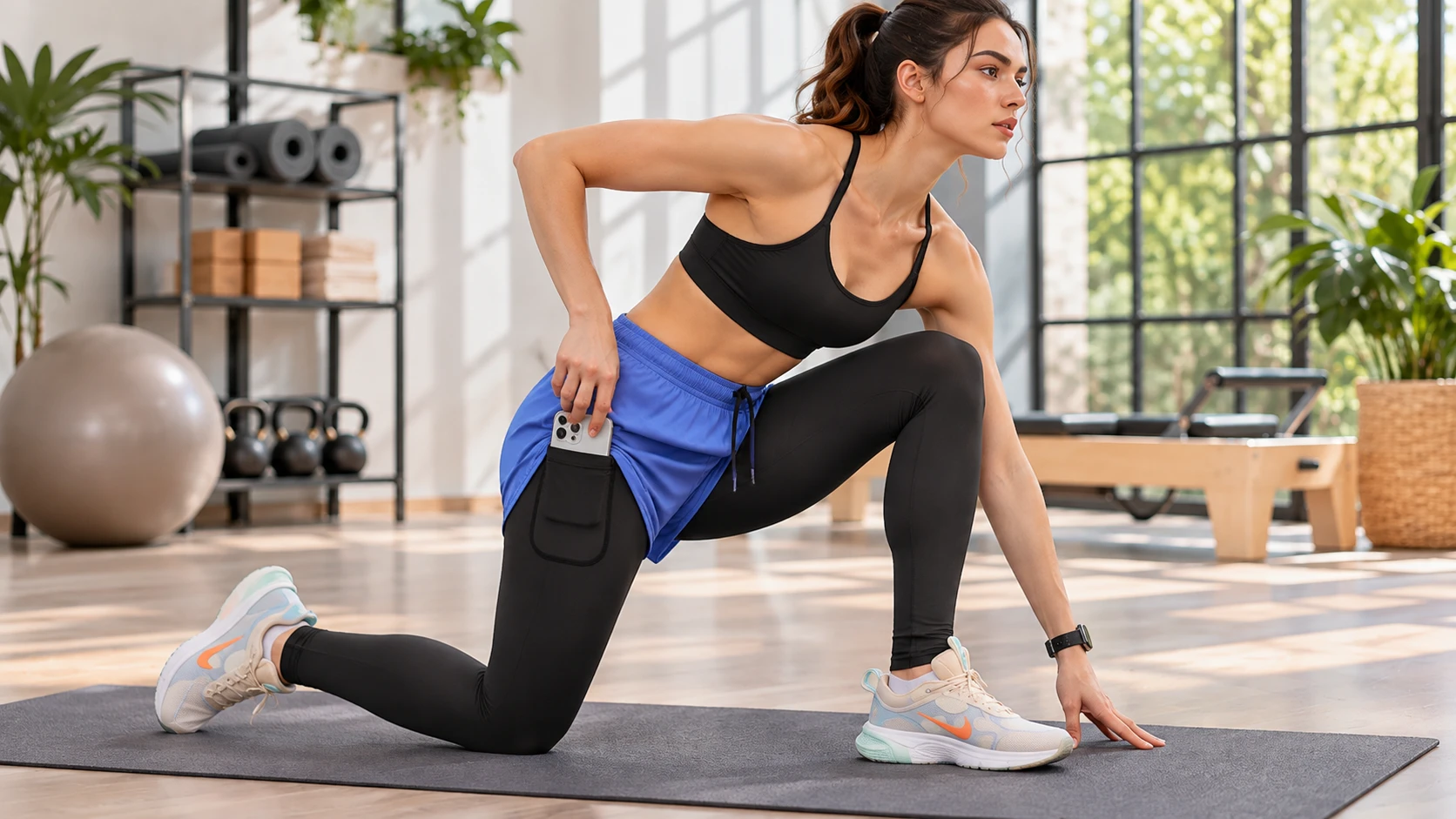
Decide What the Leggings Must Carry
“Phone pocket” is an incomplete specification. Define the intended phone dimensions with its case, approximate loaded mass, orientation, and whether it remains in the pocket during floor work. Cards, keys, and a large phone create different shapes and contact points.
A collection designed for mixed gym sessions may need storage during standing exercises but not during seated or side-lying movements. Confirm that use case before adding larger pockets to every style. For a dedicated mat-work product, a small essentials pocket or an expectation of empty pockets during exercise may be more appropriate.
Make the carrying requirement explicit in the product brief. Otherwise, a developer may optimize easy access while the buyer expects secure retention through rotations and repeated rising. Those are separate requirements and should be reviewed separately.
Carried-item specification — Record item type; length × width × thickness including case (mm); mass including case (g); orientation; intended activities; whether the item stays inside during floor work; one-sided/two-sided load; retention and accessibility expectations.
Load categories — Light: cards or keys; medium: compact phone/accessories; heavy: large phone with case. These are qualitative project categories, not standardized weight bands. Confirm actual item mass and dimensions for testing.
Map Pocket Placement Through the Contact Path
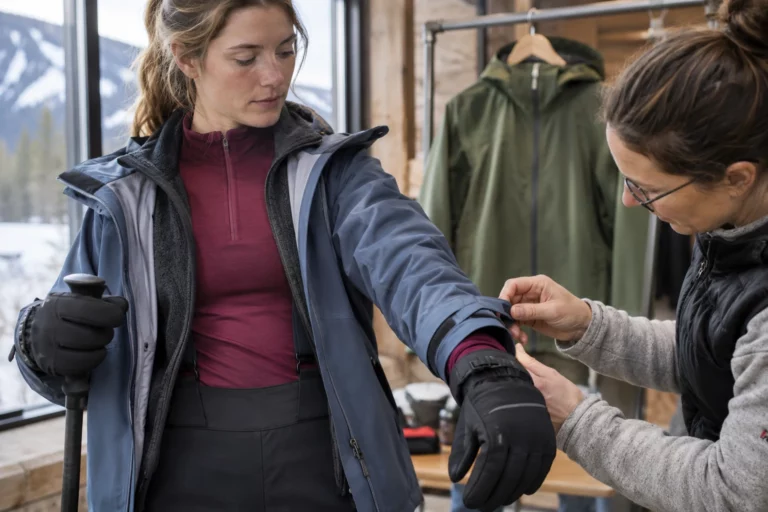
Mark the proposed pocket outline on the sample, then observe the intended item through sitting, side support, kneeling, and rising. Follow its corners and edges as the hip bends. A location that looks clear in standing may move into a pressure area during a transition.
Compare positions by their potential interference, not by a universal preferred height:
| Proposed location | Floor-training question |
| Outer thigh | Does the loaded pocket meet the mat during side support or rotation? |
| Rear waistband | Does the object press into the wearer during sitting or reclining? |
| Front waistband | Does the item interfere with hip flexion or abdominal folding? |
| Higher side panel | Does the load pull locally at the hip or distort the waist edge? |
These are checks to perform, not predetermined failures. Body proportions, item size, garment construction, and the actual movement change the outcome.
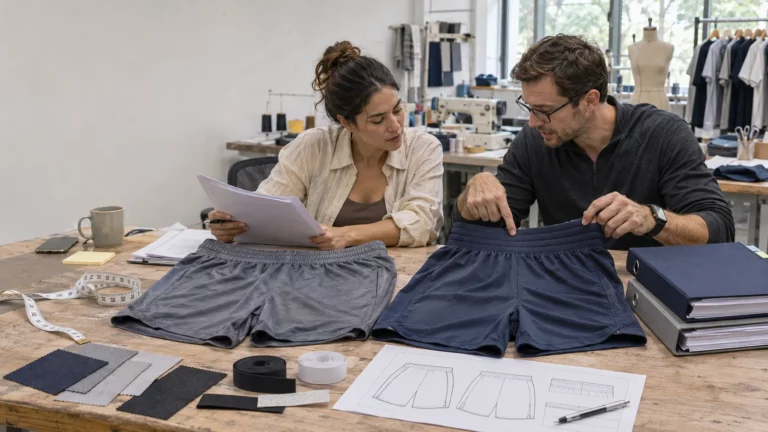
Specify placement from defined garment reference points and show the loaded object on the drawing. A pocket label alone cannot communicate the required clearance. Review both sides when the workout includes alternating transitions.
Pocket placement measurement sheet
Specify pocket top and bottom from defined garment reference points; horizontal offset from side seam/panel; finished opening width; usable internal depth and width; seam clearance; and loaded object location. Pocket position on the pattern is not necessarily the same as the loaded phone contact point.
Size grading
For XS–XL or the agreed range, document whether pocket dimensions remain fixed or are graded and how placement is referenced. Validate representative sizes and body proportions; the same numerical offset can create different contact zones.
Support the Pocket Without Creating a Stiff Island
Pocket depth helps retain an item, but the supporting panel also needs attention. A secure opening can coexist with a pocket bag that stretches downward, allowing the phone to settle lower than intended.
Ask the developer to distinguish opening retention, pocket-bag deformation, and movement of the whole leg panel. If only the opening is tightened, the item may remain enclosed while still pulling the garment out of position.
Review how pocket edges connect to panel seams and how reinforcement behaves when the hip bends. Additional stitching or a firmer backing may control local deformation, but it can also create a noticeable boundary against softer fabric. Assess that tradeoff in the loaded garment.
Keep decorative panel lines visible during this review. Color blocking and asymmetric shapes may affect where a pocket can be integrated. Treat the visual design and storage construction as one layout decision, with explicit approval of any changed seam or panel.
Construction comparison
- Integrated side-panel pocket:Clean appearance but possible panel distortion.
- Patch pocket:Flexible positioning but edge bulk/drag.
- Waistband pocket:Discreet but potential seated pressure.
- Reinforced opening:Retention but localized stiffness.
- Double-layer bag:Support but extra bulk/heat.
Pocket Support and Failure Diagnosis
Evaluate opening retention, pocket-bag stretch, panel support, seam attachment, reinforcement and recovery separately. Phone release may indicate opening/orientation issues; phone settling may indicate bag extension; whole-panel pull may indicate load distribution; edge pressure may indicate seam or reinforcement bulk. Treat these as hypotheses to verify.
Evaluate Fabric Against the Actual Training Surface
Mat contact is a pairing between two surfaces. The exterior of a legging may move differently against a textured training mat than against a smoother studio surface. A soft hand feel in the showroom does not establish how that pairing behaves during a seated turn or kneeling transition.
Ask for candidate fabrics with their intended exterior finishes, then compare them against the surfaces in the brief. Inspect whether fabric remains momentarily caught as the wearer moves, whether a panel shifts, and whether the effect occurs near a seam or loaded pocket.
Separate drag from wear resistance. Friction concerns resistance to movement; abrasion resistance concerns damage from rubbing. A favorable abrasion result does not establish low drag against a particular mat. Likewise, a surface that glides readily still needs appropriate durability assessment.
Avoid selecting a smoother finish solely to solve one transition. Review its consequences for appearance, touch, pocket support, and the garment’s other requirements before approving the material change.
Fabric–mat evaluation
Document mat material, texture and condition; exterior fabric face and finish; fabric stretch/recovery, thickness, pilling and abrasion requirements; movement, load, repetitions, drag observation and garment displacement. Friction and abrasion resistance are different properties; a result on one mat cannot be generalized to all surfaces.
Separate Pocket Pull From Mat Drag
Use a small comparison matrix before requesting a major redesign. Keep the garment, participant, carried item, and movement consistent while changing pocket loading and surface.
| Comparison | Pocket condition | Surface |
| A | Empty | Intended training mat |
| B | Defined load | Same training mat |
| C | Empty | Second relevant surface |
| D | Same defined load | Second relevant surface |
This is a project development comparison, not a standardized laboratory method. Select suitable surfaces and document them clearly.
If a problem appears mainly after loading, investigate the pocket and surrounding support first. If it appears with empty pockets on one surface, investigate contact behavior. If both factors are needed to reproduce it, examine their interaction before choosing a correction.
Track the item and garment independently. A phone settling deeper inside an otherwise stable pocket is different from the entire panel migrating downward. Note whether the opening, pocket base, side seam, and waist edge move together.
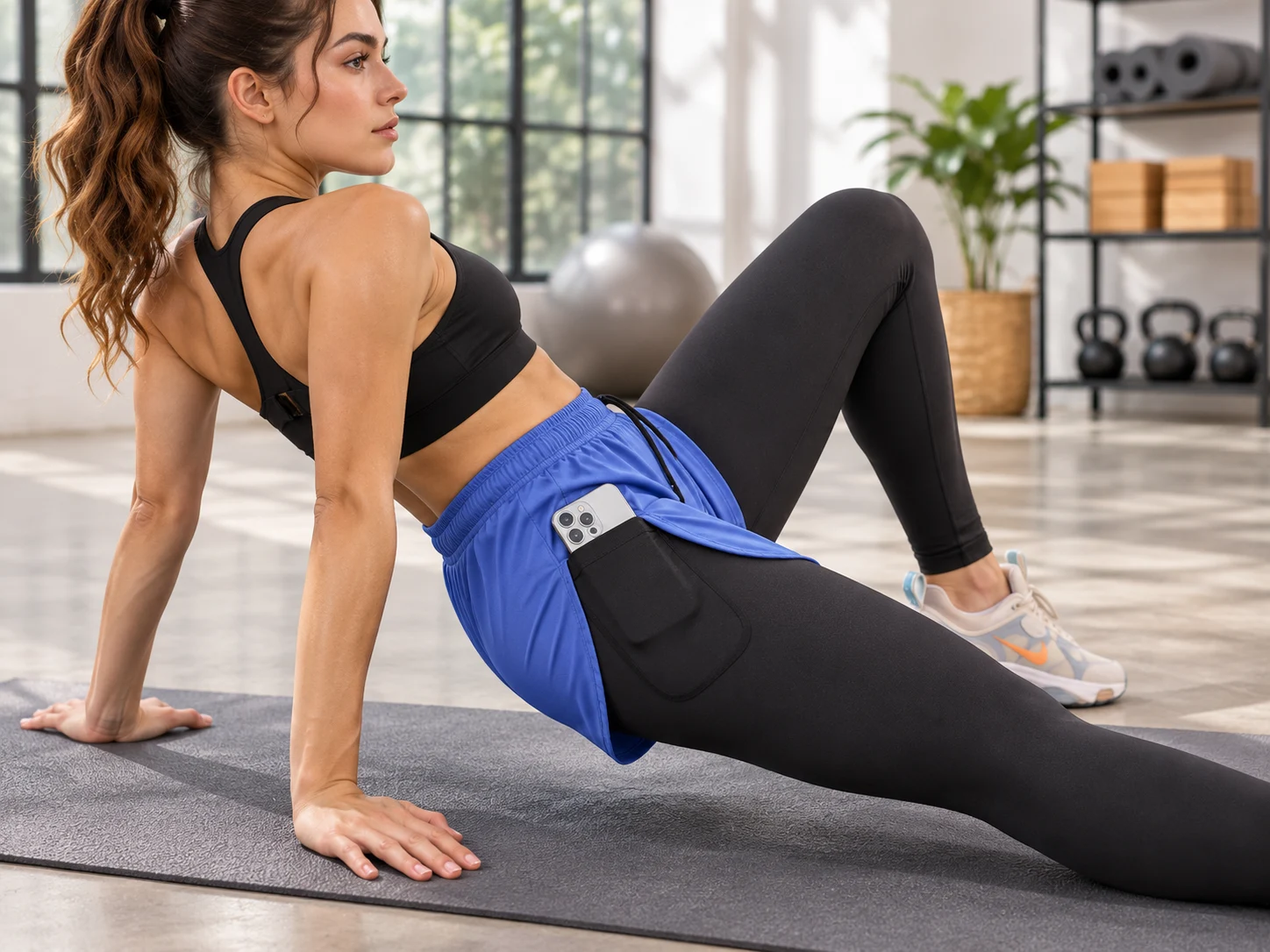
Compare the first transition with later repetitions. Increasing displacement can reveal accumulated movement that a final standing photograph conceals. Record necessary readjustment as an event; resetting the garment after every repetition would hide that accumulation.
Quantitative A/B/C/D record
For each condition in the A/B/C/D comparison, record phone settling (cm), pocket-bag sag (cm), leg-panel migration (cm), waistband migration (cm), and adjustment count. Use consistent measurement definitions across all four conditions.
The following figures illustrate how results may be recorded: A, empty pocket on mat 1, waistband migration 0.5 cm; B, loaded pocket on mat 1, pocket-bag sag 1.5 cm and waistband migration 2.0 cm; C, empty pocket on mat 2, waistband migration 0.3 cm; D, loaded pocket on mat 2, pocket-bag sag 1.0 cm and waistband migration 1.2 cm.
These figures are illustrative only, not actual test results or pass/fail limits.
Measurement definitions
Use fixed garment/body landmarks and a stated sign convention. Pocket sag = loaded pocket-base position minus baseline position; separately record item migration within the bag, leg-panel migration, waistband migration and manual adjustments. Do not infer whole-garment movement from phone movement alone.
Standardized floor-training protocol
Test standing baseline, deep squat, kneeling, seated rotation, side support, floor-to-standing and repeated transitions. Log repetitions, hold time, item and load, pocket side, mat type, displacement, readjustments and discomfort. Suggested internal severity: 1 none; 2 minor contact; 3 noticeable; 4 repeated discomfort/adjustment; 5 unacceptable. This is subjective, not an instrumented pressure test.
Request Design Alternatives That Address the Observed Force
Translate the observation into a focused development request. For a loaded pocket that drops, ask for alternatives addressing bag support, attachment, position, or intended carrying capacity. For localized mat drag, request review of the exterior finish and seam arrangement at the contact area.
Avoid asking for a tighter waist by default. It may leave the original pull unchanged while adding pressure elsewhere. The proposed revision should explain which observed force it addresses and what tradeoff requires review.
Root cause → revision — Bag drops: revise support; item shifts: review depth/orientation; panel migrates: review attachment/load path; drag at seam: review seam or exterior face; waistband slips: review load distribution and fit; localized pressure: review placement. Change one controlled variable where feasible and document tradeoffs.
Sample revision register — R01: phone sag → trial pocket-bag support → retest; R02: sag improved but contact pressure → adjust placement → retest; R03: all agreed critical checks passed → freeze approved specification. Recheck previously passing movements if the revision may affect them.
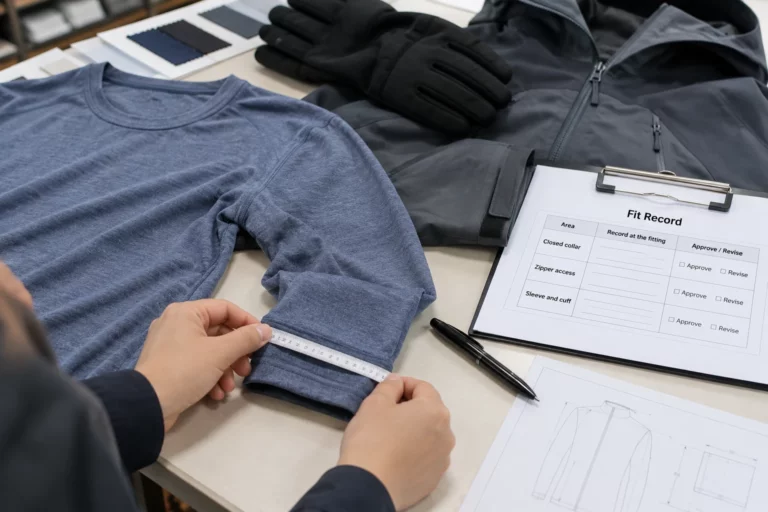
Pocket CTQ / bulk release — Control pocket top/side position and tolerances, opening width, usable depth, bag material, seam/reinforcement construction, fabric finish/recovery, agreed load retention, sag limit and after-wash stability. Gate decisions: Approve / Revise / Retest / Hold. A passing prototype is not automatic bulk authorization; confirm final fabric, grading, production specifications and QC.
Change control — Changes in carried item, pocket position, bag material, reinforcement, fabric finish or panel construction require documented impact review and appropriate retesting.
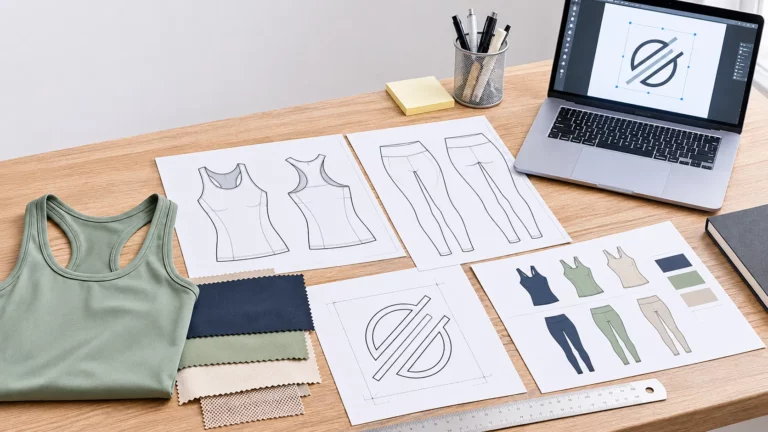
Harvest SPF’s color block high waist yoga leggings provide a reference for discussing panel layout and silhouette. The listed style does not establish a tested phone-pocket configuration; confirm the feasibility and scope of any requested adaptation.
Buyers can discuss pocket-layout changes, fabric options, and sampling requirements with Harvest SPF through its OEM/ODM development service, subject to project feasibility and an agreed scope. Ask the quotation to identify the pocket variant, material option, and comparison sample included. This makes alternatives easier to assess without commissioning an undefined series of revisions.
Harvest SPF OEM/ODM development support — Harvest SPF can discuss fabric stretch/recovery and exterior finish, pocket and panel layout, seam/reinforcement construction, prototype alternatives, movement/load comparisons, size-set review and approved bulk specifications within an agreed scope. The cited color-block leggings are a layout reference, not evidence of a prevalidated phone-pocket configuration.
Retain the approved carrying conditions with the design record. Changing phone size, pocket position, or exterior finish can alter the original decision and should prompt an appropriate review.
Conclusion
Developing gym leggings for repeated floor transitions requires attention to where external forces enter the garment. Define the carried item, map its contact path, review pocket support, and separate loading effects from mat drag. Select revisions that address the observed cause while preserving the intended comfort and silhouette.
Request a Gym Leggings Pocket Development Review
Provide style drawing, item dimensions and loaded weight, intended pocket position/dimensions/construction, fabric composition/GSM, target floor movements and mat, observed fit problems, sample reference, size range, quantity, target FOB and delivery schedule.
Review My Gym Leggings Pocket Project.
FAQs
Is a rear waistband pocket better for floor training?
It depends on the carried item and movement. Check whether it presses during sitting or reclining; location alone does not establish suitability.
Will a tighter pocket opening prevent sagging?
It may improve item retention, but the pocket bag and surrounding panel can still deform. Assess enclosure and support separately.
Does good abrasion resistance mean less mat drag?
No. Resistance to rubbing damage and resistance to sliding describe different properties. Evaluate the relevant fabric-and-mat combination.
Should both pockets be loaded during evaluation?
Match the intended use. Review one-sided and two-sided loading when both are realistic, keeping the item and placement clearly documented.
What is the best pocket placement for floor training?
No universal position; evaluate the carried item, movement, pressure/contact zones and fabric–surface pairing.
How is pocket sag measured?
Use defined garment landmarks to compare baseline and loaded positions under consistent movements and conditions.
Should pockets be tested across sizes?
Yes, when grading or body proportions can alter contact, pressure or garment migration.
Does greater depth always improve retention?
No. Opening retention, bag support, orientation and panel stability also matter.
What must be approved before bulk?
Placement, dimensions, materials, seams, loaded performance, relevant size-set and quality-control requirements.