

Each fit requirement in a yoga wear RFQ needs to relate back to a reference, a decision, and a question for the manufacturer to answer. The style and target wearer, measurement options, material references, construction preferences, sample request, and expected order breakdown should be included. Then any incomplete data or contradictory directives should be identified before requesting a development plan from the manufacturer.
The importance of that can be seen in the case of a brand that has the required information to begin a dialogue but has not completed all its specifications. The manufacturer needs to know which attributes are used to define the product and which attributes the brand wants developed.
A Yoga Wear RFQ Should Connect Design, Fit, Fabric, and Commercial Requirements
A production-oriented yoga wear RFQ should connect the intended wearer, silhouette, reference samples, fit requirements, fabric behavior, construction preferences, sampling objectives, and estimated quantities. Open items should have an owner, decision deadline, and next action.
RFQ workflow: Define objective → Assign reference roles → Specify fit and fabric → Log open questions → Request supplier proposal → Compare sampling scope and quotation → Approve the first sample brief.

Give the RFQ One Immediate Objective
Start with a sentence describing the decision needed from the supplier. For example: “Review whether the attached references are sufficient to develop a base-size crossover-waist yoga short, and identify what must be clarified before sampling.”
This directs attention to the readiness of the brief. Add the intended wearer, activity, silhouette, and size range, but keep market positioning concise.
Keep one style reference throughout the request. For a concrete example, consider the crossover waistband on Harvest SPF’s women’s athletic yoga shorts. Identify the features to discuss and the changes proposed for the new style. A product reference does not establish the specifications of a future custom order.
Identify the RFQ Development Stage
Full tech-pack RFQ: request feasibility and production quotation. Reference-sample RFQ: request technical interpretation. Concept-development RFQ: request fabric and pattern proposal. Fit-correction RFQ: request diagnosis and revision scope. Reorder RFQ: confirm the approved specification and changes.
Initial RFQ readiness checklist: product/style; intended wearer and activity; reference images or samples; target silhouette; size range; fabric target or reference (if available); measurements and construction preferences (if available); estimated quantity; destination market; requested timing; and a numbered open-question list.
An incomplete RFQ can still be reviewed, but its quote and sample scope should clearly identify assumptions.
Assign a Specific Job to Each Reference
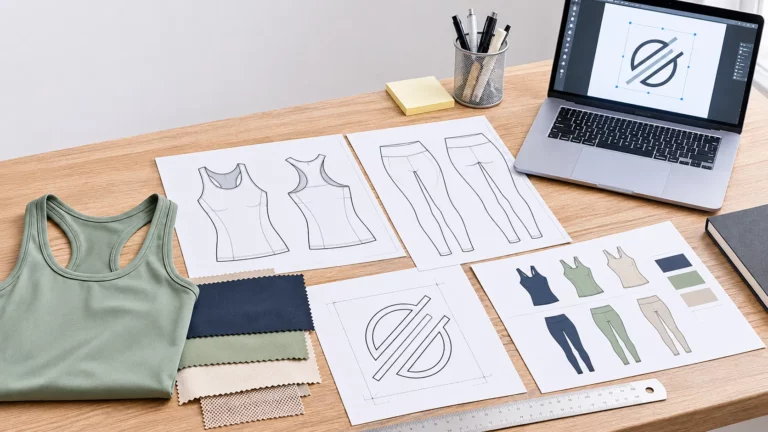
A physical garment, photograph, measurement sheet, and fabric swatch can communicate different things. Tell the factory what each reference should control.
For an illustrative short, the garment might establish leg shape while the drawing defines the crossover waistband. A swatch might communicate surface feel without fixing composition. Label those roles directly.
Add a short exception list: retain the leg silhouette, change the inseam, omit the existing logo, and request advice on the waistband construction. This prevents a reference from being interpreted as an instruction to reproduce every visible feature.
Record the reference garment’s size and condition. If it has been washed or worn, identify that history where known. Photographs should include front, back, and relevant detail views, with dimensions supplied separately when scale matters.
Reference Control Matrix and Exception List
Physical garment → specified fit or silhouette features, not necessarily every construction detail. Photo → visual concept, not exact dimensions. Tech pack → stated specifications, not missing details. Fabric swatch → identified feel/appearance, not automatically stretch or durability. Size chart → stated body or garment dimensions, not the entire pattern.
Example exception list: retain leg silhouette; change waistband to crossover; revise inseam; exclude existing logo; request supplier recommendation for seams. Label each reference with the feature it controls.
Expose Conflicts Before They Become Sample Decisions
A complete attachment folder can still contain incompatible instructions. Review the package feature by feature and resolve differences that would force the factory to choose on the buyer’s behalf.
The following example shows how one yoga wear RFQ can record uncertainty. These entries are illustrative.
| Feature | Available information | RFQ clarification |
| Inseam | Reference garment and drawing differ | Identify the intended finished length and measurement method |
| Waistband | Photo shows a crossover; sketch shows a straight edge | Confirm the controlling design |
| Fabric | Swatch feels right; composition is unknown | Request identification or a suitable proposal |
| Sizing | Retail size labels are available | Supply the intended body profile and request missing garment specifications |
| First sample | Final color is unavailable | Confirm whether the sample will use the intended fabric in another color or a different fabric, and identify which fit conclusions remain provisional |
Avoid a blanket instruction that one document overrides everything. Different references may control different features. Identify the controlling source beside the affected requirement.
If a conflict remains open, give it a question and an owner. The next useful action might be a revised drawing, a measurement confirmation, or a supplier construction proposal.
RFQ Open-Issue Priority and Decision Log
Critical: conflicting waistband shape or inseam definition—resolve before the relevant pattern work. High: unknown stretch/recovery—define the provisional sample scope. Medium: unconfirmed decoration—may remain open for a fit-only sample. Priority always depends on the stated sample objective.
Log fields: Issue ID | Question | Reference | Owner | Priority | Decision deadline | Status | Resolution | Revision date.
Example: Q01 | Confirm crossover edge shape | Sketch R02 vs. sample | Buyer | Critical | Before pattern release | Open.
Make Unfinished Specifications Visible
Use simple labels such as “buyer requirement,” “supplier proposal requested,” and “awaiting buyer decision.” These are practical working labels, not an industry approval standard.
Apply them to individual fields. A blank waistband height could mean the buyer forgot the value, wants a recommendation, or has not decided. State which applies.
For measurements already supplied, identify the unit, measurement location, garment condition, and whether the value represents a flat width or circumference. Keep the intended body profile separate from finished-garment measurements. If a garment measurement tolerance remains undecided, ask for review rather than inserting an arbitrary allowance.
The general clothing specification checklist can help assemble the basic documents. In the RFQ, concentrate on what remains unresolved and what information would close each gap.
Yoga Wear Base-Size Fit Measurement Sheet
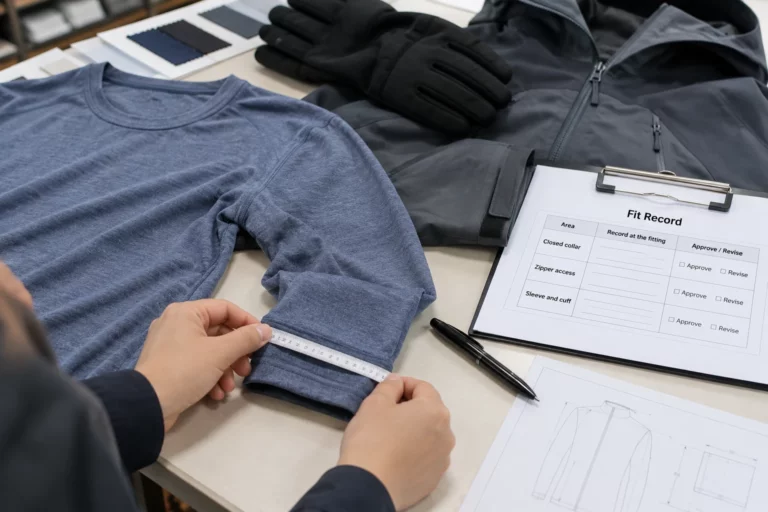
Record each POM (point of measurement), reference points, units, flat width vs. circumference, relaxed/stretched condition, target value, tolerance status, and approval status.
For crossover shorts: waist width; hip width and specified depth; front/back rise; inseam; leg opening; finished waistband height; and overall length as applicable. Keep target body measurements separate from finished-garment measurements.
Negative ease example: for a 70 cm body waist and 63 cm finished garment waist circumference, (70 − 63) / 70 × 100% = 10%. This is an illustration, not a recommended fit target; fabric extension force and recovery also affect pressure. Do not invent universal garment tolerances.
Set a Clear Basis for Fabric Proposals
When the material is unfinished, specify the type of help required.
If a fabric is fixed, provide its reference and available specifications. If only the feel is fixed, explain which attributes matter and invite suitable options. If both are open, describe the intended garment behavior and ask the supplier to explain its proposed starting point.
For the crossover short, a softness reference does not establish the force needed to stretch the waistband or its recovery. Ask what material information is available and what should be verified during development.
Request disclosure of any temporary sample fabric. The supplier should explain which observations are useful and which remain provisional. A silhouette sample made in a substitute material may leave pressure, recovery, or coverage questions unanswered.
Fabric Requirement and Verification Matrix
Specify or request proposals for: fiber composition; GSM; knit structure; stretch direction and extension; extension force; elastic recovery and growth; squat opacity; moisture management; surface feel; pilling; and relevant colorfastness. Record the proposed test conditions and acceptance criteria separately.
Stretch percentage, force to extend, recovery, and residual bagging describe different material behaviors. Compare fabrics under consistent conditions; composition or softness alone cannot establish waistband support.
Substitute-fabric approval rule: a temporary material may support provisional silhouette and construction review, but not final approval of compression, opacity, recovery, or fabric-dependent fit. Verify those properties with the intended production material.
Limit the First Review to Named Decisions
State what the first development round should resolve. A focused brief might prioritize waistband appearance, proposed construction, and the base-size measurement framework.
For a top, the open question may concern neckline coverage or strap arrangement. Identify the relevant detail and ask for a drawing or construction explanation if the photograph is insufficient. Avoid treating a styling image as evidence of support performance.

Request a first reply that lists:
- Information needed from the buyer before pattern development.
- Proposed interpretations of unresolved design details.
- Material or construction alternatives requiring a decision.
- The suggested sample scope and its limitations.
This creates a usable response before the brand commissions physical samples. Agree separately how later fit, movement, and size-range verification will be handled.
First Sample Objective and Movement Fit Review
Silhouette sample → overall shape only. Construction sample → waistband/seam concept. Base-size fit sample → defined fit criteria. Fabric trial → fabric behavior. Pre-production sample → production-intent specifications; none automatically approves all sizes or future changes.
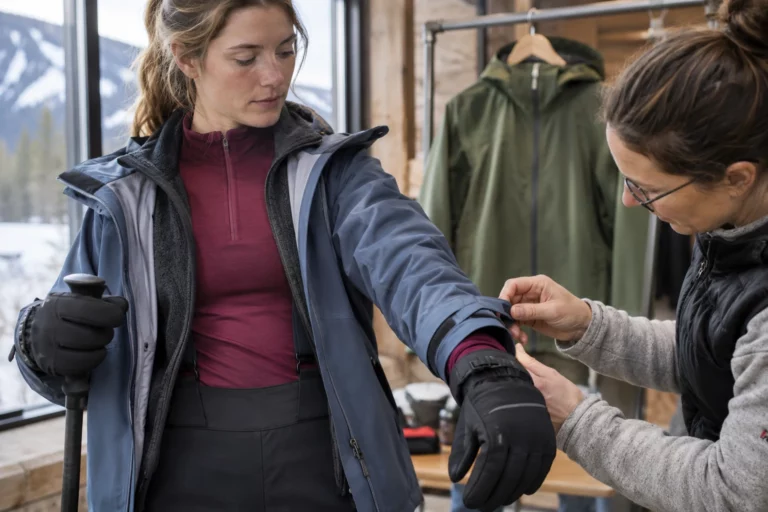
Movement matrix: deep squat—waistband stability and opacity; forward bend—back-waist/neckline coverage; seated position—waist pressure and under-bust comfort; overhead reach—hem/armhole movement; repeated movement—adjustment count, garment migration, and recovery.
Fit record: movement and repetitions | observed issue | measured migration/coverage where relevant | discomfort score | tester | sample revision | approve/revise/retest/hold | next action. Set project-specific pass criteria before the trial.
First-fit decision sheet example: waistband appearance—approved; stability—revise; hip fit—approved; inseam—buyer decision; fabric recovery—provisional; grading—not yet reviewed.
Connect the Technical Brief to the Quotation
Once the open questions are visible, provide estimated quantities by style, color, and size, along with the destination market and requested timing. Mark provisional estimates clearly.
Ask whether the quotation assumes an existing pattern, a modified silhouette, or new development. Confirm whether technical-document preparation, material proposals, and the requested sample work are included. The quote should identify assumptions that could change its scope.
Harvest SPF’s OEM/ODM services cover tech-pack assistance, fabric selection or development, prototype sampling, and client fit review. Identify the support needed for the proposed style and confirm the agreed deliverables, sampling charges, and timing with the team.
For a yoga wear sourcing inquiry, Harvest SPF should receive the same unresolved-question list as the buyer’s internal team. Ask for the proposed sequence, missing inputs, and project-specific sampling terms before commissioning work.
Comparable Commercial RFQ and Quotation Assumptions
Buyer inputs: style/SKU; estimated quantities by style, color, and size; number of colorways; size range; fabric; decoration; packaging; destination market; Incoterm (e.g., FOB or EXW); target price if available; and requested shipment date.
Confirm whether MOQ means per style, per color, per size, or total project. Request the quotation basis and validity, pattern/tech-pack development, included sampling rounds, sample charges and credit terms, fabric and bulk MOQs, testing, lead times, and conditional material commitments.
Project cost = separately quoted development + testing + production + other agreed charges, avoiding double counting items already included in unit prices. A preliminary FOB estimate is not a final bulk price when critical inputs remain unresolved.
Ready-to-Send Yoga Wear OEM RFQ Template
Brand/project: ____ | Style/SKU: ____ | Product: crossover-waist yoga shorts | Target market: ____ | Intended wearer/activity: ____ | Reference files: ____ | Target silhouette: ____ | Fabric composition or performance target: ____ | Base size/size range: ____ | Measurement spec: attached/incomplete | Waistband/construction: ____ | Fit issues: ____ | First sample objective: ____ | Estimated quantity by color and size: ____ | Target price/Incoterm: ____ | Delivery window: ____ | Numbered open questions: ____ | Requested supplier deliverables: technical proposal, sample scope, cost and timeline.
RFQ Readiness and Supplier First Response
Readiness stages: ready for technical review; ready for development quotation; ready for first sample; or hold for essential information. Ready for quotation does not necessarily mean ready for sampling.
Ask the supplier to confirm style understanding, missing inputs, conflicts, fabric/construction recommendations, sample scope and limitations, development charges, quote assumptions, lead time, buyer decisions, responsible owner, and next action.
RFQ-to-sampling sequence: buyer RFQ → supplier completeness review → issue assignment → technical proposal and quote → buyer approves scope → sample development → fit review and revision → next-stage approval.
Conclusion
A useful yoga wear RFQ makes incomplete information manageable. Its value lies in connecting references, requirements, and unanswered questions so the manufacturer can propose a defined next step. Clear responsibility for those questions gives the first fit review a stronger starting point.
How Harvest SPF Supports Yoga Wear RFQ & Fit Development
Harvest SPF can discuss RFQ technical review, fabric selection/development, waistband and pattern construction, prototype sampling, fit and movement evaluation, representative size-set planning, and bulk specification coordination as applicable to the project.
Harvest SPF helps yoga wear brands turn incomplete design references into actionable OEM/ODM development briefs by connecting fabric behavior, pattern construction, fit objectives, sampling scope, and commercial assumptions.
FAQs
Can an RFQ be sent before the measurements are complete?
Yes. Identify the missing measurements and ask whether developing the garment specification is included in the proposed service. Confirm the starting requirements before sampling.
What if the photograph and physical sample disagree?
Identify which reference controls the affected feature. If the buyer has not decided, describe the conflict and request clarification or a proposal before pattern development.
Should every unanswered question delay the first sample?
That depends on its effect. A question affecting pattern shape or material behavior may need resolution first. Other details can remain provisional if both parties understand the sample’s limits.
Is the first quotation a confirmed production price?
Confirm its basis with the supplier. Unresolved fabric, construction, quantities, or development scope may require the quotation to be updated.
Additional Buyer FAQs
What is the minimum information for a yoga wear RFQ?
Identify the style, intended wearer, fit objective, references, size range, quantities, market, timing, and unresolved questions.
Can a supplier develop a tech pack from photos?
It may be possible as a separately scoped development service; confirm missing information, deliverables, charges, and approval steps.
How do body and garment measurements differ?
Body measurements describe the wearer; garment measurements describe the finished product, interpreted with fabric stretch and ease.
Can a first fit sample use substitute fabric?
Only for clearly limited provisional review; verify fabric-dependent fit and performance using the intended material.
When can an RFQ support a production quotation?
When material, construction, quantities, pricing basis, and outstanding cost-sensitive assumptions are identified.
Clarify Your Yoga Wear RFQ Before Sampling
Send Harvest SPF your product photos or sketches, details of any available reference garment, target fit and silhouette, base size and size range, available measurements, fabric references or performance targets, and construction preferences. Include unresolved fit questions, estimated quantities by color and size, destination market, delivery target, and target price if available.
Ask the team to identify missing inputs and confirm the proposed development scope, sampling plan, quotation assumptions, charges, and timing before sampling begins.