
Selecting a low MOQ activewear manufacturer for a 300–500-piece trial order is not simply about arranging a smaller production run. For apparel brands and procurement teams, the order becomes a controlled commercial test of landed cost, fit consistency, supplier execution, market response, and reorder potential before committing to larger inventory investment.
Profitability depends less on the lowest quoted unit price than on disciplined SKU planning, production-ready materials, precise specifications, and measurable approval criteria. Harvest SPF supports this model through functional-textile research, ODM/OEM production capabilities, flexible cut-and-sew orders from 300 pieces, and more than 30 patents related to fiber and fabric innovation.
Why a 300–500 Piece Trial Order Can Be Commercially Valuable
Treat the Order as a Validation Batch
The trial should answer four questions: Can the style achieve the required margin? Is the size curve commercially accurate? Does the fabric perform after wear and care? Can the supply chain deliver consistent quality on schedule?
Low MOQ reduces inventory exposure, but sampling, patterns, labels, testing, packaging, inspection, and freight remain. Because these costs are spread across fewer units, a trial order requires tighter planning than a repeat order.
Match the Production Method to the MOQ
A low-MOQ activewear manufacturer must align the construction method with the intended order volume. In many low-MOQ programs, cut-and-sew production may start from around 300 pieces, while seamless production often starts from around 500 pieces and may require minimums by style, color, and size. Full-package development involving new yarn or fabric can require higher volumes because material development creates separate minimums.
For an initial test, an established fabric platform with customized color, logo, trims, and labels is usually more economical than proprietary fabric development.
Build an Order Structure That Protects Margin
Concentrate Volume in One Hero Style
A practical 300–500-piece order normally performs better when volume is concentrated. One core style in one or two colors usually creates cleaner production planning and more useful sales data than several unrelated styles split into shallow quantities.
A 400-piece program centered on one legging, training top, or base layer also limits pattern, marker, trim, packaging, and approval complexity.
Control the Color and Size Matrix
Each added color can create separate fabric allocation, lab dips, trims, labels, cutting plans, and inspection points. Each added size increases grading work and inventory fragmentation. The size curve should come from historical sales, comparable products, preorder data, or retailer input rather than an even split.
The purchase order should specify quantity by style, color, and size, plus acceptable overage or shortage.
Calculate Profitability Before Issuing the Purchase Order
Model the Full Landed Unit Cost
A useful costing formula is:
Landed unit cost = factory unit cost + allocated development cost + labels and packaging + testing and inspection + freight and import charges + defect reserve
This formula helps buyers compare suppliers based on real delivered cost rather than factory price alone.
Sampling and development should be allocated across the trial quantity. Freight should reflect shipment method and carton volume. Duties and brokerage should be confirmed for the destination market and product classification.
Set Margin and Cash Thresholds
Gross margin can be calculated as:
Gross margin = (net sales price − landed unit cost) ÷ net sales price
Net sales price should account for wholesale discounts, marketplace fees, returns, and promotional allowances. Deposit timing, production balance, freight payment, customs clearance, and customer payment terms also determine how long capital remains tied up. Common payment terms may include a 30% deposit and a 70% balance before shipment or against shipping documents.
Reduce Development Risk Before Bulk Production
Approve a Complete Tech Pack
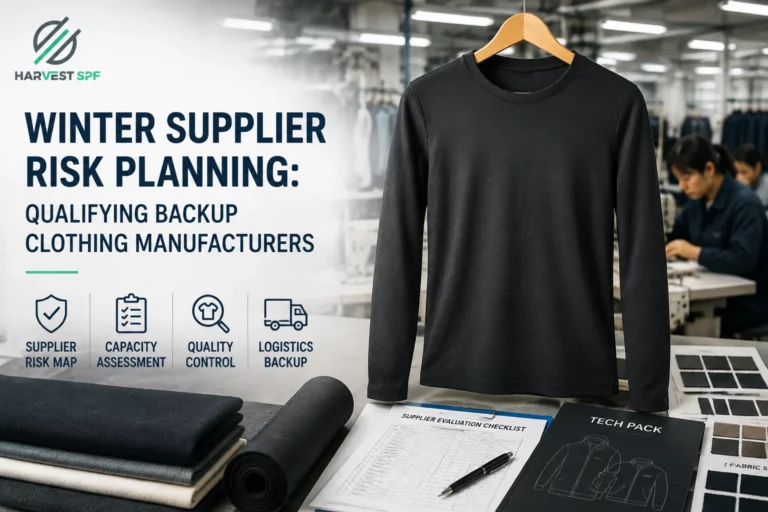
The tech pack should define the bill of materials, graded measurements, construction, seam types, artwork placement, color references, labels, packaging, and testing expectations.
Buyers should also confirm whether the approved sample is a fit sample, sales sample, or pre-production sample, because each sample has a different approval purpose.
A documented workflow should move from project brief and technical design through fabric selection, quotation, prototype sampling, approval, production, inspection, and shipping. Prototype refinement may require several rounds before bulk authorization.
Prioritize Available Functional Fabrics
Fabric availability is often the central constraint in a low-MOQ activewear program. Repeatable, production-ready fabrics can shorten lead time and reduce development cost; new knitting, dyeing, finishing, or functional treatments may create minimums above the garment quantity.
Selection should begin with the required function: moisture management, breathability, stretch recovery, thermal regulation, compression, softness, abrasion resistance, or odor control. Any performance claim should be supported by suitable test documentation.
Establish Quality and Compliance Gates
Define Measurable Inspection Standards
Quality criteria should classify critical, major, and minor defects. Inspection can cover measurements, seam integrity, skipped stitches, shade variation, artwork placement, label accuracy, appearance, packaging, and quantity. Sample-based lot inspection can follow an AQL system, where sample size and defect limits determine whether a shipment is accepted or rejected.
Activewear checks may also include dimensional stability, colorfastness, stretch and recovery, pilling, opacity, and seam performance. Test methods and pass criteria should be agreed before production.
Confirm Destination-Market Labeling
Compliance affects both landed cost and launch readiness. In the United States, most textile products require fiber content, country of origin, and responsible company identification; apparel also generally requires care instructions. European rules regulate fiber names and composition labeling.
The purchase order should assign responsibility for label artwork, translations, test reports, packaging claims, traceability, subcontracting visibility, and corrective-action records.
Plan Production and Reordering Around Verified Data
Separate Development, Production, and Transit
A quotation should distinguish prototype timing, fabric booking, lab dips, bulk production, inspection, and transport. Published guidance indicates that customized orders using ready fabric may require about 15–20 days for production, while new fabric can add roughly 30 days; season and capacity can also affect timing.
Commercial documents should align on currency, payment schedule, shipping term, inspection responsibility, carton specifications, and document requirements.
Use a Trial-Order Scorecard Before Reordering
The post-launch review should track sell-through by size and color, realized gross margin, return reasons, defect rate, delivery accuracy, sample-to-bulk consistency, and supplier responsiveness. Without a scorecard, buyers may reorder based on impressions rather than evidence.
Reorder approval should follow predefined thresholds. A strong reorder preserves the validated fit, fabric, construction, and core colors, while new colors or adjacent styles are introduced gradually. The next purchase order should incorporate revised size ratios, packaging improvements, confirmed inspection criteria, and cost opportunities from higher volume.
FAQ
Is 300 Pieces Enough for a Private-Label Activewear Trial?
Yes, when the construction method supports the quantity and the order uses a focused style-color matrix. Cut-and-sew programs can be feasible from 300 pieces, while seamless programs commonly require at least 500 pieces and may apply minimums by style, color, and size.
What Creates the Largest Cost Risk?
The main risks are excessive SKU fragmentation, custom fabric development, repeated sample changes, specialized trims, inefficient freight, and compliance work added after quotation.
Should a Trial Order Use Custom Fabric?
Custom fabric is appropriate when the performance difference is central to the product proposition and expected volume can support material minimums. An established functional fabric with controlled customization usually provides a clearer first-order route.
What Must Be Approved Before Production?
Core approvals include the final tech pack, bill of materials, graded measurements, artwork, color standards, label and packaging files, approved sample, test plan, inspection criteria, purchase order, and payment terms.
When Should a Reorder Be Placed?
The reorder point should combine actual weekly sales, remaining inventory, production lead time, transit, customs clearance, and safety stock. Waiting for depletion can create lost sales or expensive expedited freight.
How can brands reduce cost in a 300–500-piece activewear trial?
Brands can reduce cost by limiting SKU fragmentation, using available production-ready fabrics, controlling colors, avoiding excessive logo techniques, and confirming packaging and transportation choices before quotation.
Is low MOQ always cheaper for activewear production?
No. Low MOQ can reduce inventory risk, but the unit cost may be higher because development, sampling, packaging, testing, and freight are allocated across fewer pieces.
Conclusion
Design the Trial as a Measured Investment
A profitable 300–500-piece activewear trial depends on disciplined scope, reliable landed costing, available materials, precise technical documentation, measurable quality controls, and a predefined reorder framework. Low MOQ limits exposure while generating commercial and operational evidence; it does not replace procurement planning.
Apparel brands, retailers, and sourcing teams planning a 300–500-piece activewear trial can contact Harvest SPF to review the product category, available functional fabrics, target costing, sampling requirements, MOQ structure, and production route. Share a concise project brief with style type, target quantity, fabric requirements, size range, branding needs, target price, and launch timeline to receive a practical technical and commercial assessment without committing to bulk production.