

A sustainable activewear supply chain cannot be achieved simply by the assertion of being eco-friendly. The buying process needs to take into account the factors of renewable material percentage, stretchability, stability, transparency, washing performance, price, MOQ, and reliability. Usage of bio-based spandex will enable lowering the dependence on the existing fossil raw materials for activewear.
Commercial value depends on verified material specifications and disciplined garment engineering rather than material naming alone. Founded in 1993, Harvest SPF combines functional-textile research, fiber and fabric development, more than 30 patents, and OEM/ODM support for sustainable performance apparel.

Why Bio-Based Spandex Matters in B2B Activewear Sourcing
Material Positioning Must Be Accurate
Bio-based spandex is a stretchable fiber where one part of its raw materials is from renewable biological sources. Bio-based spandex is not necessarily biodegradable, compostable, recycled, or free from plastics. The sourcing documents will need to include the grade of the fiber, the percentage of its bio-based material, fabric structure, yarns’ source, and any other relevant documents.
Performance Remains Non-Negotiable
From a commercial perspective, a lower-impact material has limited value if it lacks shape retention, becomes see-through under stretch, or performs inconsistently after washing. Evaluation should include elongation, recovery, fabric growth, waistband retention, seam performance, dimensional stability, pilling, abrasion resistance, and colorfastness. Results can be affected by knitting style, spandex percentage, fabric weight, dyeing process, finishing, pattern making, and use.
Sustainable Fabric Blends for Custom Activewear
Bamboo-Derived Fibers, Organic Cotton, and Bio-Based Spandex
Bamboo fiber and organic cotton offer the potential to develop a soft and natural feeling fabric base for yoga clothing, tops, activewear, and low to medium compression clothing. Bio-spandex enhances comfort and shape retention.
Procurement review should confirm the legally correct fiber name, verified organic content, shrinkage behavior, pilling resistance, and recovery after repeated laundering. Natural-touch blends may require tighter control of compaction and finishing than conventional synthetic activewear fabrics. The available development portfolio includes bamboo-spandex and bamboo-cotton-elastane compositions for active and casual applications.
Bamboo Lyocell and Bio-Based Spandex
Bamboo lyocell blends can provide a smooth hand, fluid drape, and close-to-skin comfort for leggings, fitted tops, sports bras, lounge-active hybrids, and coordinated sets. Commercial suitability depends on opacity, surface durability, drying performance, and resistance to bagging at the knees and seat.
Claims involving moisture management, antibacterial performance, or odor control should be supported by test reports for the exact fabric rather than assumed from the fiber category. Bamboo lyocell and spandex blends can be positioned as smooth, flexible options for gym, yoga, and lifestyle activewear when supported by the right construction and testing.
Fabric Weight and Construction by Product
GSM influences opacity, warmth, compression, drape, and sewing behavior. Midweight four-way-stretch fabrics are often suitable for yoga leggings and daily training pieces, while lighter fabrics may work better for tops, tennis apparel, and warm-weather styles. Higher-support bras and compression bottoms require stronger recovery and stable construction.
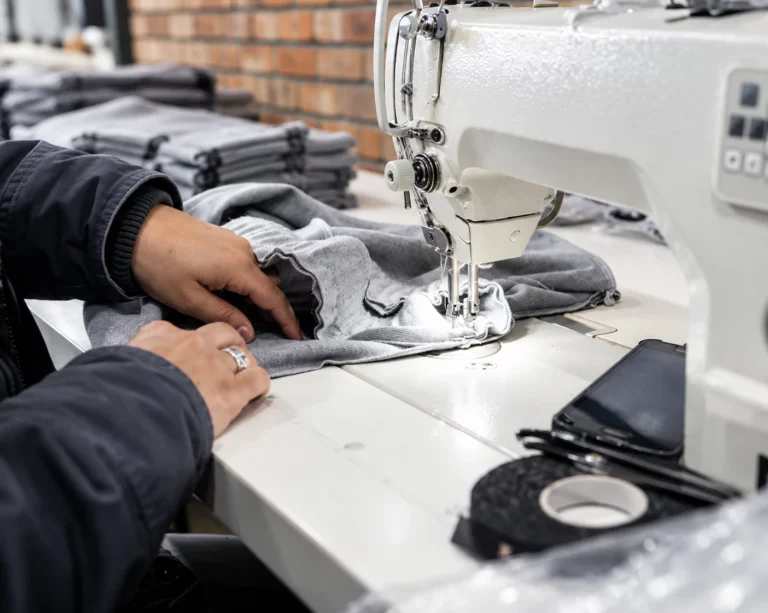
Seamless products require yarn-level programming and body-mapped structures. Cut-and-sew styles provide greater flexibility for paneling, pockets, seam placement, and mixed materials. The two construction routes also involve different development processes, machinery, and minimum quantities.
Product Development Priorities
Leggings, Yoga Pants, and Compression Bottoms
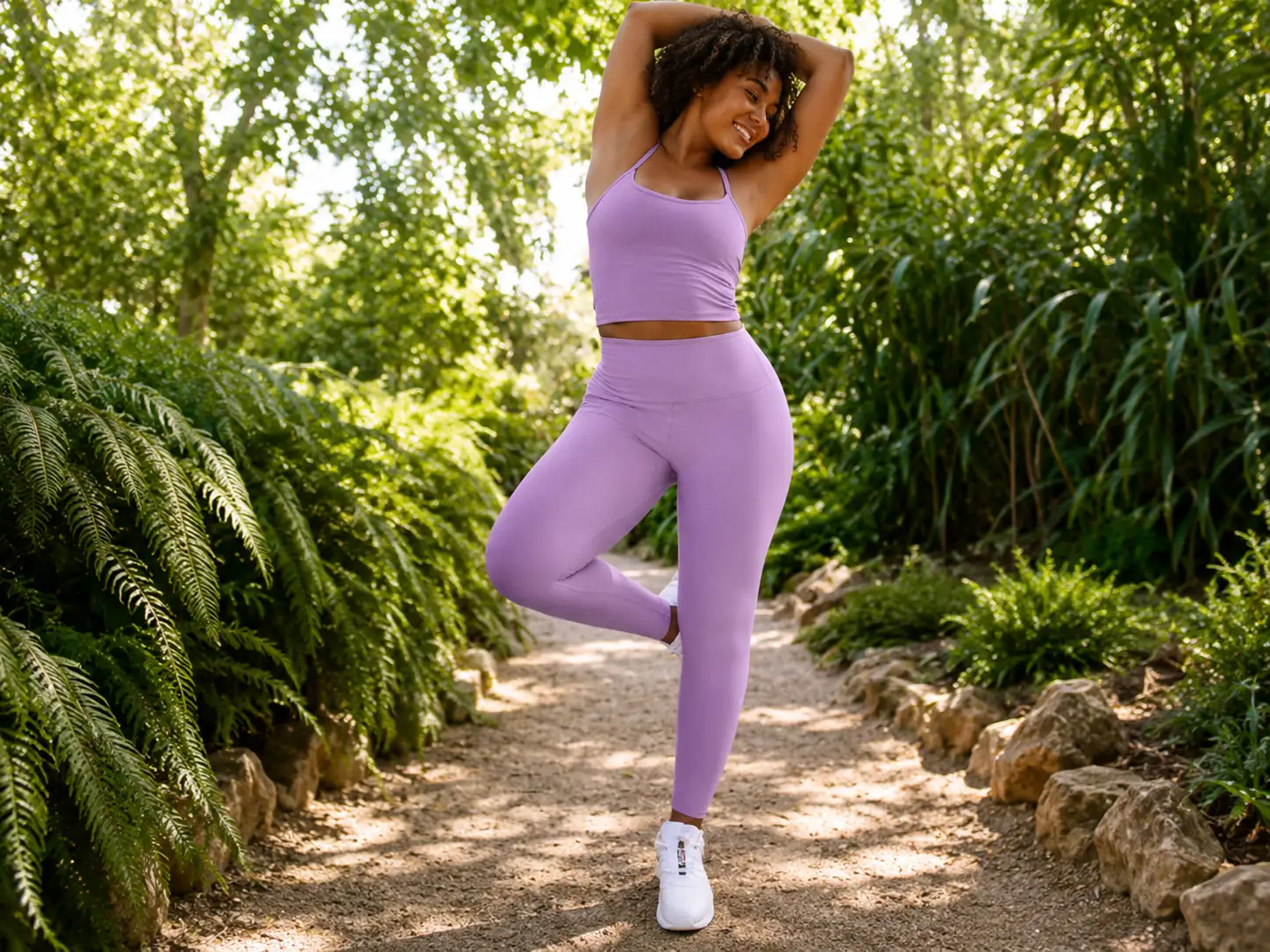
Leggings require coordinated decisions on rise, waistband depth, compression, gusset shape, inseam, pocket placement, seam type, and grading. Squat-proof performance should be assessed across colors and sizes because opacity changes with dye shade, stretch ratio, fabric density, and fit.
Fit testing should include bending, squatting, stretching, and repeated movement to confirm real-use performance.
Functional options may include side phone pockets and concealed waistband pockets for cards or keys. Pocket openings require adequate reinforcement to reduce distortion, while waistband construction must retain shape after repeated stretching and laundering.
Sports Bras, Tops, Shorts, and Tennis Styles
Sports bras require defined support levels, lining, underband recovery, cup construction, and strap geometry. Support levels should be matched to the intended activity, such as studio wear, yoga, training, or higher-impact workouts. Fitted training tops need stable necklines and armholes under repeated movement. Shorts require hem control, pocket security, and coverage appropriate to the target activity.
Tennis skirts and dresses may integrate inner shorts, ball pockets, stretch waistbands, and lightweight outer layers. A coordinated material platform can support consistent colors and performance levels across capsule collections. The existing product scope covers yoga apparel, gym wear, compression garments, seamless sportswear, and men’s and women’s activewear.
OEM/ODM Manufacturing and Commercial Planning
Selecting the Development Model
OEM production is suitable for established programs with completed tech packs, measurement charts, artwork, materials, labels, and packaging instructions. ODM development provides broader technical support, including silhouette refinement, fabric selection, color direction, pattern development, sizing, and sample refinement.
Full-package development may begin with yarn spinning or custom fabric knitting when no suitable stock fabric exists. The selected model should reflect design readiness, launch timing, budget, material availability, and acceptable development risk.
Sampling, MOQ, and Lead Time
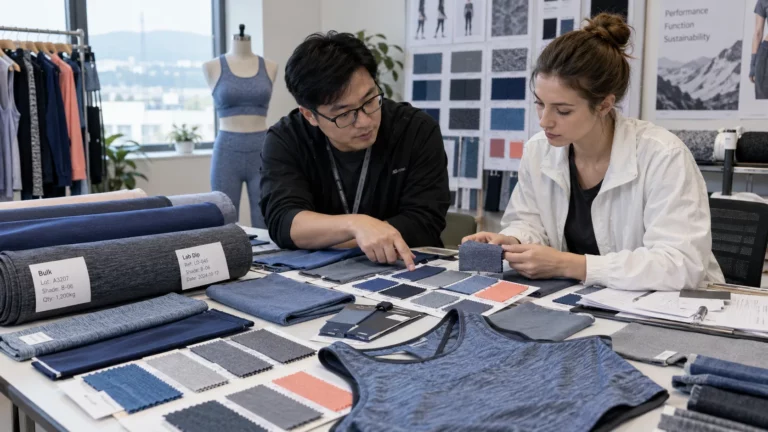
A structured process normally moves from project briefing and tech-pack review to fabric selection, quotation, prototype sampling, fit approval, order placement, bulk production, inspection, packing, and shipping. Two or three prototype rounds may be required before fit and construction are authorized for production.
Harvest SPF’s customization guidance may list cut-and-sew orders from around 300 pieces, seamless orders from around 500 pieces per style, color, and size, and full-package ODM programs from around 1,000 pieces. Customized orders using ready fabric are generally listed at 15–20 days for quantities below 5,000 pieces, while custom fabric adds development time. Actual schedules remain dependent on season, testing, trims, revisions, and raw material availability.
Quality Assurance for Bulk Production
Build a Procurement-Focused Test Matrix
Fabric testing may cover composition, weight, width, shrinkage, spirality, pilling, abrasion, colorfastness, elongation, and recovery. Garment testing should examine fit, measurement tolerances, seam stretch, stitch security, pocket position, logo adhesion, opacity, wash appearance, and packaging accuracy.
High-risk styles benefit from movement trials and repeated laundering before bulk authorization. Pre-production sampling should confirm construction feasibility, decoration placement, garment measurements, fit, and fabric performance before production begins.
Traceability and Claim Documentation
Sustainability files should connect the finished garment to the relevant yarn, fabric mill, dye lot, and production order. Useful records include technical data sheets, composition reports, material-origin declarations, chemical-safety reports, transaction documents where applicable, and batch references.
Certificates should be reviewed for validity, facility scope, material scope, and transaction relevance. A general factory certificate cannot automatically substantiate every sustainability claim on every garment. Buyers should request claim-specific evidence before using sustainability claims in marketing materials.
In-Process and Final Inspection
Quality control should begin with incoming fabric inspection and shade-band approval. In-line checks can identify measurement drift, seam defects, skipped stitches, puckering, and pocket misalignment before completion.
Final inspection may use an agreed sampling plan or an independent inspection service. The published manufacturing process supports in-house or third-party inspection, followed by packing-list confirmation and international shipping arrangements.
Supplier Evaluation Criteria
Technical and Commercial Fit
A sustainable activewear manufacturer should demonstrate:
- Stretch-fabric handling
- Activewear pattern capability
- Material development support
- Repeat-order sourcing
- Quality control systems
- Transparent production planning
- Traceability and claim documentation
Commercial assessment should cover MOQ by construction, sampling rounds, fabric lead time, color minimums, decoration methods, packaging, payment stages, and shipping coordination. Development capability should also extend from fabric recommendation and tech-pack review through prototype sampling, inspection, packing, and delivery planning.
Common Sourcing Red Flags
Risk indicators include vague “eco-friendly” wording, missing fiber grades, unclear bio-based content percentage, unsupported biodegradability claims, inconsistent sample and bulk fabrics, incomplete test methods, unclear certificate scope, and unusually low prices that do not align with custom material development.
Additional concerns include absent shade control, no retained production sample, unconfirmed measurement tolerances, and no written procedure for defective goods. Clear documentation before order placement reduces dispute exposure and protects development schedules.
FAQ
Is Bio-Based Spandex Biodegradable?
Not necessarily. “Bio-based” describes the renewable origin of part of the feedstock, while biodegradability describes material breakdown under defined environmental conditions. The two claims require different evidence.
Is Bio-Based Spandex the Same as Recycled Spandex?
No. Bio-based refers to renewable feedstock content, while recycled refers to material recovered from waste streams. Both claims require separate documentation.
Can Bio-Based Spandex Perform Like Conventional Spandex?
It can, but performance must be verified through elongation, recovery, wash durability, opacity, and garment testing.
Which Products Suit Bamboo Lyocell and Bio-Based Spandex?
Common applications include yoga leggings, soft-support sports bras, fitted tops, studio sets, training shorts, and selected tennis styles. Final suitability depends on fabric weight, recovery, opacity, abrasion resistance, drying performance, and garment construction.
What Determines MOQ?
MOQ is influenced by stock versus custom fabric, color development, construction method, style count, size breakdown, trims, branding, packaging, and testing requirements. Seamless and custom-knitted programs generally require higher minimums than stock-fabric cut-and-sew styles.
How Many Sampling Rounds Are Typical?
Two or three prototype rounds are commonly used for fit and construction refinement. Complex garments, custom-knitted fabrics, or new functional treatments may require additional rounds before pre-production approval.
What Requires Approval Before Bulk Production?
Final fabric, color, measurements, fit, construction, decoration, labels, packaging, test results, tolerance standards, inspection method, and delivery schedule should be approved before bulk materials and production capacity are committed.
Conclusion
A Practical Sourcing Path
Bio-based spandex activewear should be sourced as a complete technical system rather than as a single-fiber claim. Strong procurement decisions connect verified materials with product-specific construction, fit engineering, performance testing, realistic MOQ planning, and documented bulk-quality controls. Bamboo, organic cotton, and bamboo lyocell blends can support differentiated collections when comfort is balanced with recovery, durability, opacity, and production consistency.
Brands and sourcing teams developing bio-based spandex activewear can contact Harvest SPF for material consultation, sampling, OEM/ODM planning, MOQ review, and production-route evaluation. To begin, share the product category, estimated quantity, target fabric performance, size range, branding needs, and launch schedule for a practical project review.